


Hi, Martin from bloomlabs here.
Welcome to our monthly market overview of the Voluntary Biodiversity Market (VBM) and other related nature finance developments, built on data from our intelligence platform Bloom and the market updates that matter.
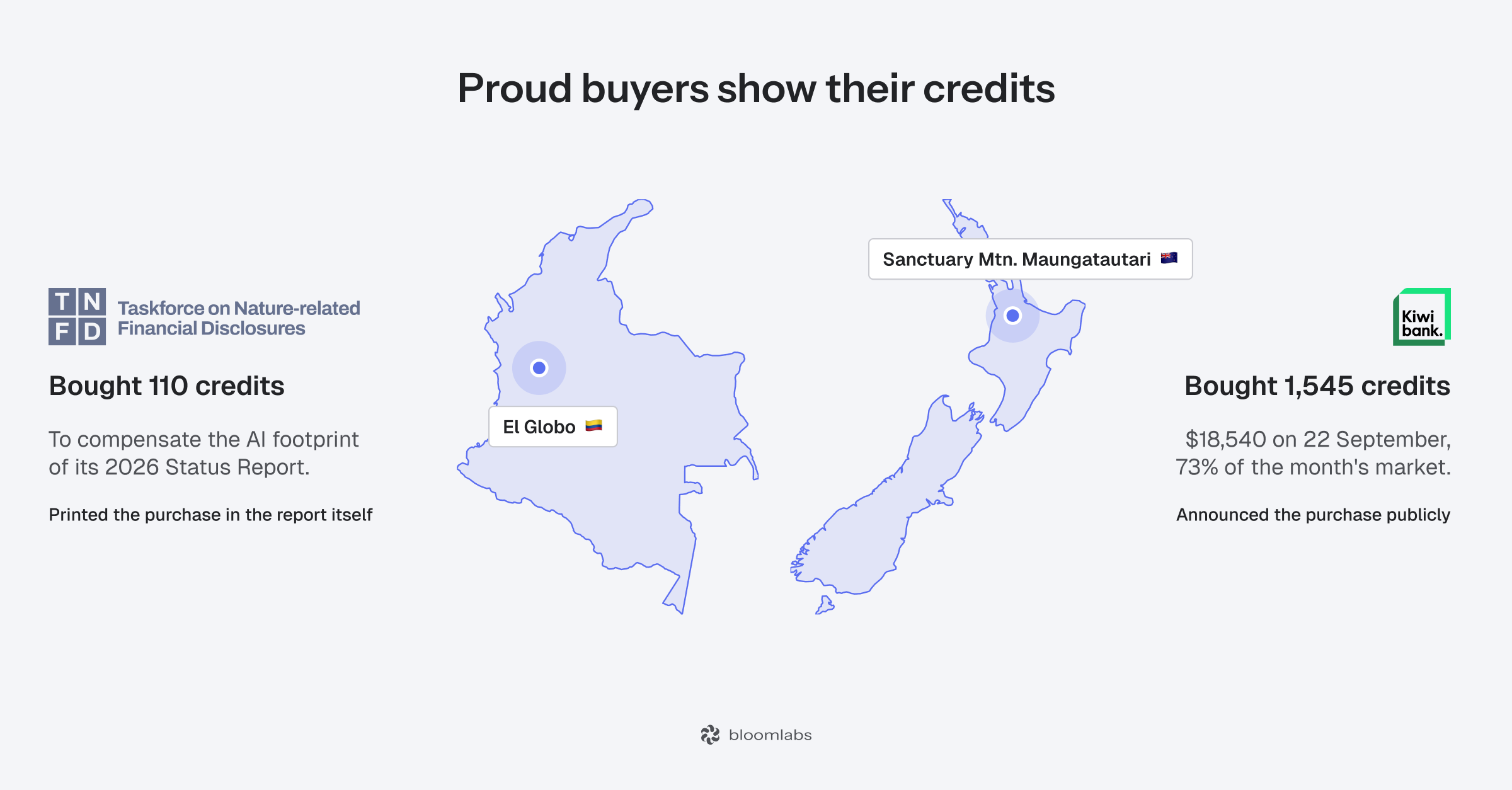
Two buyers talked about their credits this month. The TNFD bought 110 Tebu units from Terrasos to compensate for the AI footprint of its 2026 Status Report, calculated the equivalence itself and printed it in the report. Kiwibank, a New Zealand state-owned bank, retired 1,545 Sanctuary Mountain Maungatautari credits for $18,540, as the biodiversity half of a carbon and biodiversity bundle, and published a statement on why. Developers tell us marketing is one of the main reasons companies buy, yet buyers almost never say anything in public. A standard setter and a bank just did, in the same month.
On the policy side, New Zealand published the criteria its government will use to endorse voluntary nature schemes, Indonesia opened an international workshop and picked 13 national parks as pilot financing sites, and South Africa held its first national dialogue on nature credits. Crédit Agricole became the third large European bank this year to open a natural capital division.
Learn more and explore the data on Bloom.
The market in September
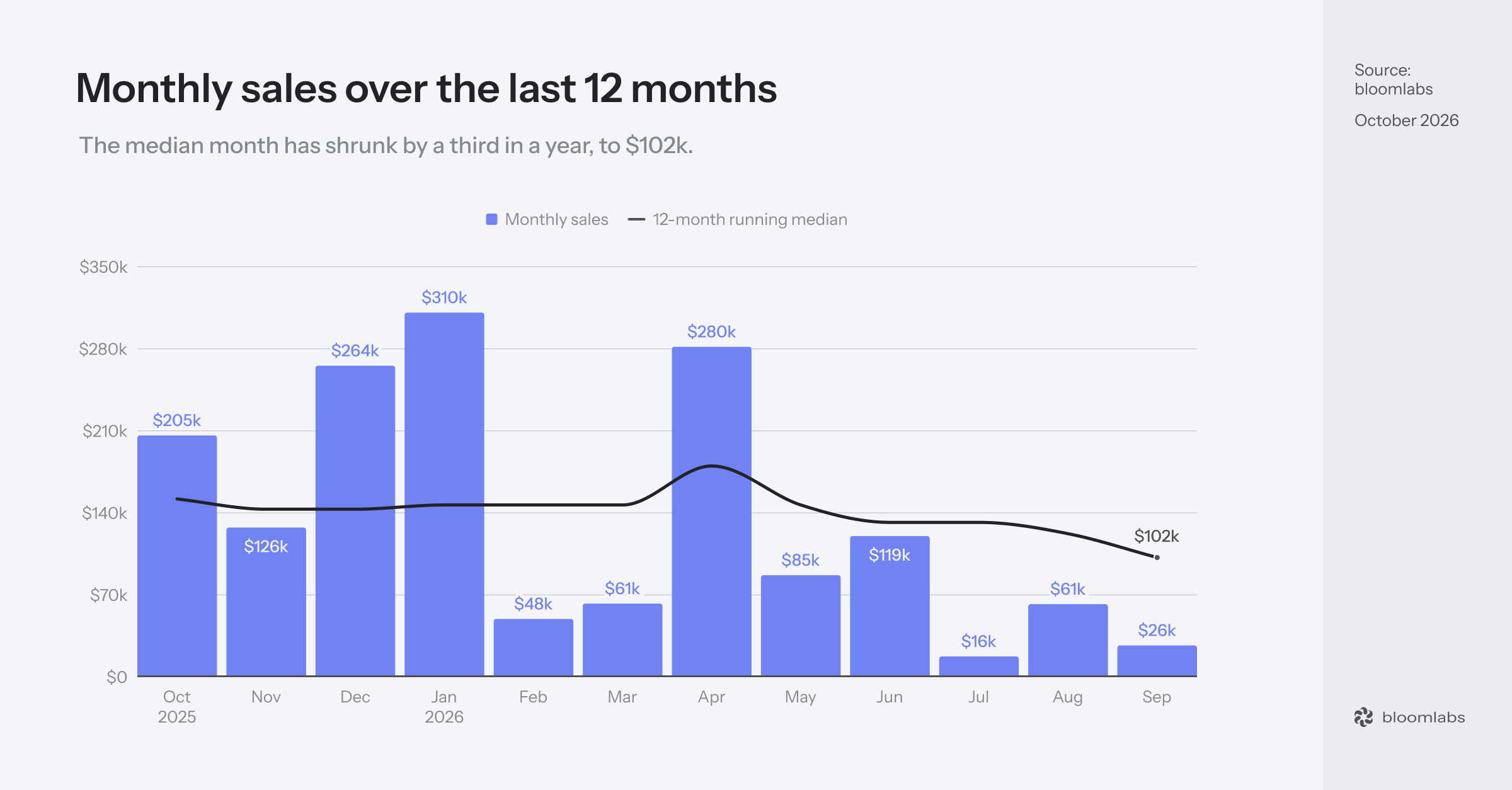
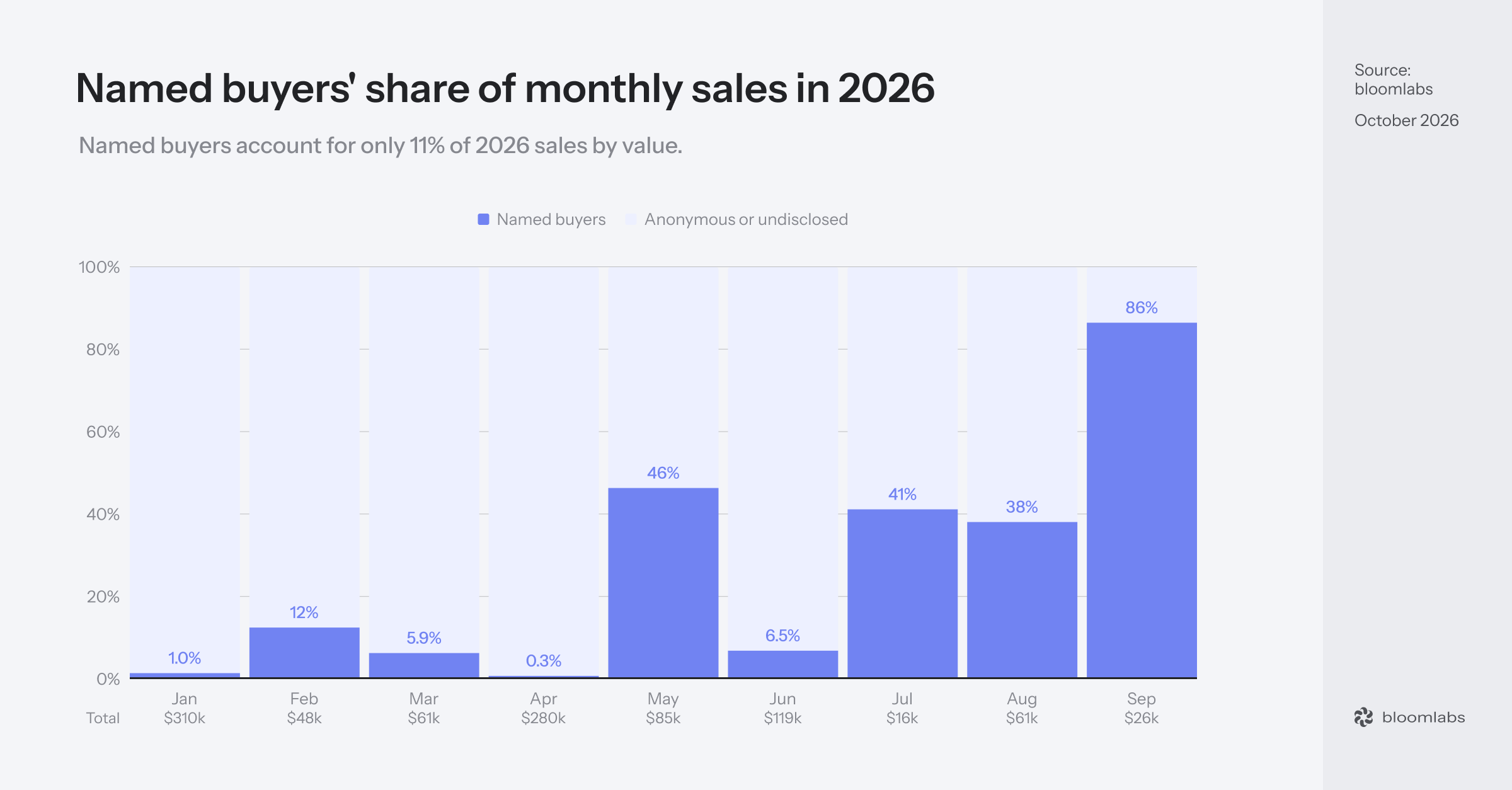
September 2026 recorded $25,534 in sales across 85 transactions, down from August’s $61k. For comparison, the earlier months of the year came in at $310k in January, $48k in February, $61k in March, $280k in April, $85k in May, $119k in June, and $16k in July. The 12-month running median (calculated for each month with the previous 11 months included) is slowly decreasing and now is at $102k.
The five largest transactions made up 88% of September’s value, the highest concentration of any month this year except April. One deal carried the month, Kiwibank‘s 1,545 credits on Sanctuary Mountain Maungatautari for $18,540, 73% of the total on its own. The average transaction was $300, against $950 in August and $192 in July, and the number of transactions, 85, is the highest since May.
September has been a decent month in the past, at $4k in 2022, $22k in 2023, $108k in 2024 and $138k in 2025. This year’s $26k is the lowest September since 2023, and the first September in our data to close below the previous year.
Projects
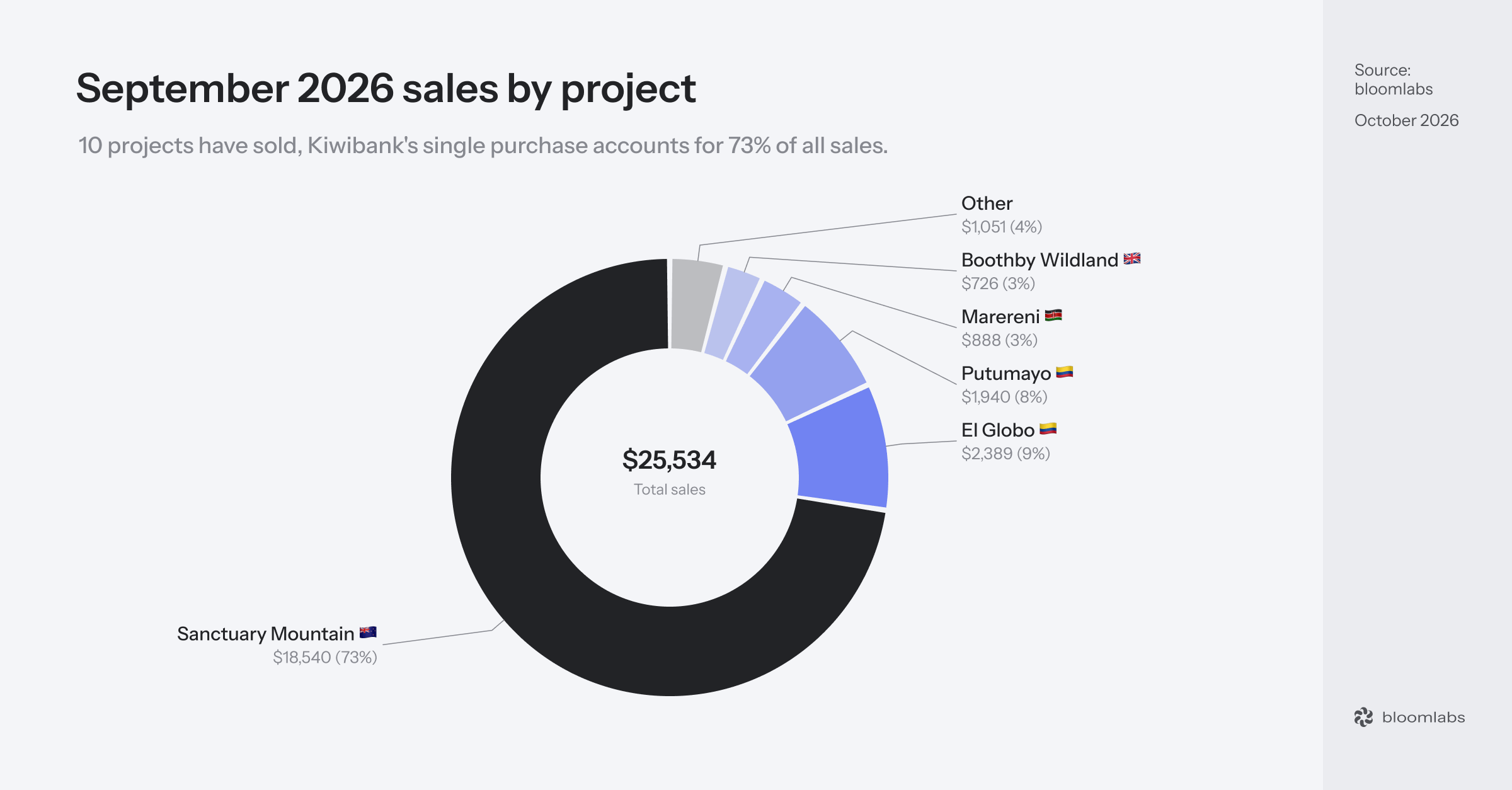
10 projects sold in September across 5 countries, and 9 of them had also sold in August. The newcomer is Aguadulce, Terrasos‘s second Colombian project, which records its first sales in our data. Osa Peninsula, Seatrees‘s Costa Rican coral project, and Jaguar Pantanal in Brazil were the two August sellers to record nothing.
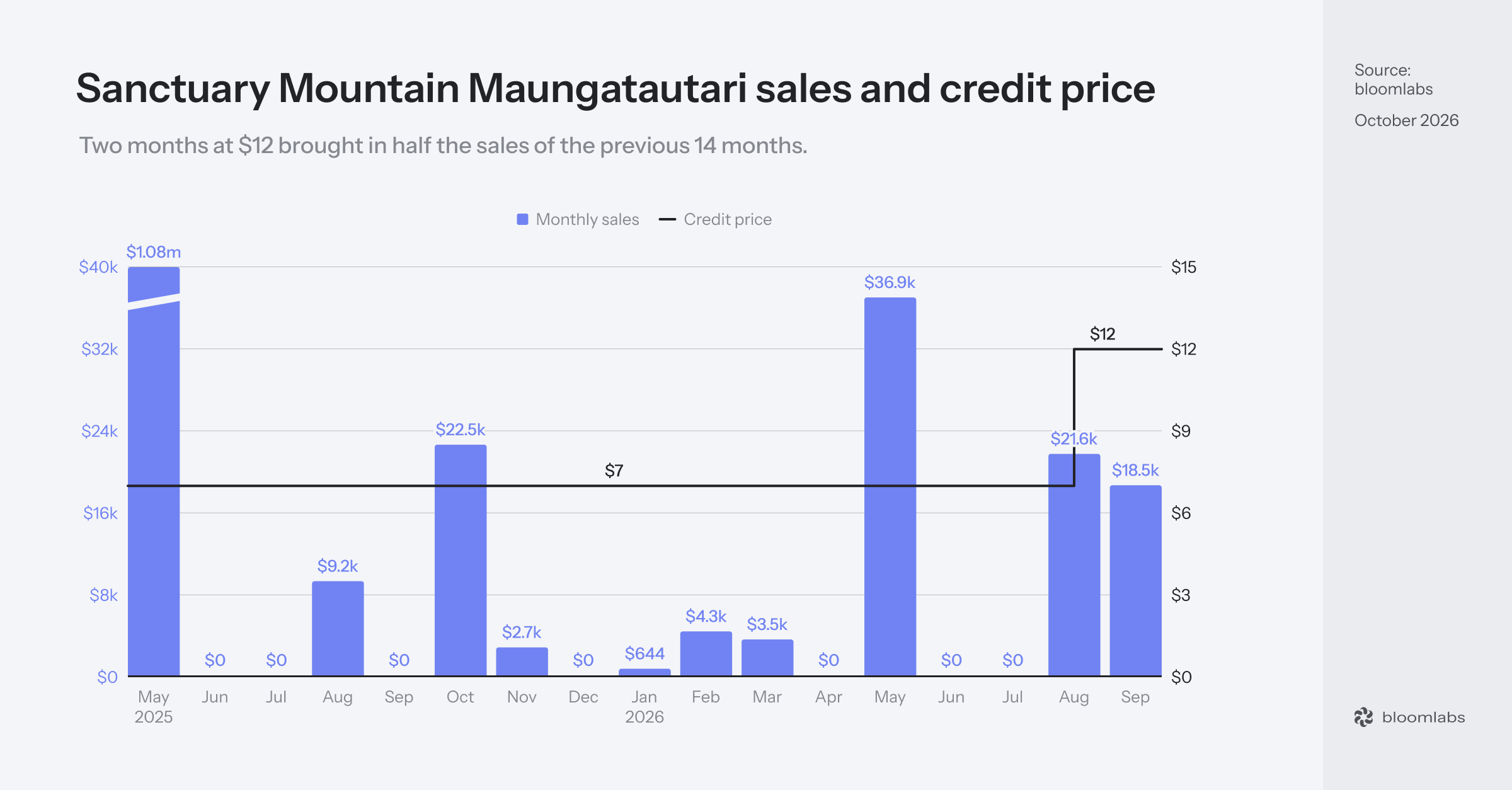
Sanctuary Mountain Maungatautari, the Ekos project under the BioCredita Programme, recorded a single transaction of $18,540, 73% of the month and its third-best month of 2026 after May’s $36,855 and August’s $21,600. It is also the second month at the new price. Every Sanctuary Mountain credit sold from May 2025 to May 2026 went for $7, and every one since August has gone for $12, a 71% increase. Four business buyers in August and one in September accepted it without a visible drop in volume, which argues for price not being a deal breaker component today.
Colombia was the second pole with $4,749, or 19% of the month, split across the two Colombian developers that sell every month. Terrasos had its busiest month of the year by count, $2,809 across 20 transactions of its Tebus, and for the first time across two projects. El Globo took $2,389 across 12 transactions, and Aguadulce, the second Terrasos project, sold its first 10 credits for $420 to 8 buyers. Putumayo brought $1,940 across 8 transactions, Savimbo’s month was carried by one anonymous business purchase of 112 credits for $1,800 at $16 per credit.
Marereni, the Kenyan mangrove project sold by Seatrees, recorded $888 across 11 transactions of its $3 credits, all consumer. It follows $11,985 in August, which is the Marereni rhythm, a quiet month of small purchases between business batches.
Boothby Wildland, the Nattergal site sold through Earthly, contributed $726 for 3 credits at $242, one business purchase. It is the only Earthly project to sell in September, after the $5,082 August that was the best month of the year for the English sites.
Wilderlands‘ four Australian projects took $631 between them across 44 transactions, with Coorong Lakes at $183, Alleena at $177, Crowes Lookout at $145 and Budgerum at $126. That is the lowest month for Wilderlands in our data, below the $783 of August 2025.
Buyers
Business buyers accounted for 86% of September’s value across only 7 transactions, while consumer buyers made up $3,685 across 78 transactions.
Named buyers covered 86% of September’s value, by far the highest share this year, against 38% in August and 46% in May. The one large deal has a name on it, and the anonymous Wilderlands and Marereni purchases that normally dilute the named share were less prominent. Six of the seven business purchases are named, and all six are first-time buyers.
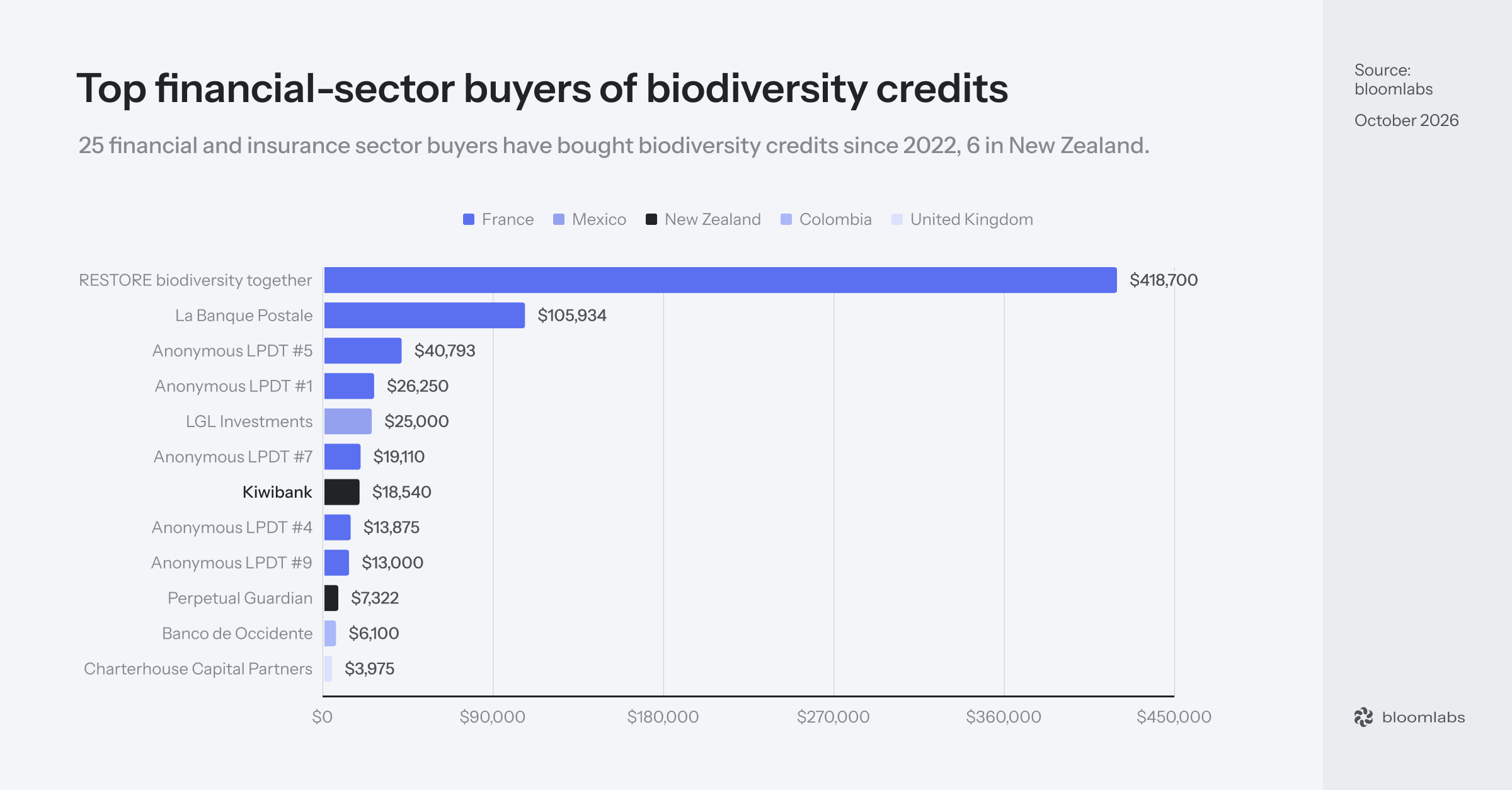
The largest was Kiwibank, the New Zealand state-owned bank, which retired 1,545 Sanctuary Mountain credits for $18,540 on 22 September, the biodiversity portion of a larger carbon and biodiversity bundle. It is the first purchase we record from the organization, the first purchase from any NZ bank, and the sixth financial-sector buyer on Sanctuary Mountain after Perpetual Guardian, Monument Finance, NZ Green Investment Finance, Moneyworks and Direct Capital.
Kiwibank is also one of the first banks to publicly communicate on its credits purchase, a behavior that we still don’t see often, even though developers themselves report marketing being one of the top motivations to buy. The NZ institution, stating that “As we begin to understand our relationship with nature, we’re proud to take this first step by supporting Sanctuary Mountain Maungatautari. It’s one way we’re bringing our Purpose to life by contributing to a better future for Aotearoa New Zealand”, provides a strong trust signal to the country and the market as a whole.
Sean Weaver, CEO of Ekos, confirmed to us that the purchase was a bundle of carbon and biodiversity credits. Kiwibank manages its own greenhouse gas inventory, reduction plan and carbon position communications, and came to Ekos only to buy the bundles. Each bundle pairs ICVCM-CCP-approved carbon credits with biodiversity credits verified by a third party under the BioCredita programme, with Ekos acting as reseller on behalf of Sanctuary Mountain Maungatautari. A bank, with a mature carbon programme, added biodiversity to its carbon purchases. This is a perfect illustration of a road the market can take, apart from compliance systems.
Across the whole market, only La Banque Postale‘s $106k purchase of Cros du Mouton credits in France in 2024 is a larger bank transaction. Since May we have gone from two Latin American banks on El Globo to a private equity manager and a retail bank on Sanctuary Mountain. Finance as a sector keeps showing regular transactions.
The other five named business buyers are small and local. XM Compañía de Expertos en Mercados, the operator of Colombia‘s wholesale electricity market, bought 15 El Globo credits for $574 on 3 September, at the $38.24 price. Rocket Merchandise & Lyons Presentations, a British promotional merchandise agency with under 50 staff, bought 3 Boothby Wildland credits for $726 on 17 September, which continues the run of small UK firms buying Earthly credits that we described in July. The last three are Colombian consultancies buying a handful of Terrasos credits each: GEOCOL Consultores, a Bogotá engineering firm with about 370 staff, took one El Globo credit, and eQual Consultoría y Servicios Ambientales and Hábitat Focus, two environmental consultancies, took 3 and 1 Aguadulce credits.
Cross-border value was 0.5% of the month. Kiwibank, XM, Rocket and the three Colombian consultancies all bought in their own country. The domestic pattern we have written about does not move. Something our new Countries dataset will help to better understand as most nations eventually start developing their own credit systems.
If you are exploring whether and how biodiversity credits fit into your organization’s strategy, we would love to talk, so reach out at hello@bloomlabs.earth.
News
Featured
TNFD bought biodiversity credits to compensate for its own report
The Taskforce on Nature-related Financial Disclosures released its 2026 Status Report on 21 September, during Climate Week NYC. 802 organizations have committed to TNFD-aligned disclosure, including financial institutions with $26.6 trillion under management, and more than 1,000 organizations across 56 countries have published TNFD-aligned reports, double the count of a year ago. 56% of surveyed investors are already exploring or deploying capital into nature-related opportunities, and 74% expect that financing to grow two to five times in the next five years.
To address the energy and water use of the AI tools it used to prepare the report, the TNFD purchased 110 Tebu biodiversity units through Terrasos, for 1,100 m2 of cloud forest conservation in Colombia over 30 years. Terrasos calculated the equivalence with the Potentially Disappeared Fraction of species (PDF) metric, which translates pressures such as emissions and water use into an area of habitat.
The organization that writes the rules for nature disclosure used a voluntary biodiversity credit to compensate for a footprint, calculated the equivalence, and published it in its flagship publication. A standard setter of this weight has shown how a footprint translates to a credit purchase. Corporate sustainability teams reading that report now have a template.
This is a critical precedent of a well-known organization using voluntary biodiversity credits to compensate (or offset) their impacts. It is incredibly rare as such voluntary compensation is often considered too risky given the integrity requirements that can come with it, such as following the mitigation hierarchy. Time will tell if it is a one-off or if a trend has been started.
National news
New Zealand published the criteria for endorsing voluntary nature schemes
On 21 September, Associate Environment Minister Andrew Hoggard released the domestic scheme endorsement criteria that the May framework promised. A scheme applying for endorsement has to show governance that is accountable and impartial, manage its risks, and produce credits that are additional, durable, real and measurable, transparent, respectful of rights including those of Māori and local communities, and not double-counted. Guidance on using scientific evidence to measure outcomes came out alongside, and the Ministry for the Environment published the criteria as version 0.1. Endorsement is a signal of independent assessment, and the government is explicit that it is not a Crown guarantee.
New Zealand is the market where the domestic buyer pattern is the strongest in our data, with Sanctuary Mountain Maungatautari regularly selling to local companies. The endorsement is designed for biodiversity credits schemes that have nothing to certify themselves against, yet. We expect Ekos to be among the first to apply, and we will be watching whether an endorsed label changes the ticket size of the buyers we already see.
Indonesia moved strongly, again
It is becoming a habit to see Indonesia actively engaging with biodiversity credits, with 5 appearances in this year’s 8 previous MMOs. And this month follows the trend.
On 15 September, Environment Minister Moh. Jumhur Hidayat opened an international workshop on biodiversity credit implementation in Jakarta, run with the governments of the United Kingdom and France and the International Advisory Panel on Biodiversity Credits (IAPB). The ministry says it is formalizing a national biodiversity credit framework built on scientific integrity, social inclusion and transparent governance, aligned with the Global Biodiversity Framework and prepared for COP17. Indonesia is also considering a bid to host COP18 in 2028.
The same day, Deputy Forestry Minister Rohmat Marzuki’s task force on innovative financing selected 13 national parks and two iconic-species landscapes as pilot financing sites, and set out the next steps, a regulatory framework for biodiversity utilization and licensing, a pilot selection mechanism, and non-tax state revenue procedures. Marzuki’s line was that credits are “not merely financial assets, but important instruments of natural capital”.
Indonesia is now the country with the most parallel tracks we track, the environment ministry’s framework, the forestry ministry’s park pilots, the BIOFIN pilot in Jambi, and the China cooperation.
South Africa held its first national dialogue on nature credits
The South African National Biodiversity Institute hosted a dialogue on nature credit markets on 22 September at the Walter Sisulu National Botanical Garden, with the environment department, AFD, the Office Français de la Biodiversité, UNDP, the IAPB and the Green Climate Fund. SANBI’s CEO Shonisani Munzhedzi framed credits as a complement to public and development finance, not a substitute. The draft NBSAP for 2026 to 2035, which we covered in August, is being finalized alongside a biodiversity finance plan.
Look at who was in the room from France. AFD and OFB run the CAP4NATFIN project with SANBI on a national biodiversity finance taxonomy, and Expertise France is designing Bolivia’s mechanism. France is exporting its market design work faster than its own domestic sales would suggest.
Two more countries put credits in their plans
The Dominican Republic‘s BIOFIN policy review, led by the environment ministry with UNDP, recommends exploring a compliance biodiversity credit market for offsetting impacts in the near term, and the Inter-American Development Bank has a separate technical cooperation on a voluntary market.
Zimbabwe plans payments for ecosystem services pilots and names biodiversity credits in its 2026 to 2030 strategy, following the framework workshop we covered in May.
Market news
Eco-Markets Australia launched a biodiversity standard built for both ESG and compliance use
Eco-Markets Australia launched the Australasian Biodiversity Improvement Standard on 22 September in Brisbane. It sits under the ENVOMARK framework alongside Reef Credits, the water quality market for the Great Barrier Reef, and the Cassowary Credits Scheme launched in 2025. The standard is written for credits that can be purchased for ESG and compliance purposes and is positioned to align with the Nature Repair Market, the carbon credit scheme and state offset schemes. Amy Basnett, head of programs, told us three methodologies are in development with pilot projects lining up for 2027.
Australia already has the largest voluntary transaction count through Wilderlands’ market activity alone. Additionally, its national voluntary scheme, the Nature Repair Market, will make its certificates offset-eligible on 1 December - a likely response to activate more demand since there have been no official transactions in the market yet. It will be interesting to see if we will see a similar connection between national and private schemes like we are seeing in Europe. There, Germany’s Eco-Points and England’s BNG units are compliance units that the private sector has repackaged into voluntary units for anyone to buy and retire. France took the opposite route with “France Crédits Biodiversité”, a state-recognized voluntary scheme, and it has already led to a couple of high-profile purchases by La Banque Postale and La Poste.
AfN’s first two UK environmental accounts are registered
Broughton Sanctuary, the 607-hectare Yorkshire estate we covered in June, is now registered as Environmental Account UK00001 under the Accounting for Nature standard, and Rebalance Earth confirmed it has fully funded the restoration with West Yorkshire Pension Fund backing. The baseline Ecosystem Condition Index of 23 is forecast to reach 47 over ten years, for around 150,000 nature credits. On 23 September, CreditNature and Oxygen Conservation announced that Invergeldie in Perthshire is UK00002, the first of Oxygen’s Scottish estates to produce nature credits under the NARIA framework.
A pension fund is now on the funding side of a voluntary nature credit project. It arrived as project finance, and the credits will follow verification.
Insurance came to the BCA Forum
The Biodiversity Credit Alliance‘s 28th Forum meeting on 24 September covered the role of insurance in biodiversity credit markets. The reference product is SCOR’s Nature Restoration and Conservation initiative, built with the Society for Ecological Restoration, which splits ecological restoration cover into three products, Restore for implementation, Manage for ongoing management, and Conserve for maintaining the achieved condition. Projects need a minimum grade A under SER’s standards to qualify, and claims are assessed by certified restoration practitioners.
A reinsurer pricing permanence and delivery risks can turn a promise of 30 years into a contract someone else is paid to worry about. Brazil’s forest service made the same point at Terrasos’s offsets forum in Bogotá on 10 September, asking for guarantees, insurance and buffers before its environmental reserve quotas could link to credit markets.
That said, a difference in expectations is visible: supply side players often expect insurers to also invest in or buy nature credits as a nature risk management tool. The early insurance pioneers think differently: they mostly see themselves in a position to de-risk projects without entering into credit transactions. Same thing is happening in the voluntary carbon market with insurers and brokers like Kita, Oka or Howden leading the way. So far, we do not see a reason why it would be different in the voluntary biodiversity market. We have repeatedly seen that many nature risk management interventions (e.g. watershed restoration for ensuring consistent water supply) do not require nature credit issuance. These are pure risk management operations that have little regard for disclosures or marketing.
Capital and demand signals
Crédit Agricole created a natural capital division
On 28 September, Crédit Agricole launched Crédit Agricole Capital Naturel, a division dedicated to the preservation, regeneration and enhancement of natural capital, headed by Timothée Jaulin. Forests come first, with an Amundi fund, Arbora Nova, targeting EUR 200 million. The bank’s own framing is that 670,000 hectares of French forest are in decline and the country’s forest carbon sink has lost 24 million tonnes a year over two decades.
After Barclays in April and Société Générale in June, this is the third large European bank this year to give nature its own business line, with a budget and a mandate to find assets. France now has state-recognized credits under France Crédits Biodiversité for it to look at.
A Nature Bonds Initiative launched in Geneva on 7 October
The Nature Bonds Initiative has been launched at Building Bridges 2026 on 7 October, with the aim of building the market infrastructure that makes nature bonds credible, comparable and investable, across standards, taxonomies, verification and project pipelines.
Bonds and credits keep ending up in the same conversations, since a bond needs a verified outcome to pay against and a credit is a verified outcome looking for a payer. Of course, there is much more to build to make it work - we are cautiously optimistic.
Recommended reads
Financing Nature 2026
The Paulson Institute, The Nature Conservancy and WWF published a mid-decade update to their 2020 Financing Nature report. The biodiversity financing gap has nearly doubled, from $711 billion a year to $1.317 trillion, and harmful subsidies to agriculture, forestry and fisheries rose from $542 billion in 2019 to $840 billion in 2024. For every dollar spent protecting nature, thirty go to activities that degrade it. The five recommendations are to stop paying to destroy nature, treat nature as critical infrastructure, plan climate and nature as one problem, make nature-positive investment the easy investment, and scale what already works, with Project Finance for Permanence, carbon markets and impact investing named as the proven models.
Importantly, we interpret the report as a strong support signal for regulatory compliance markets. So far, that is the surest way to establish stable private sector-led payment streams for nature.
Incomplete coverage of the state of nature across biodiversity credit methodologies
A preprint by Kota Kato, published on EarthArXiv on 2 September, maps 13 biodiversity credit methodologies against the four core State of Nature indicators, ecosystem extent, ecosystem condition, species extinction risk and species populations. 51 metrics were organized into 21 indicators. 16 of them map to ecosystem condition and only two to species, and 11 of the 13 methodologies lack at least one core indicator entirely.
This is the first paper we know of to hold credit methodologies against the metrics TNFD, GRI and SBTN are folding into their frameworks, which we covered in May. If disclosure will be written in the State of Nature language and most credits only measure condition, then most credits cannot yet be plugged into a company’s disclosure without a translation.
Upcoming events
Webinar, matchmaking demand and offers, biodiversity credits and the food sector, 19 October, online
Global Nature Fund and GIZ bring biodiversity credit providers together with German food companies under the IKI From Farm to Fork project, with results from a survey of what food sector actors expect from credits and a session on what a typical supply chain restoration project looks like. Registration is open to anyone.
CBD COP17, 19 to 30 October, Yerevan, Armenia
The single most important policy event for biodiversity credits this year, and the first global review of progress against the Global Biodiversity Framework. Resource mobilization and finance is the track where credits sit, the IAPB’s first exposure drafts of its standards are due, and the Nairobi scorecard in July already placed the finance target last.
Eurosite Annual Meeting, 2 to 4 November, Seville, Spain
The European land conservation network’s annual meeting, with Conservation Finance as one of four thematic lines and a closing field visit to Doñana.
Forum Biodiversité & Économie, 3 to 4 November, Paris, France
The French Biodiversity Agency’s biennial forum for business. On 3 November from 14:15 to 15:45, the ministry’s biodiversity finance team runs a participatory workshop on how to build significant and durable voluntary demand for biodiversity credits, with an overview of the global and French market built on Bloom data. I will participate as a speaker to present and discuss our analysis, using our latest Countries feature.
Webinar, Global Biodiversity Score 2.0 launch, 16 November, online
CDC Biodiversité, one of the most influential French organizations in biodiversity credits, is presenting the second version of their Global Biodiversity Score, a tool enabling companies and financial institutions to measure their biodiversity footprint.