


Hi, Martin from bloomlabs here.
Welcome to our monthly market overview of the Voluntary Biodiversity Market (VBM), built on data from our intelligence platform Bloom and the market updates that matter.
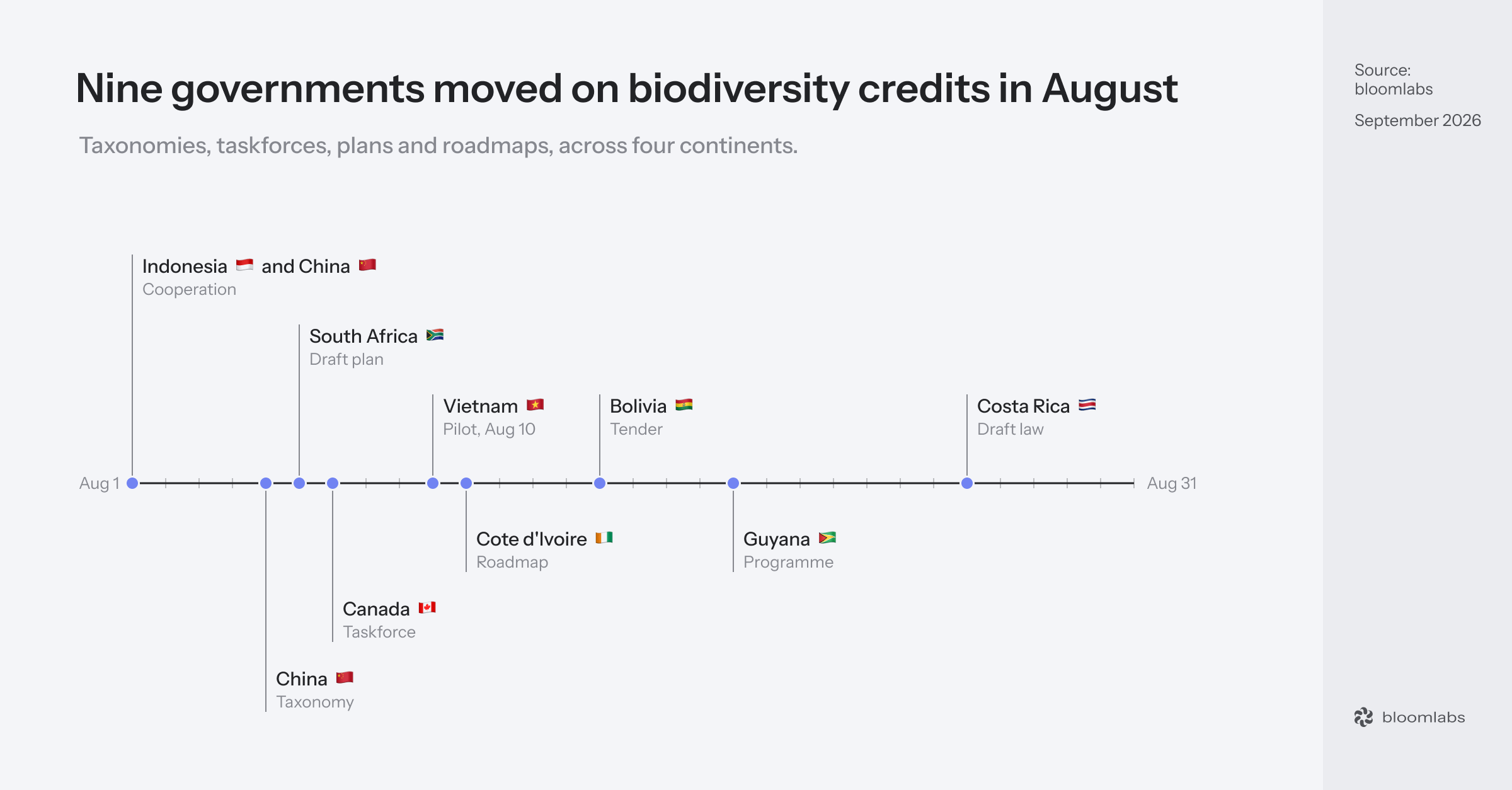
Nine countries show up in this edition’s national news. Canada created a taskforce on natural capital accounting with C$3.8 billion of federal money. China is finalizing a biodiversity taxonomy that would let its banks extend credit against biodiversity outcomes, and Indonesia agreed to cooperate with it a week earlier. South Africa named credits in its draft ten-year plan, Vietnam confirmed it will pilot them, and development agencies commissioned scheme designs for Bolivia, Cote d’Ivoire, Costa Rica and Guyana in the same month.
August itself was a half-sized month at $50k across 62 transactions, against a $97k median since 2024. Two deals were 51% of it, an anonymous 3,000-unit purchase on Coorong Lakes and Alborn Enterprises’ 1,485 credits on Sanctuary Mountain, and Alborn is a returning buyer that multiplied its first purchase by ten. Direct Capital, a New Zealand private equity manager, is the first fund of its kind we have recorded on the buy side.
On the policy side, the ICVCM approved three programs that also run biodiversity standards, Canada put a taskforce on natural capital, and development agencies designed credit schemes for Bolivia, Cote d’Ivoire, Costa Rica and Guyana in the same month.
We also launched our Countries dataset, 94 countries plus the EU, each ranked on how far it has actually gone on biodiversity credits.
Learn more and explore the data on Bloom.
Market context
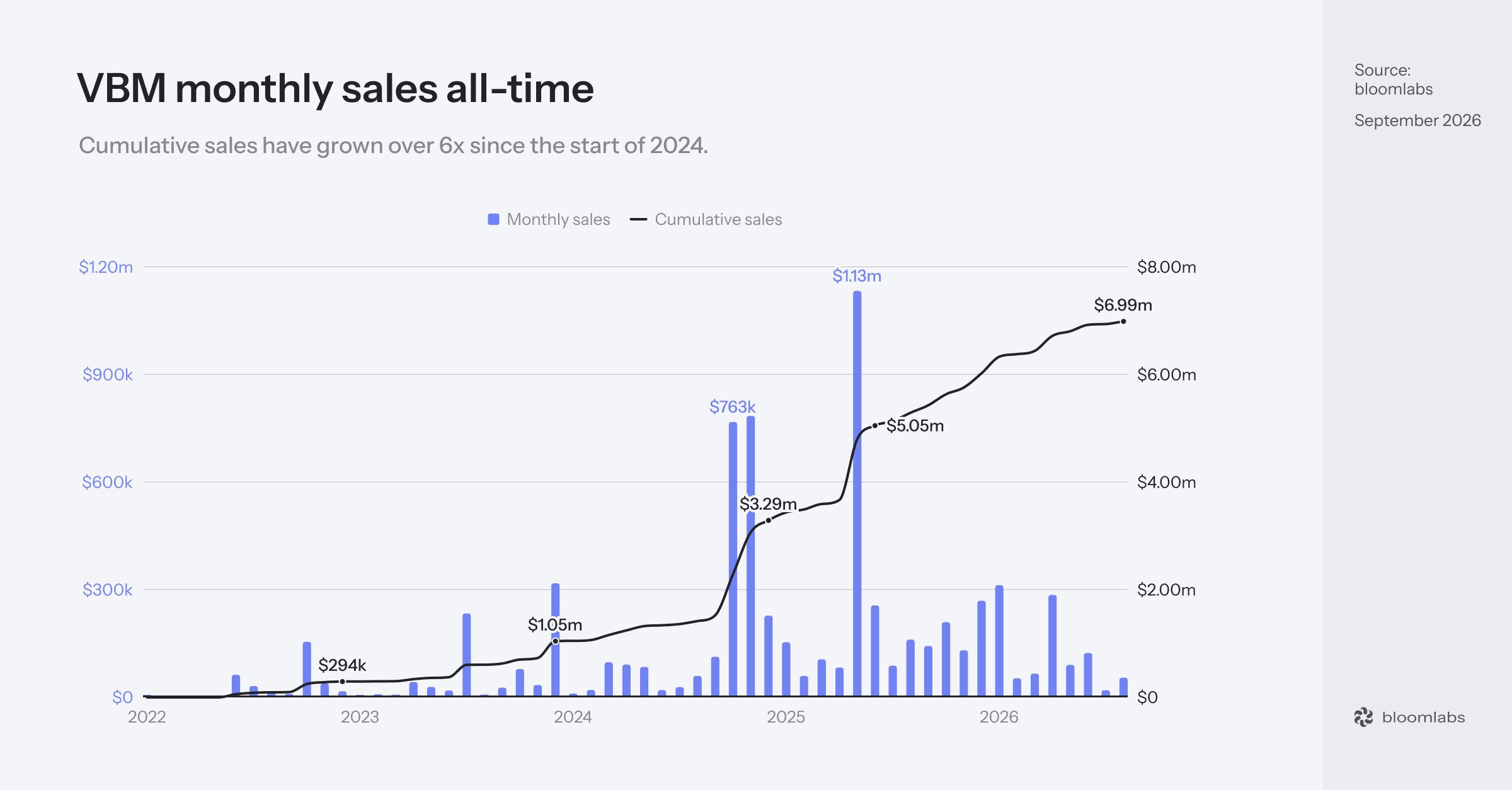
VBM has now sold $6.99m worth of credits since the first recorded sale in early 2022.
Volatility is still significant, since 2026 alone runs from $15k in July to $308k in January, and quarterly totals have moved from under $100k to nearly $1.8m across the life of the market. August landed at $50k, which is a recovery from July but still half of an average month. This is why month-on-month or quarter-on-quarter comparisons still do not tell us much, and it is also why we would not read one better month as the start of a trend any more than we read July as a decline.
August 2026
August 2026 recorded $50k in sales across 62 transactions, up from July’s $15k. For comparison, the earlier months of the year came in at $308k in January, $48k in February, $61k in March, $280k in April, $85k in May, $119k in June, and $15k in July. With a median monthly value of $97k since 2024, August sits at about half of an average month, and it is the fourth month this year under that median.
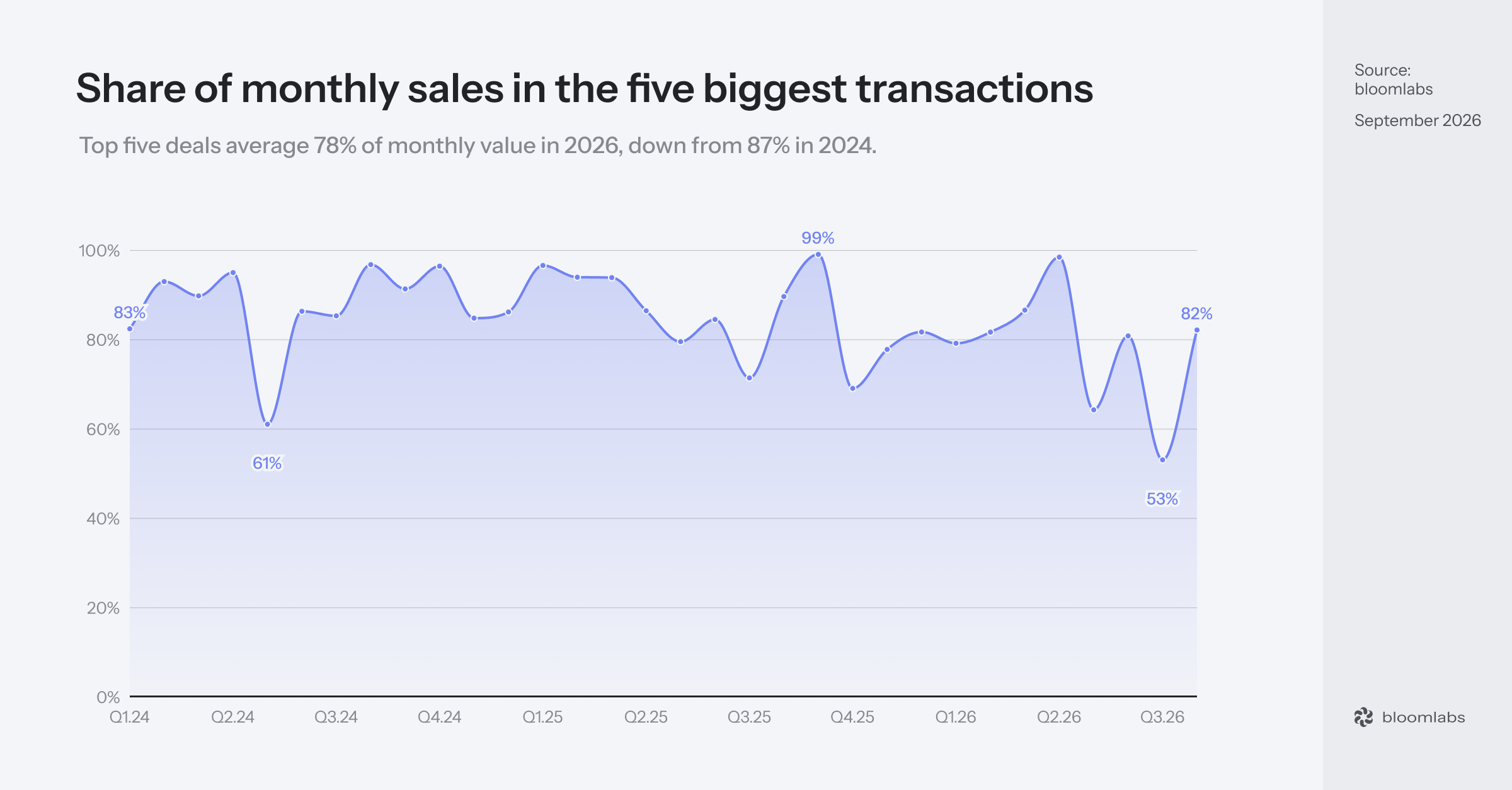
The five largest transactions made up 82% of August’s value, back to the concentration we saw for most of the year after July’s 53%. Two deals carried the month: an anonymous 3,000-unit Coorong Lakes purchase at $15,690 and Alborn Enterprises‘ 1,485 credits on Sanctuary Mountain Maungatautari at $10,395, which together are 51% of the total. The average transaction was $818, against $176 in July and $1,445 in June, and there were 62 transactions against 84 in July. Fewer transactions but more money, because a handful of mid-sized business purchases came back.
August has been an average month in every year we track, at $9k in 2022, $2k in 2023, $55k in 2024 and $156k in 2025. This year’s $50k is the second-lowest August since the market had any volume to speak of, but it sits inside the range.
Projects
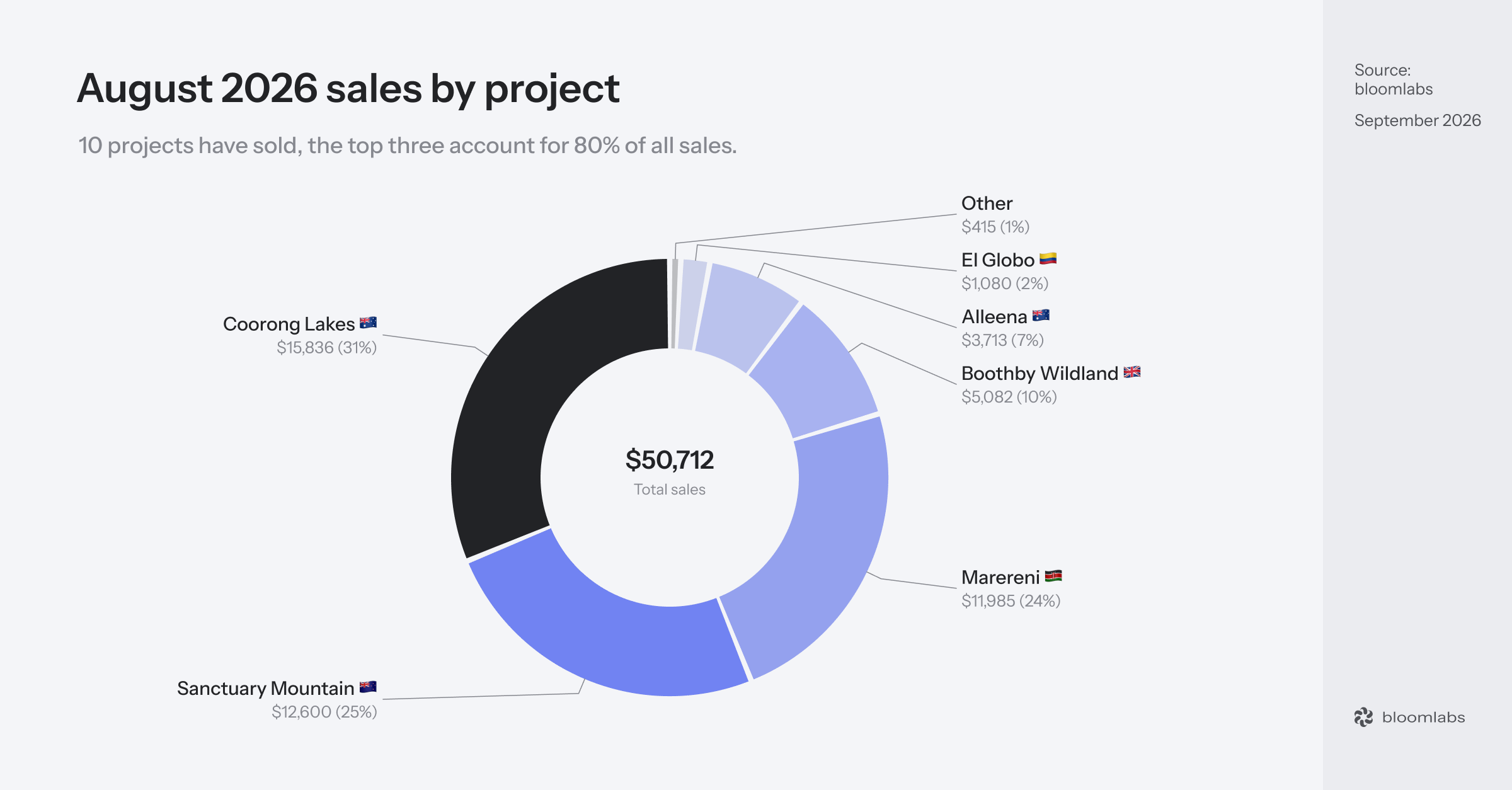
10 projects sold in August across 6 countries, and 9 of them had also sold in July, so the supply side did little change.
Wilderlands‘ four Australian projects took 39% of the total between them, and Coorong Lakes alone took 31% of the month at $15,836 across 9 transactions. It is the largest Coorong Lakes transaction since June 2025 ($50,266), though well short of the project’s $94,140 record from October 2022. Alleena added $3,713 across 10 transactions, including a 1,666-unit purchase at $3,282 and a 150-unit one at $296. Budgerum and Crowes Lookout brought $101 and $99, which is the long tail of small consumer purchases Wilderlands sells every month.
Sanctuary Mountain Maungatautari, the Ekos project, recorded $12,600 across 8 transactions, 25% of the month and its second-best month of 2026 after May’s $36,855. All 8 retirements landed on August 19, five of them from companies and three from individuals, which is the same pattern as Ekos’s May batch, and looks like a quarterly retirement run.
Marereni, the Kenyan mangrove project sold by Seatrees, brought $11,985 across 7 transactions, 24% of the month, carried by two anonymous business purchases of 2,301 and 1,296 credits at $3. It is the project’s third-best month of 2026, after $51,963 in January and $16,791 in May, and well up from the $843 of July. Osa Peninsula, their Costa Rican coral project, sold two Coral Blocks at $40 to one buyer.
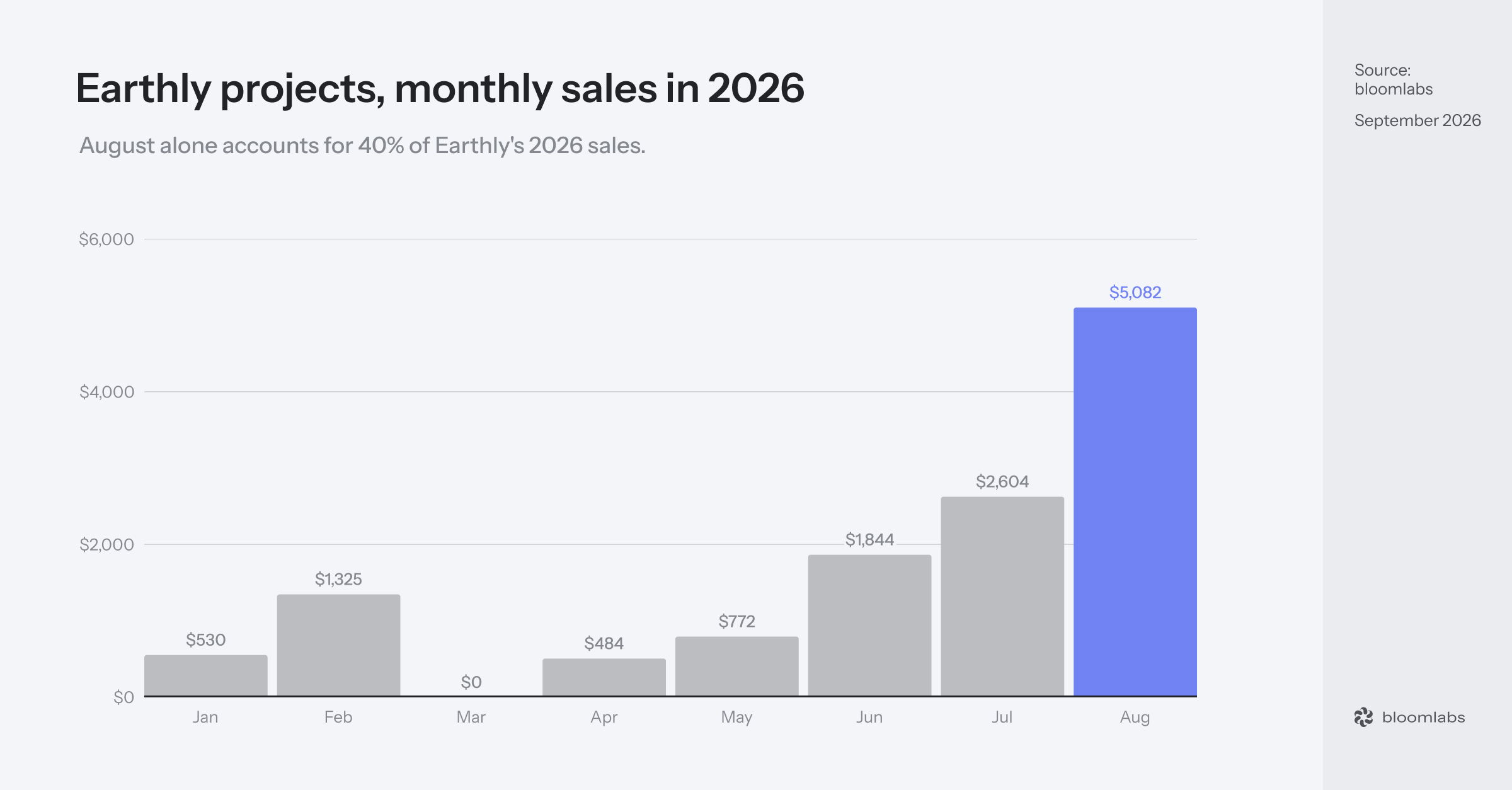
Boothby Wildland, the Nattergal site sold through Earthly, contributed $5,082 across 2 transactions, which makes August the best month of the year for Earthly’s English projects, on a monthly rise from $530 in January through $2,604 in July.
Lastly, in Colombia, El Globo added $1,080 across 2 transactions, and Putumayo added $135 across 7 transactions.
Buyers
Business buyers accounted for 88% of August’s value across 13 transactions, while consumer buyers made up $6,181 across 49 transactions. The consumer figure is inflated by one purchase. A single individual bought 20 Boothby Wildland credits for $4,840 on August 26, the largest individual purchase we have recorded on any Earthly project and more than the whole of Earthly’s July.
The largest named buyer was Alborn Enterprises Ltd, a small New Zealand accommodation business, which retired 1,485 Sanctuary Mountain credits for $10,395 on August 19. It first bought 141 credits for $987 in November 2025, so this is a returning buyer multiplying its purchase by ten. A very interesting behavior to keep an eye on, since it is not an isolated case. Boosterra Technologies OU, New Zealand Educational Institute Te Riu Roa Incorporated, Flamingo Technologies, British Transplantation Society, or Banco de Occidente all have made the same gradually increasing purchases in the past.
For a mechanism still being tested worldwide, returning buyers increasing their transaction amounts is a great sign. It could signal the start of a shared trust around credits, developers issuing them, and governments betting on them - because yes, the majority of those buyers come from countries where credits are being studied and piloted. And that brings us to a new dimension we just built in Bloom.
Our new Countries dataset
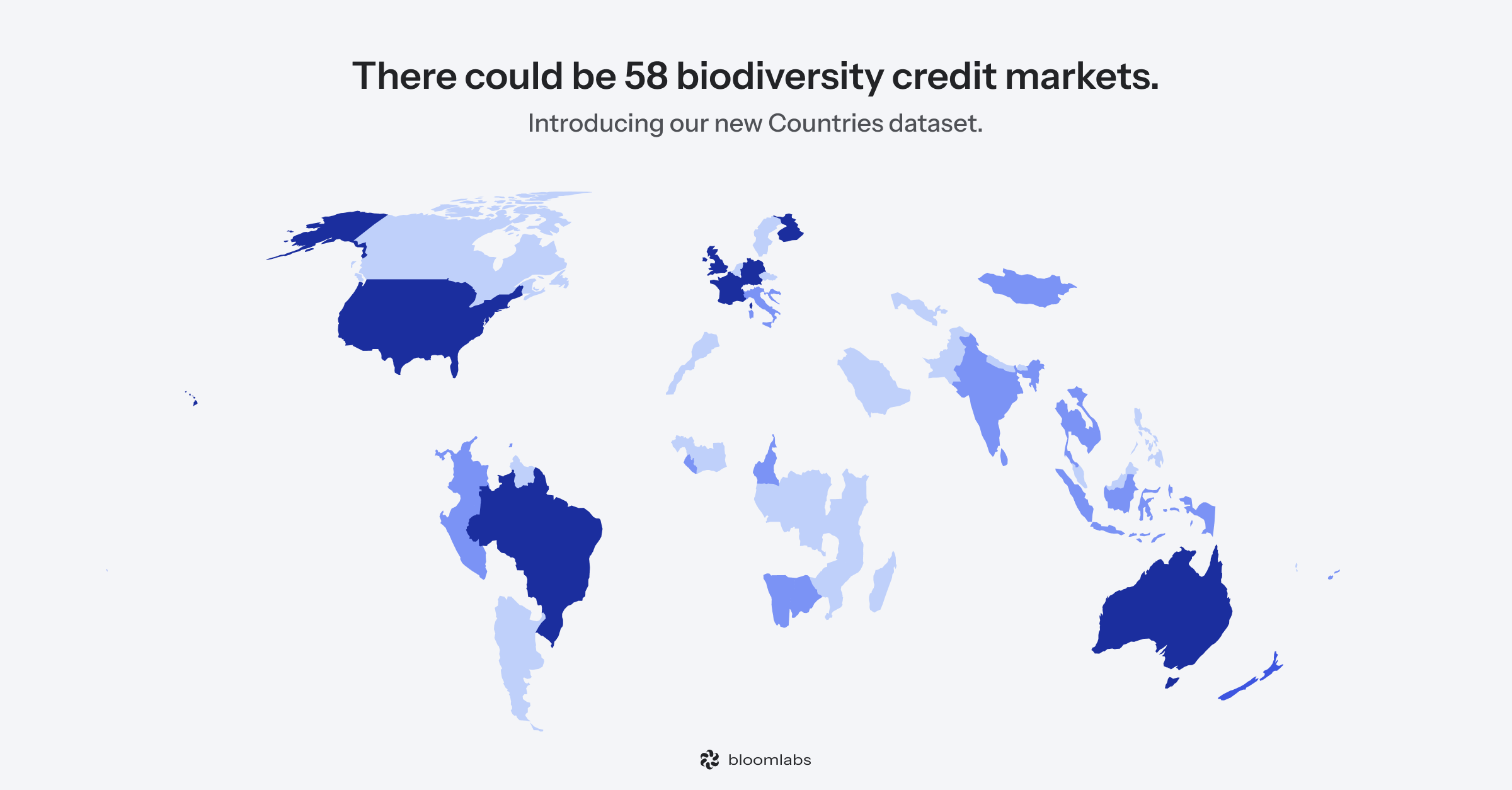
We recently launched the Countries dataset, 94 countries plus the EU, each with its own page on Bloom. A country gets in if it names credits in its CBD filings, has market activity in our data, or has launched a credit-related initiative. We then place each one on a four-step ladder, from referencing credits in national documents to running an operational credit system.
Today that gives 7 operational countries, 1 piloting, 19 exploring and 31 referencing, plus 37 with market activity and no stage. The policy side comes from the 4,500 or so NBSAPs, national targets and national reports on the CBD reporting tool, which we keep in-house, and every country page is updated at least twice a month.
This new feature already provides great intel. The 7 operational countries account for 61% of all recorded sales, and they average about $600k each, twelve times what the 51 countries at earlier stages manage. The 3 countries with compliance systems average close to nine times the sales of the other 92 - Germany does most of that work. And 19 countries with projects, organizations or transactions in our data have never named biodiversity credits in a CBD filing, Mexico, Spain, Ecuador and Costa Rica among them. Every national item in this MMO edition, from Canada’s task force to the four agency-designed schemes, now has a page you can open to see where the country sits on the ladder and what it has sold.
News
Featured
The schemes had a busy month
On August 4, the Integrity Council for the Voluntary Carbon Market approved Plan Vivo‘s PV Climate, Cercarbono, and BioCarbon Standard as CCP-Eligible, the label that says a carbon crediting program meets its Core Carbon Principles.
Getting the CCP label takes two separate approvals. First the programme gets approved (what Plan Vivo, Cercarbono, and BioCarbon just did). Then, each individual methodology inside that programme gets approved separately. A credit only carries the label when both happened, so that is not yet the case for the trio. However, it does imply that these 3 can now pretend to join the 13% of newly issued carbon credits carrying the label worldwide.
None of this is biodiversity news, but these three programs are also three of the most active biodiversity standard setters we track. Plan Vivo runs PV Nature, Cercarbono runs its Biodiversity Certification Programme, and BioCarbon runs its own biodiversity standard. A CCP label puts the governance of these organizations, including their registries and audit rules, through an independent review. A buyer weighing a stacked carbon and biodiversity purchase has one less thing to check.
Two of the three then shipped biodiversity infrastructure within weeks. On August 12, BioCarbon opened public comment on version 5 of its biodiversity standard, which adds multicrediting programs, meaning one project can issue biodiversity credits alongside carbon and other environmental units under the same scheme. And on September 2, Plan Vivo launched the PV Nature Project Marketplace and Registry with Trusticate, a blockchain-backed registry where every certificate issuance, transfer, and retirement will be recorded.
The standards that already sell carbon are the ones building the rails for biodiversity, because that is where the projects and the buyers already are. We wrote in June that stacked projects are the realistic first use case for biodiversity credits (together with credit bundling). The open question is whether the biodiversity units that flow through these rails will be sold on their own merits or stay a co-benefit.
National news
Canada put a taskforce on natural capital, with a budget already behind it
On August 7, the Canadian government created a 15-member independent taskforce on natural capital accounting and nature financing. It will advise on how to measure and value nature and how to mobilize private capital, and it builds on Prime Minister Mark Carney’s “A Force of Nature” strategy and a C$3.8 billion federal nature investment. The taskforce held its first meeting on August 14.
Canada is already talking about biodiversity credits in its 7th National Report. We expect this group to produce something closer to a market design than a report. Canada is definitely on our watchlist for 2027.
China is finalizing a biodiversity taxonomy, and Indonesia wants to trade with it
China is about to finalize a biodiversity taxonomy, a classification of which activities count as biodiversity-positive, that would let banks extend credit against biodiversity outcomes. A week earlier, on August 1, Indonesia and China agreed to cooperate on carbon markets, biodiversity credits, and benefit-sharing mechanisms as part of a wider climate partnership.
A bank will not lend against a credit until someone has defined what counts. China writing that list, and Indonesia signing up to trade against it while it runs its own three credit tracks, is the first time we have seen two Asian governments line up the supply side and the finance side in the same month. If China’s banks start lending against the taxonomy, the demand question this market keeps asking will have an answer that does not depend on European or American buyers. And, as we know, the People’s Republic can be pretty efficient when mobilized towards a common goal.
South Africa names credits in its draft ten-year plan
South Africa‘s draft National Biodiversity Strategy and Action Plan for 2026 to 2035, out for comment since early August, lists market-based mechanisms including biodiversity credits among the tools it will explore. That adds South Africa to the more than 50 countries whose national plans now mention the instrument, and it does so in a country where supply already exists. Dabchick, led by the AMES Foundation, is however the only project identified in the nation to date.
Vietnam will pilot biodiversity credits
Vietnam‘s government confirmed it will pilot biodiversity credits under its national nature strategy to diversify financing for conservation and restoration. We do not have the pilot design yet, but we do know that Vietnam was also the country the EU and Germany chose for a EUR 27.5 million forest restoration program the same week. Vietnam has sold carbon credits at state level through the World Bank’s Forest Carbon Partnership Facility since 2023, so it has the registry and the institutional experience to run a second instrument.
Development agencies are designing credit schemes for four countries at once
Expertise France, the French government’s technical agency, published a EUR 150,000 tender to design a biodiversity credits mechanism for Bolivia and prepare its pilot, with bids due August 24.
Cote d’Ivoire held a validation workshop on August 11 for a draft national roadmap on biodiversity credits, developed with international support.
UNDP’s BIOFIN initiative is working with Costa Rica on a law focused specifically on biodiversity credits.
And Guyana, under the EU-funded Financing for Forests program run by the Global Green Growth Institute, is looking at biodiversity credits as one route to bring capital into its forest sector.
Market news
BCA published a taxonomy for combining biodiversity and carbon credits
The Biodiversity Credit Alliance released a knowledge brief that sets out a working vocabulary for how biodiversity and carbon credits link, with bundling, stacking, and stapling defined as distinct models.
We defined stacking and bundling ourselves in our carbon and biodiversity credits in practice piece, and we count 42 projects supporting stacking on Bloom. Most of the disagreement we hear about double counting comes from people using different words for the same thing, so a shared vocabulary from the BCA removes some friction. Common standards, common rules, common terms, are the ingredients for this market to work.
Wilderlands rewrote its methodology
Wilderlands released version 2.0 of its whitepaper on August 18, the first full rewrite since the methodology launched in 2022. Site eligibility now runs through BIOTA, a 15-indicator assessment scored out of 100 with a pass or fail threshold, and the land has to be of high strategic conservation value rather than merely high conservation value. Protection is through an on-title instrument, so it binds the next owner. A second project type is now available, where land already serving for compliance offset can generate Wilderlands’ voluntary credits if the offset credits are cancelled first.
Four years of selling credits have taught Wilderlands that being ready for due diligence, for a buyer’s legal team, and for conversion of compliance projects are part of the key success criteria.
ADB backs a nature credit framework for the East Asian-Australasian Flyway
The Asian Development Bank is supporting a nature credit framework for the East Asian-Australasian Flyway, the migratory bird route that runs from Siberia and Alaska to Australia and New Zealand through 22 countries. The framework would let credits fund the wetlands the birds depend on along the way. ADB launched a tender, which closed on Tuesday, to select experts who will assess ways to build up the market as part of the Regional Flyway Initiative (RFI).
Credits for a flyway break the local logic that most biodiversity credits follow, since the outcome depends on habitat in a dozen jurisdictions. Success will depend on whether anyone can get twelve regulators to recognize the same unit. If they can, it is a template for every migratory species and every shared river basin.
Charoen Pokphand is studying biodiversity credits and tokenizing its farmland
Charoen Pokphand, the Bangkok-based food and agriculture conglomerate, is studying biodiversity credits as part of a wider natural capital feasibility study, and its produce arm partnered with Token X, the digital asset subsidiary of Siam Commercial Bank, to issue green tokens against farmland carbon credits.
This is one of the largest food companies in the world looking at biodiversity credits from the supply side, as a producer rather than a buyer. If CP’s farmland can generate units, CP’s customers, who include most of the retailers in Southeast Asia, become the buyers of an insetting product. A massive potential to keep a close eye on.
Suggested read
Securing Kenya’s Prosperity: The need for a robust Biodiversity Offset Framework
Terrasos, EarthAcre and the Kenya Wildlife Conservancies Association published a 52-page case funded by the Mulago Foundation, for writing biodiversity offsets into Kenyan law.
The argument runs on fiscal numbers: nature-based sectors carry 44% of Kenya’s GDP and 70% of its employment, the country is about to spend $38 billion on roads and dams through its new National Infrastructure Fund, and 31 of its 58 Key Biodiversity Areas are already in unfavorable condition. Kenya’s own report to the CBD puts the gap to its conservation goals at $5 billion.
Residual impacts developers do not pay for do not disappear, they land on the Treasury. The mitigation hierarchy already sits in Kenya’s EIA (Environmental Impact Assessment) rules. Make it binding, define No Net Loss as the floor, set technical standards for additionality, permanence (20 years minimum) and like-for-like equivalence, give NEMA (National Environment Management Authority) the regulator’s seat with no delivery role, and allow habitat banks as the aggregating mechanism, with a 10 to 1 ratio for impacts on Key Biodiversity Areas. The Colombian case study is Terrasos’s own, Enel Green Power meeting a 150 MW solar park’s obligation through two tropical dry forest habitat banks under 20-year easements and a trust fund.
The report clearly identifies the end buyer. Energy, linear infrastructure and mining are named as the demand sectors, with the Naivasha to Kisumu railway, the Olkaria geothermal extension and the Kwale mineral sands mine as the worked examples. It is rare to see this level of pragmatism and direct naming of the “culprits”.
Terrasos operates the habitat banks the report recommends, EarthAcre is developing credits on Kenyan conservancies, and KWCA represents the landholders who would host the banks. Every developer we track privately wants regulatory demand, but this time it is stated out loud.
Upcoming events
Climate Week NYC, September 20 to 27, New York, US
One of the largest climate events of the year, held alongside the UN General Assembly, with a climate and nature focus area and a thousand-plus affiliated events across the city. The value for our market is less the main stage than the density of nature finance side events and announcements that cluster around it. The World Biodiversity Summit runs on the sidelines on September 24.
CBD COP17, October 19 to 30, Yerevan, Armenia
The single most important policy event for biodiversity credits this year, and the first global review of progress against the Global Biodiversity Framework. Governments will negotiate resource mobilization and finance, which is the track where biodiversity credits sit, so this is the clearest read we will get on official support for the market. The IAPB’s first exposure drafts of its standards are also due at COP17. We will cover the outcome in the October edition.
Eurosite Annual Meeting, November 2 to 4, Seville, Spain
The European land conservation network’s annual meeting, with Conservation Finance as one of four thematic lines, which is where nature and biodiversity credits sit on the agenda. Registration is open on the event page.
Le Forum Biodiversité & Économie, November 3 to 4, Paris, France
The sixth edition of the French Biodiversity Agency’s biennial forum for business, held at the Cité des sciences et de l’industrie and aimed at companies of every size and sector that want to act on biodiversity.
