


We can tell you what sold in the voluntary biodiversity market, who bought it, when, how much, at what price, and under which scheme, because we spend our days running the database that records it.
What we could never really tell you, until now, is how any of it actually happened. We never really knew what a developer said in a sales call, which channel produced the deal, or why one buyer signed while another walked away. We had ideas and assumptions from the many discussions we held with market participants, but nothing data-based.
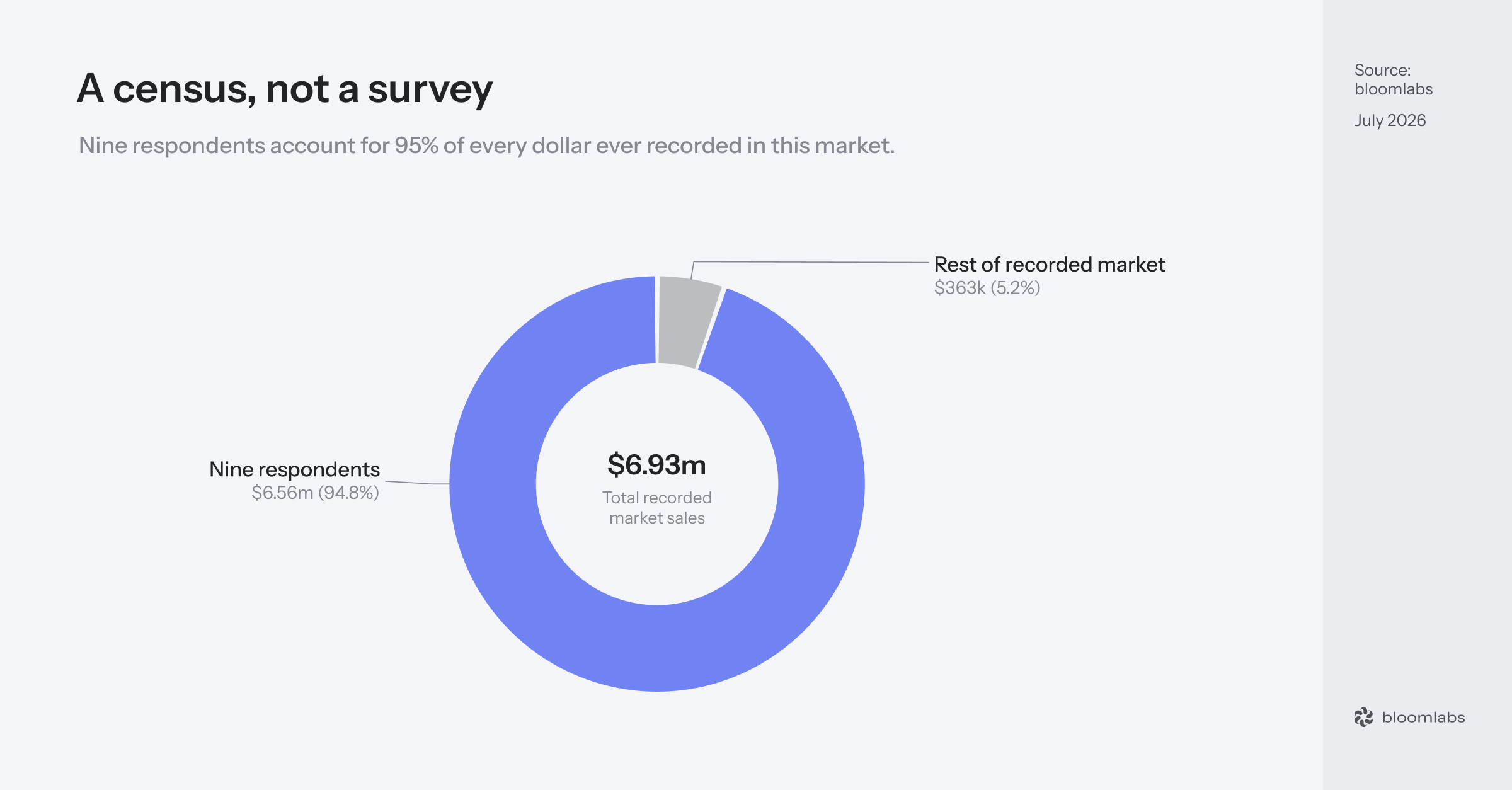
So last month we decided to send each of the highest-selling biodiversity credit developers in Bloom a questionnaire. The respondents have cumulatively sold $6.56M of the $6.93M in biodiversity credit sales recorded, around 95% of all tracked sales value.
What they told us is sometimes surprising, often logical, and more encouraging than some might suggest. Selling biodiversity credits is almost nobody’s full-time job. The product has no shared definition, even among the people who have sold most. Price turns out to be almost irrelevant to whether a deal closes. And the current demand was mostly not formed by the product or by policy, it was manufactured deal by deal through brokers, marketing channels, and carbon.
Demand that was manufactured can be manufactured again, and more is in developer’s hands than one might think. We walk through all of it below, and end with the condensed playbook these nine developers would hand to the next one.
What we can and cannot claim
A few survey limits are worth stating first. These are nine self-reported responses, given as best estimates. Five developers agreed to be named, four asked to stay anonymous, so their answers appear only inside aggregates or as unattributed observations.
Moreover, we only surveyed developers who have sold credits. The much larger group of developers who have issued credits but haven’t reported sales yet - 27 in Bloom - is absent from this data, so what follows is a portrait of what worked, not a representative picture of what developers attempt.
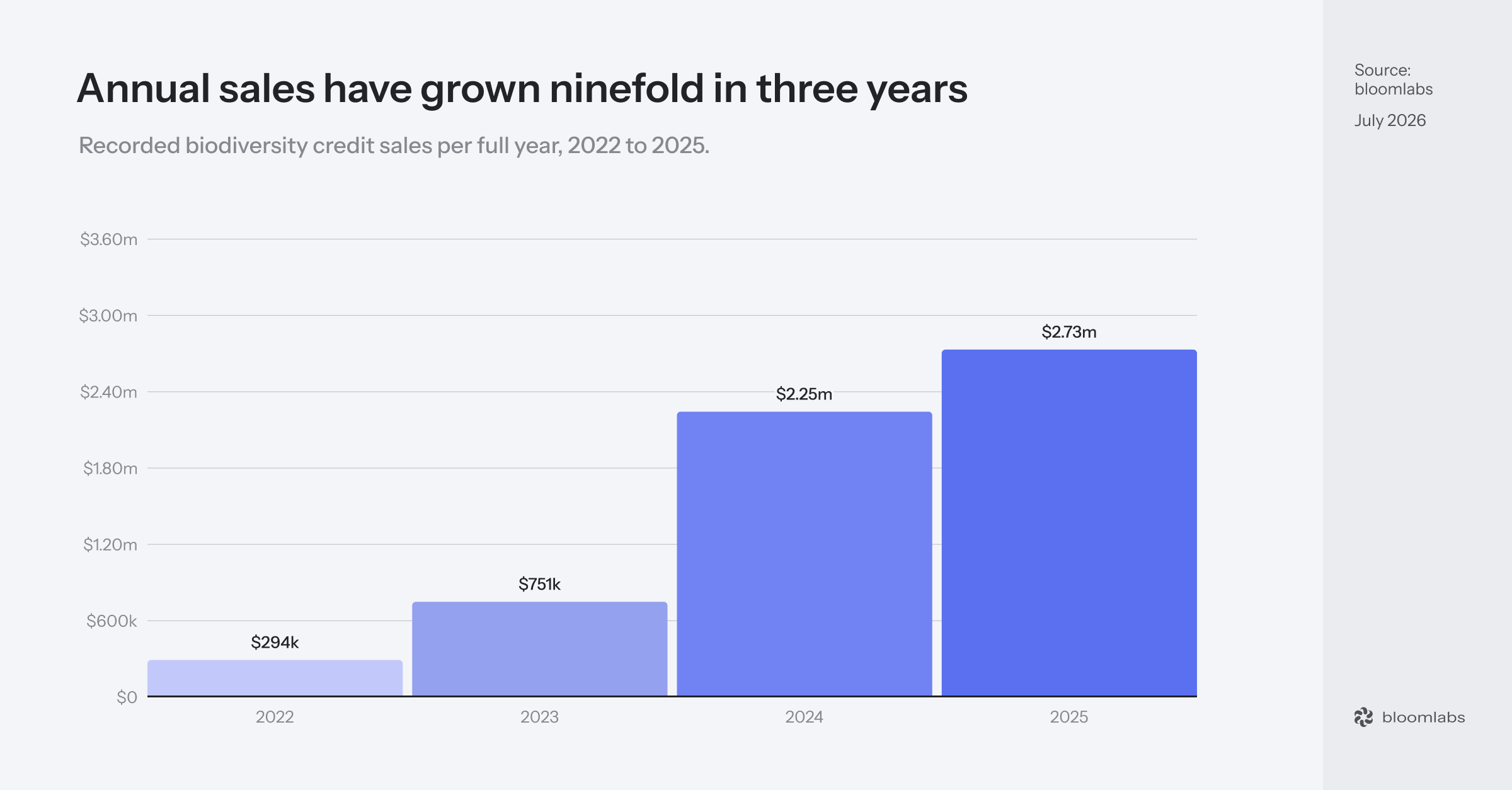
All sales figures below are read live from Bloom as of July 2026, across roughly 7,100 recorded transactions.
The market’s sales force is part-time
In an organization, who actually sells the credits? We asked each developer who is internally responsible for this, and the answers split evenly four ways.
Three organizations have a dedicated salesperson, two leave it to the founder or CEO, two fold it into a project or operations manager’s broader role, and two answered outside those categories. A market usually converges on a common approach of running sales as it matures, and this one has not yet started to. It is itself a measure of how young the market is.
The three biggest sellers have no dedicated credit salesperson at all. Wilderlands, the largest at $1.9M in recorded sales, relies on founder-led sales. green account, at $1.44M, sells through an operations manager for whom transacting is part of a broader role. Ekos, at $1.19M, has a sales team, but that team sells carbon and offers biodiversity alongside it.
The three developers who do have a dedicated salesperson are all mid-tier by volume. Whatever produces sales so far, it is not specialized sales representatives, it is credits embedded in the founder’s network, a part-time activity of an operations manager, or another asset’s pipeline.
The time allocation numbers confirm this finding. Only one of the nine reports that its seller spends more than 75% of their time on sales. For six of the nine, the person responsible for selling credits spends 50% of their time or less on it, and at Savimbo the founder puts it below 10%.
Now hold that staffing picture against what the deals themselves demand. Eight of nine developers report a typical B2B cycle of 3 months or longer, three of them report cycles beyond 12 months, and not one closes in under 1 month. The touch count is just as heavy, since no developer closes a typical deal in one or two conversations, and seven of the nine need 6 or more separate calls, emails, and meetings per deal.
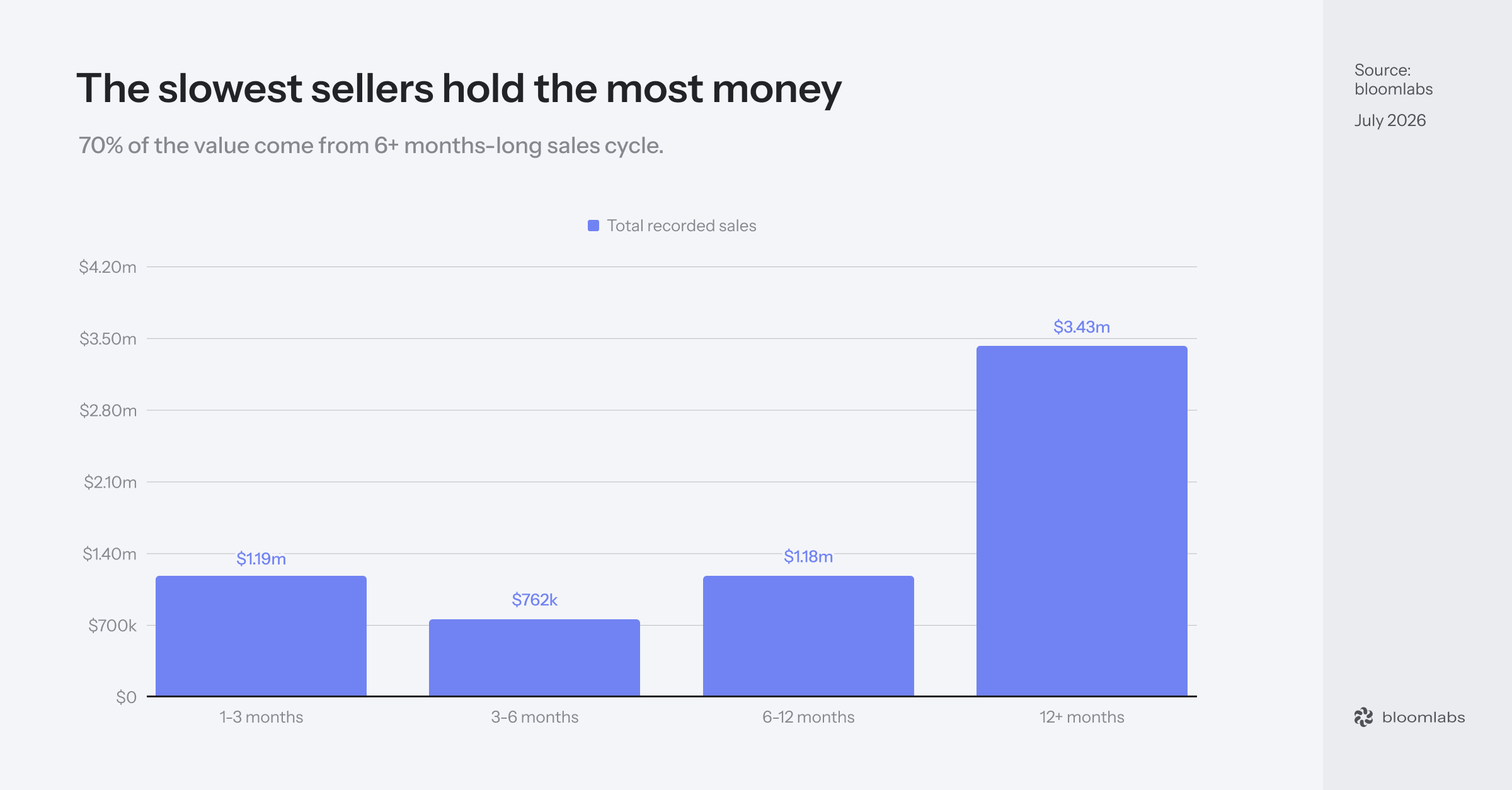
The three sellers on cycles beyond a year hold $3.43M in sales between them, which is more than half of the share of the respondents’ sales, and they include the two largest sellers. The single seller that operates on a 1 to 3-month cycle, Ekos, gets its speed from a shortcut we return to below, selling credits as an add-on inside existing carbon relationships.
Deal value spreads almost evenly across the conversation-count brackets, roughly $1.8M for the leanest sellers (3 to 5 conversations), $2.8M for the middle (6 to 10 conversations), and $2.0M for the heaviest (10+ conversations), so a high touch count is not a marker of total sales.
Overall, the average biodiversity credit deal takes 6 months and 8 buyer interactions to close, and the person running it is doing so with less than 50% of their working week.
There are two ways to interpret these results. First: it is astonishing that $7m worth of credits were even sold with such limited efforts and a relatively high required touch count. Second: developers are hedging the risk of over-committing to an early market by exploring other financial instruments, such as carbon credits or national compliance mechanisms. Either way, one could argue that the market deserves a dedicated sales function inside each project developer to be properly validated.
Where the money actually comes from
We asked each developer to split its sales across eight commercial channels, and we computed the result two ways.
The first metric weights each developer’s channel percentages by its actual sales, so a $2m seller counts for more than an $80k one, and it answers where the market’s dollars came from. The second is the simple average of the nine reported mixes, and it answers what the typical developer’s channel mix looks like.
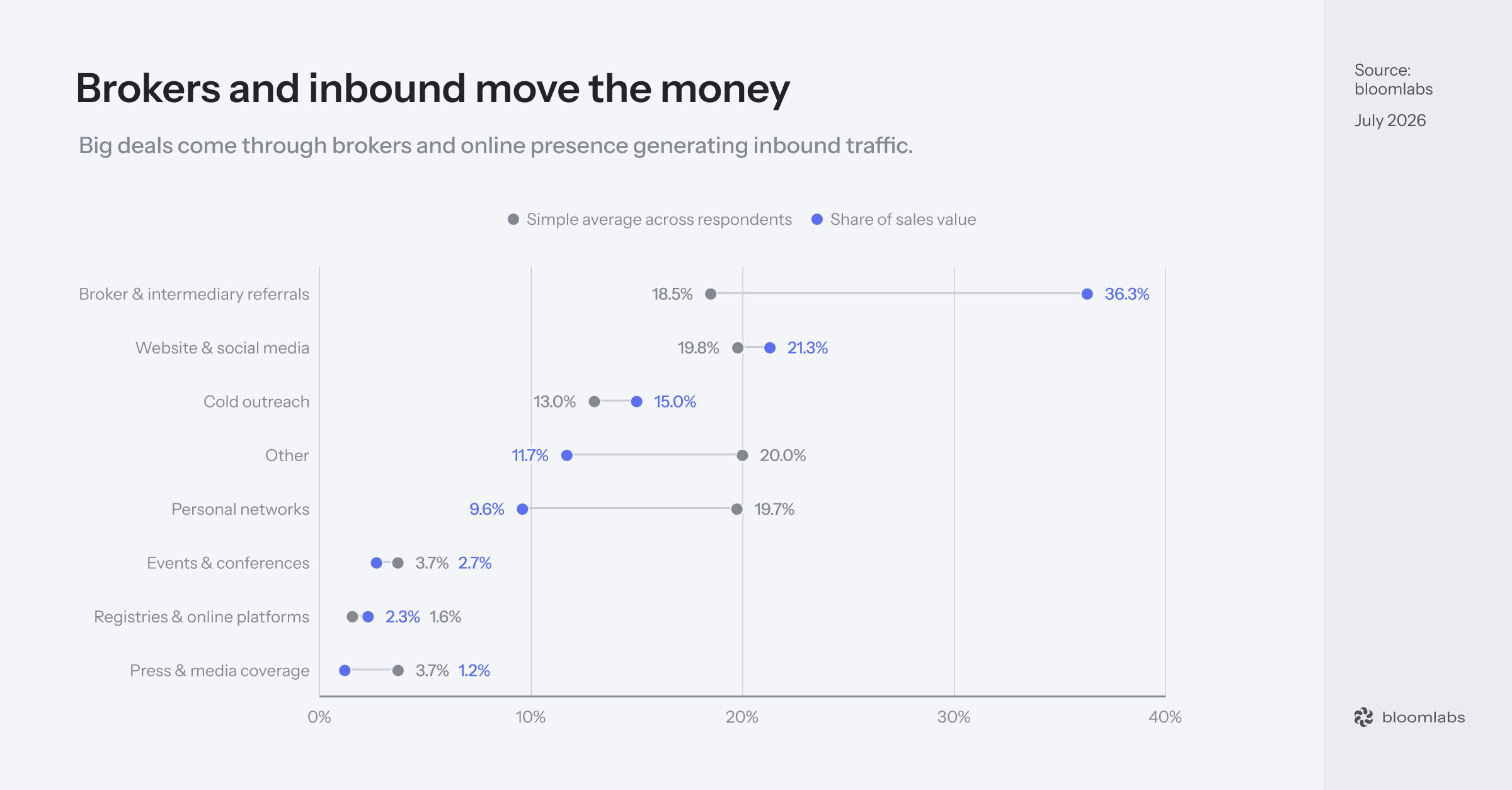
Measured in dollars, brokers top the market at 36.3% of sales value. By the simple average, no channel stands out, as website, personal networks, brokers, and other all land at 18-20%.
The gap between the two metrics is explained by one word: concentration. The broker figure is two large sellers who happen to be broker-led, green account at 96.5% through a single intermediary channel and Wilderlands at 45%. Once every developer gets an equal vote instead of a dollar-weighted one, brokers fall back.
The Other bucket, which tops the simple average, is from two anonymous developers and can be interpreted as a combination of strategic pilots and inbound demand. At the bottom of the table, events, registries, and press each sit between one and four percent on both metrics. The market’s two most visible surfaces, conferences and registries, produce almost none of its sales. Whatever a registry listing is for today, it is not yet how credits are purchased.
So the honest headline about channels has two halves. Brokers move the most money in this market, and the typical developer does not rely on them. What the typical developer actually runs on is warm, inbound demand, since website and social plus personal relationships make up roughly 40% of the mean channel mix.
To the skeptics’ surprise, demand in this market usually comes looking for developers.
Retail demand as a facade
Every conversation about biodiversity credits eventually reaches the individual buyer, the person who might sponsor a hectare the way they might fund a tree planting.
Nobody in the sample sells to consumers only. Six of the nine sell both business and consumer, three sell business only, and when we classify the actual transactions, the consumer channel amounts to roughly $132K. The six developers who run both channels have produced $3.98M of classified business sales against that $132K of retail. The storefront exists at two-thirds of these companies, and it contributes only 2% of the market’s value.
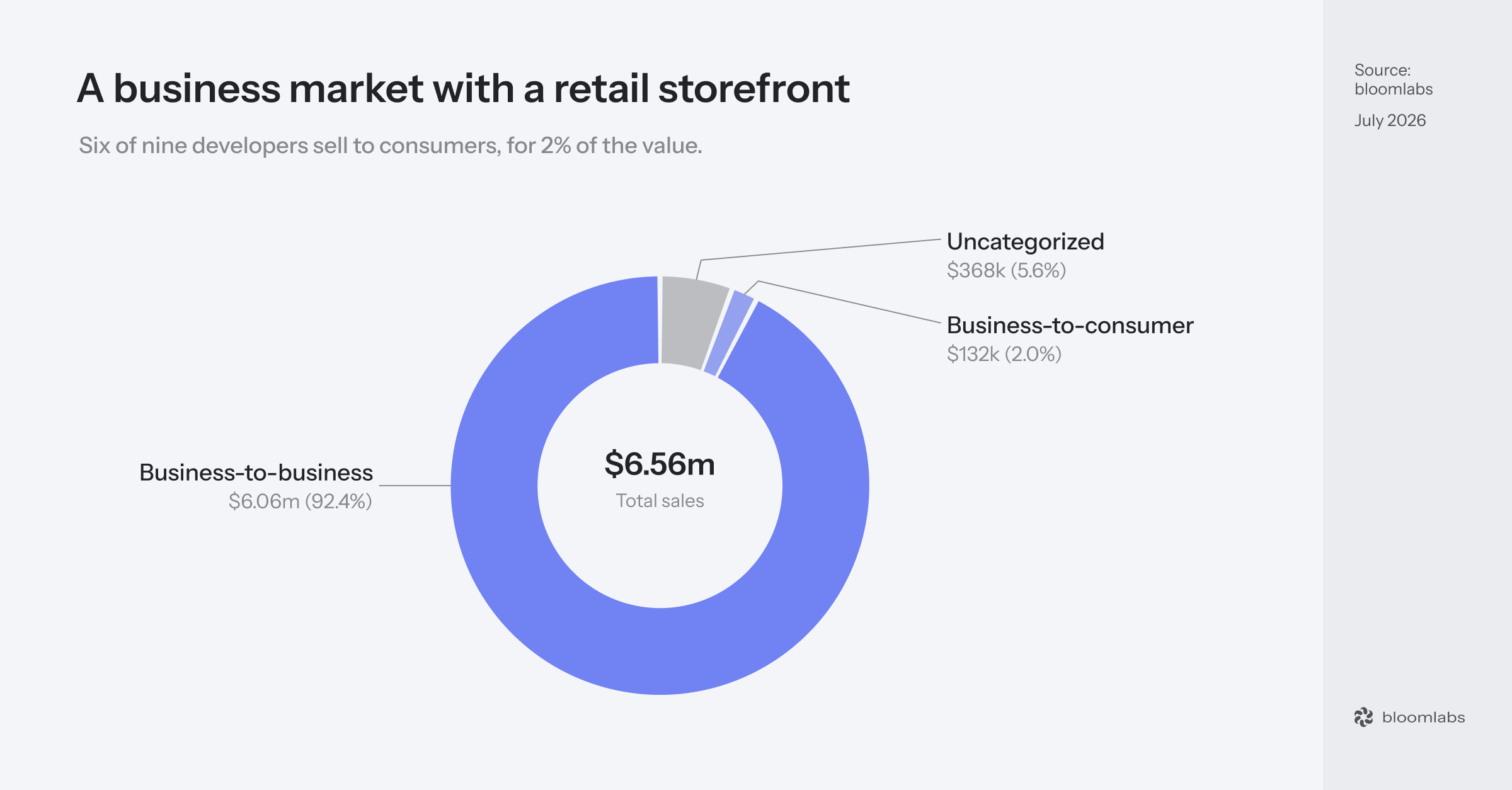
How that retail segment arrives is consistent across everyone who has one. Consumer buyers come through the developer’s own website, social media, press coverage, and word of mouth, and not one developer reports paid acquisition of any kind. Marketplaces, the layer that should in theory aggregate retail demand, are used only by a single developer.
Once the buyer lands, the levers that convert them are emotional connection to a place, a simple impact claim of the protect-X-hectares kind, and visual content, with price cited as a selling point by only one developer.
One respondent clarified the two motions apart for us, describing business sales as a consultative process built on measurable business value and reporting, and consumer sales as working only when they are simple, automated, and emotionally engaging. Ekos runs this split, with consumer trades happening on an e-commerce page while every business deal happens via conversations.
The strategic lesson comes from the developer who spent the most on the retail bet. Wilderlands names over-investing in B2C in its early days as its single biggest sales mistake, having built features and functionality that turned out not to be relevant.
The consumer channel in this market is a brand surface and an occasional gifting product, and it can be a good one, but on the evidence of nine developers and 7,100 transactions, it is not a revenue engine, and resourcing it as one is the most expensive way to learn that.
The door retail leaves open is still worth keeping open, though, for the rails already exist at two-thirds of these developers, the gifting angle converts, and a low-cost consumer channel is a cheap option on a future where individuals become more invested in nature.
A product still finding its words
“When a potential buyer has never heard of biodiversity credits, how do you explain what they are and why they have value?” Eight developers gave us eight different answers to this question.
One frames credits as measurable conservation impact, another as an upgraded form of philanthropy, another as an accounting instrument that securitizes the value of an action, another as a standardized tradable unit, another as a tool for managing a company’s nature dependencies.
The only thread running through all of them is verification, since nearly every developer anchors on the credit being measured, third-party verified, independently monitored, or transparent. Beyond that shared focus on proof, there is no common story at all. We suspect it is a large part of why the typical sale needs 6 to 10 conversations, for the first several of them are spent explaining what is being bought.
The consensus on verification represents a shared story, and Ekos reports, to its own surprise, that buyers who do engage find biodiversity credits simpler than carbon credits. That suggests the confusion is not a property of the product, and is not here to stay.
Then we asked for the real pitch: the sentence a developer actually says when a company asks why it should buy. The answers are one of the most revealing facts in the survey, for almost nobody pitches the biodiversity credit on its own merits.
The most successful sellers pitch carbon with biodiversity attached.
Wilderlands sells a stapled product, an Australian biodiversity credit attached to a verified international carbon credit, pitched as fulfilling net zero obligations with Australian impact at a fraction of the price of an ACCU, and its second proposition targets green-building accreditation points.
Ekos offers credit bundles inside the carbon management engagements it already runs, which is why it closes in 1 to 3 months while most of the sales value on the market takes 6 or more, since the biodiversity credit rides a commercial relationship that already exists.
Seatrees sells the same carbon-plus-biodiversity bundle as an answer to the twin crises of climate and biodiversity loss.
The consultative sellers start from the buyer’s own nature-related risks and reporting obligations, TNFD disclosures, biodiversity KPIs and strategies, and position the credit as the instrument that turns a commitment into a measurable result. green account leads with state endorsement, credits measured through a government-created method (German Eco-Points) and verified by nature protection authorities, using public authority as the reason to trust a private instrument.
The standalone case of “buy this because a biodiversity credit is inherently worth owning” is absent from the field, including among the developers selling the most of them. At the moment, the credit itself is not the end goal, it is only a tool. In other words, biodiversity credits are not framed as investable assets to buyers. That is part of the market’s long-term vision.
What closes deals, and what quietly kills them
We asked each developer to rate the sales materials it uses on their impact on closing deals, on a scale of one to five, and eight of the nine answered.
Two materials clear the rest of the field by a full point. The project design document tops the ranking at 4.29 out of 5, used by seven of the eight raters, and photographs or videos from the site sit at 4.25, used by all eight. What buyers respond to is documented proof that a real place is being cared for by real people.
Everything more abstract rates worse, with impact reports at 3.25 and third-party audits at 3.13 sitting in the middle of the scale, media coverage and testimonials from previous buyers at 2.50 and 2.20, and virtual site visits at the bottom at 2.00.
The ranking exposes a say-do gap, for nearly every pitch in the previous section leads with the credit being verified and measurable, yet the certification artifacts themselves rate as average closers while a photograph of the place outrates them all. Sellers pitch proof as certification while buyers close on proof as place.
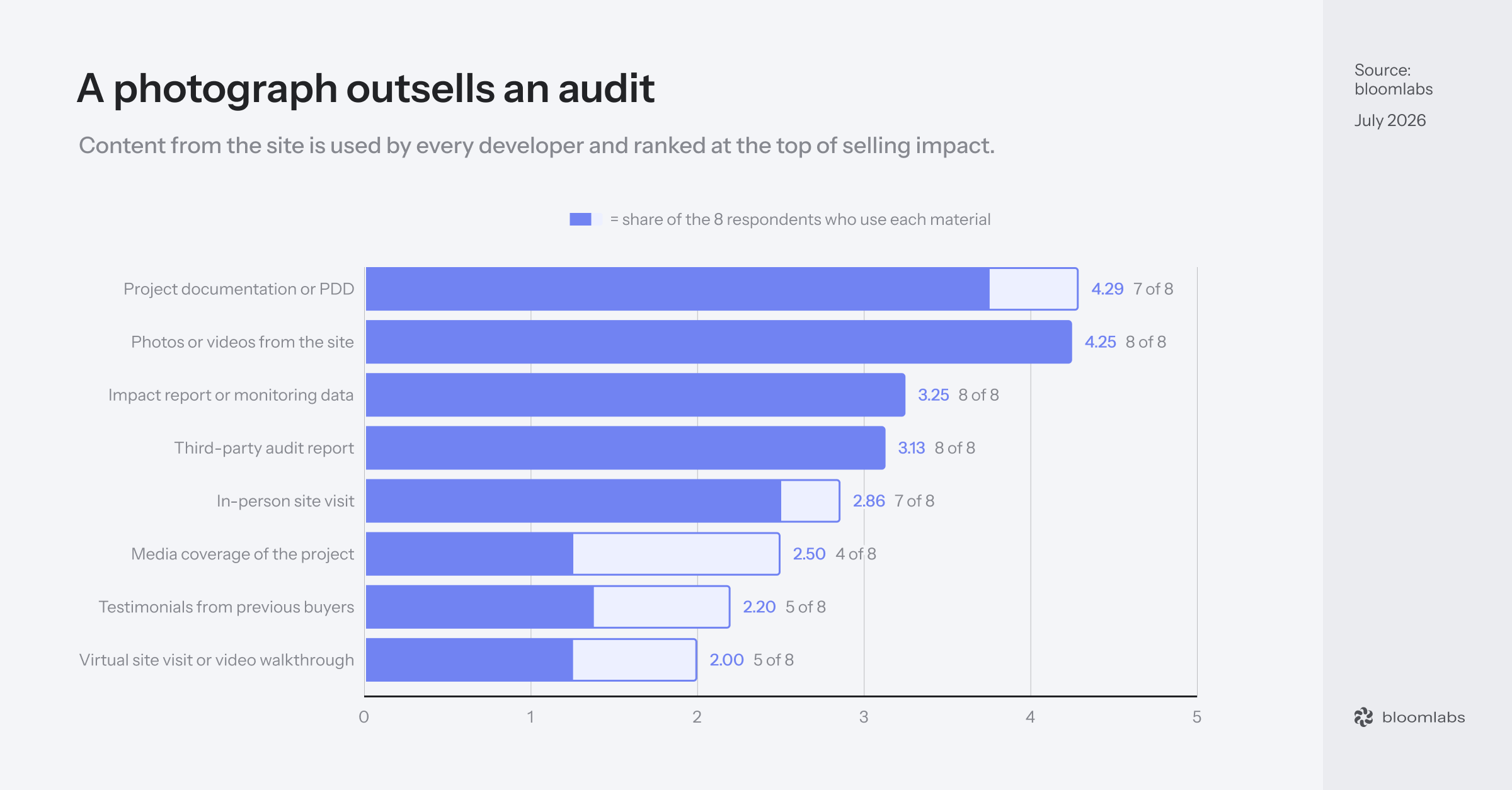
The usage counts add a second finding the ratings alone would hide. Three materials are used by every seller who answered - photos, impact reports, and third-party audits - but only the photos also rate near the top, while the two formal artifacts sit a full point below at average scores. In-person site visits split the sample instead of the difference, with three sellers rating them a 4.00 or 5.00 and three others rating them the minimum 1.00, so the 2.86 average doesn’t really describe anyone, and whether a visit closes deals seems to depend on the sales model around it.
Now let’s talk about how developers price their credits. The vast majority of them set their price on project costs plus a margin (cost+ approach). Only one of them benchmarks against comparable projects. Not a single dollar anywhere in the sample is priced on buyer willingness to pay. Price in this market is a supply-side number.
And buyers, remarkably, accept that supply-side number almost without question. Six of the eight sellers who answered say buyers never push back on price. When buyers do object, they mostly have no reference to point to, with green account reporting that they “just say it’s too expensive” and Savimbo that “they just ask for a discount” and where an anchor exists at all it is the buyer’s own internal budget ceiling or the price of carbon credits.
So if price does not kill the deals, what actually does? Four developers hear that the buyer has no internal budget for this, and four hear that the purchase needs board or leadership approval. Five developers, counting overlaps, hit some version of the regulatory wait - buyers holding until standards mature or mentioning that the credits cannot be used for compliance. Comprehension problems (the market being too new or the buyer not understanding the purchase) rank below all of that. Of course, that might be explained by developers only having sales conversations with potential buyers who are already at least somewhat familiar with biodiversity credits. The untapped universe of buyers is much larger. And there, we could expect comprehension challenges to be much more common.
Price appears in exactly zero of the objections anyone listed. Six of the eight developers who answered lost at least three serious prospects in the past year, and every single stated reason is demand-side: lack of dedicated funding, budget cuts, wait-and-see, internal apathy, no understanding of the value.
One developer attributes its largest lost deal to a buyer who recognized the value of the credits but for whom biodiversity was not yet a strategic priority, whose sustainability budget was already committed elsewhere, particularly to carbon, and who had no internal biodiversity KPI with which to justify the spend.
Biodiversity credits are priced conservatively from cost, buyers almost never contest the number, and deals still die constantly, because the binding constraint is whether the buying organization has any reason to own one. Developers in this market are not competing against each other on price, but against the absence of a consistent and strong demand driver.
Why buyers buy, 2026
We asked each developer to estimate what share of its sales value came from each of the eight purchase motivations we track in Bloom, then weighted every answer by that developer’s recorded sales to build the motivation composition of the market’s money.
Marketing and branding accounts for 36% of sales value and biodiversity co-benefits for 32%, so two thirds of every dollar traces to a company wanting to be seen supporting nature, wanting the ecological outcome, or some blend of the two. Philanthropy comes a distant third at just 11%, which by itself says the charity story was always too simple for this market.
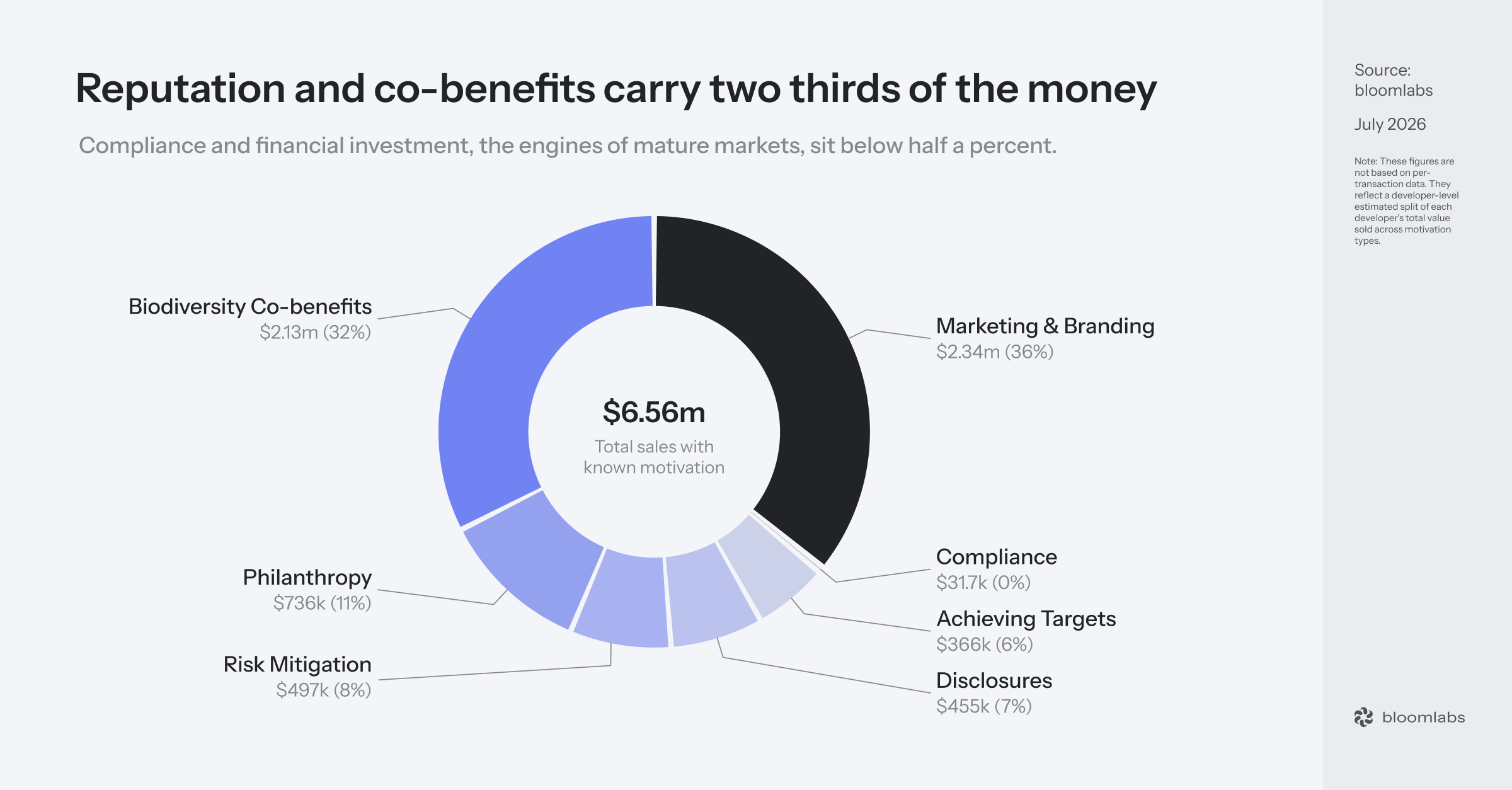
Three cautions belong next to that chart before anyone quotes it:
The co-benefits motivation is not standalone biodiversity demand yet, since it is carried by carbon, which means most of that money is buyers adding a quantified biodiversity claim to a carbon credit purchase rather than choosing biodiversity for its own sake.
The split is self-reported by the sellers, who have an obvious incentive to describe their buyers as commercially driven rather than charitable, so the marketing and branding share especially should be read with caution.
The marketing motivation is also easier to report than to observe. We can rarely point to buyers who publicly used biodiversity credits in their marketing.
The latter also has some interesting hidden parts. green account’s most surprising lesson from transacting is that companies worry more about issuing the wrong type of claim than about the impact their own business model has on nature. That fear may also be exactly why the marketing motivation stays invisible on the ground, since buyers want the reputational credit without the exposure of a public claim. We could assume they use those credits in private contexts, directly with their own clients and partners.
Moreover, the motivations that point to more structured, durable demand are no longer a rounding error. Risk mitigation, disclosures, and achieving corporate targets come to 8%, 7%, and 6% of value, roughly a fifth of the market between them, taking down the goodwill-only argument by a margin. These 3 motivations are bound to grow, with companies becoming more aware of their dependence on nature over time.
Client retention also splits this market into two different economies of demand. The two developers who report that a majority of their buyers purchase more than once, green account and Wilderlands, hold 56% of the answered sales value between them, while a second bucket of three developers with repeat rates below 25% carries another 32% in sales. So the market’s money sits in two models, a high-retention core where buyers have found an ongoing reason to return, and an economy of one-time, project-tied purchases where every sale is a fresh acquisition.
Why buyers buy, 2028
It is valuable to understand why buyers buy today, but even more valuable to anticipate why they will tomorrow. So we asked which single motivation each developer expects to grow most over the next 2 years, and we weighted the answers by each developer’s current sales, on the argument that the sellers who move the most volume might see the most of the market, and their expectations deserve more weight.
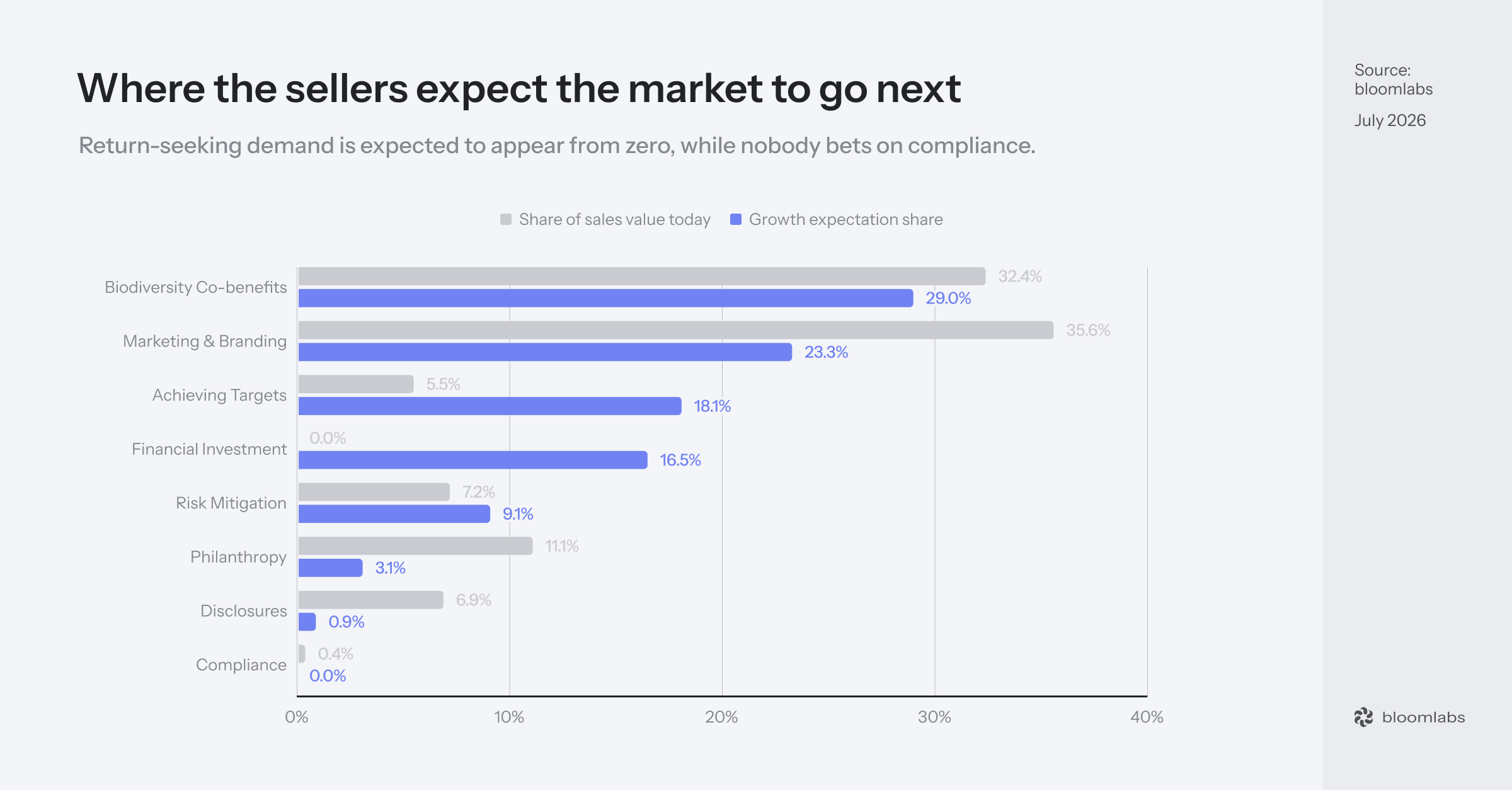
By simple count, the answers scatter across seven different motivations with no consensus at all. Weighted by sales, 3 expectations concentrate 70% of the market’s foresight. The largest seller, Wilderlands, expects biodiversity co-benefits to lead its growth, which means the developer with the most market exposure is betting on the biodiversity premium for carbon credits.
green account and Savimbo expect marketing and branding to keep leading. Ekos expects buying driven by target achievement to grow the most.
Financial investment, the motivation at a literal 0% of current sales, carries 16.5% of sales-weighted expectation, with two developers naming it as their single biggest growth driver. The return-seeking buyer does not exist in this market today and a meaningful slice of the sell side expects to meet them within two years.
The motivation nobody named is the most controversial, both for what it would take to implement and for the scale it would unlock. Not a single developer, large or small, named compliance as the motivation they expect to grow most for them, and compliance sits below half a percent of current value. The people closest to the demand do not believe regulation will be their near-term engine.
The mismatch is ironic, for 5 developers hear buyers say they are waiting for regulation while none expect compliance to power their own growth. One side of this market is waiting for something the other side has stopped counting on.
But the same finding can be the most bullish one in this article, for most of what this market has achieved so far was done without direct regulatory tailwind. That said, there are cases where some voluntary demand was built on top of legislation (e.g. in Germany, France, England, Colombia or Australia) and, so far, evidence points to regulation being the key demand driver over time, just like in every other environmental market.
We also asked whether buyers show up with motivations our taxonomy misses, and got two credible ones: voluntary accreditation schemes such as green-building star ratings, which sit between marketing and compliance and already close deals for Wilderlands, and governments buying credits as a development tool, which one developer flagged.
Public bodies are already the largest tagged buyer sector in Bloom, on the strength of a single event, four New Zealand public bodies including the Department of Conservation and two local councils purchasing $801K of Sanctuary Mountain Maungatautari credits in May 2025, more than a tenth of everything this market has ever recorded.
The playbook
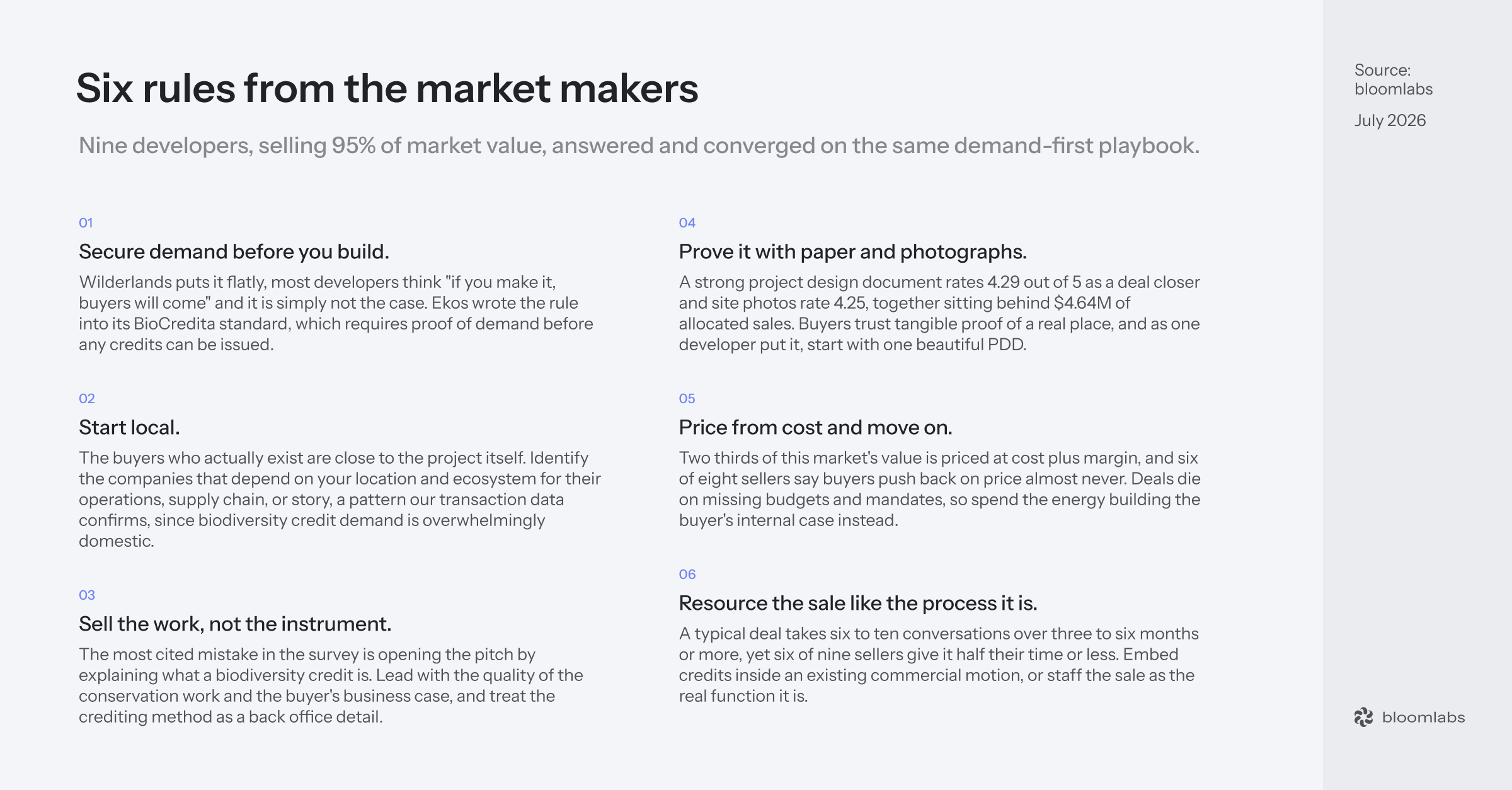
Three of our questions asked for advice: the first move for a developer with credits and no buyers, the biggest mistake each seller made, and the thing they do that others should. The answers converge so tightly across nine independent developers that they compress into 6 rules. This is the condensed version we would hand a developer entering the market this year, or one struggling to sell.
Secure the demand before you build the project, because the buyers will not simply come. Wilderlands states it plainly, saying most developers think “if you make it, buyers will come” and that “It’s simply not the case”. So start with what buyers want and need and then develop the right projects. Ekos went as far as writing the rule into its BioCredita standard, which requires developers to demonstrate demand before they may issue credits.
Start local, because the buyers who exist are near the project. The first-move advice across the sample is to identify companies in your own region that depend on your location and ecosystem for their operations, supply chain, or story, which is how Wilderlands, Cleanwave Foundation, and others frame it, and it matches what our transaction data has shown all year. Biodiversity credit demand is overwhelmingly domestic. Run the stakeholder analysis before the outreach, as green account puts it, and work out the buyers from the project’s own footprint.
Sell the conservation work and the business case, never the instrument. The most common regret in the survey is opening the pitch by explaining what a biodiversity credit is. green account’s advice is to work from the project and treat the crediting method as “a back office solution”. Cleanwave’s biggest admitted mistake was pitching the credit rather than the quality of its conservation work, and one developer’s advice to the whole market is to stop discussing units and methodologies and focus on the business cases. The credit is the receipt for the work, never the product itself.
Prove it with paper and photographs, for tangible beats formal. The two materials that close deals and carry most of allocated sales - a strong project design document and photos from the site - are also the two cheapest to produce, while audits, testimonials, or media coverage rate poorly. As one developer compressed it, the first thing a struggling seller needs is “one beautiful PDD”. And as another observed, a certificate alone is usually not enough. Buyers need something tangible and real to trust.
Price from cost, publish it, and don’t treat price as the battlefield. Two thirds of this market’s value is priced at cost plus margin, and buyers almost never push back, while every lost deal in the survey died on budget, approval, or mandate. The energy a developer spends optimizing price is energy taken from the only fight that matters, which is helping a champion inside the buying company create a funded reason to purchase.
Resource the sale like the 6-month, 8-conversation process it is. The market’s own arithmetic - half-year cycles, 6 to 10 touches, sellers at half-time or less - explains a great deal of the market’s speed by itself, and both Wilderlands and Ekos name the underlying error: treating credit sales as a side project. Either embed the credit inside a commercial motion that already exists, which is what the fastest seller in the market does with carbon, or staff and prioritize the sale as the real function it is.
One note on where this playbook comes from, for the method is the point. It exists because, for once, both halves of the picture were on the same table: every transaction this market has recorded on one side and the people behind 95% of them on the other. This is the reason we ran this questionnaire. It is what Bloom is built to provide.
What this market is made of, and what it can become
Put the whole survey together and a specific and encouraging picture of the voluntary biodiversity market appears.
Its demand was not created by the product, which the sellers themselves cannot define in one shared sentence. It was not created by policy, which motivates less than half a percent of its value and which no seller expects to drive their short-term growth. It was manufactured, deal by deal, by part-time sellers working through brokers, inbound channels, carbon relationships, and the concerns of buyers.
The developers who succeeded are the ones who accepted that reality early and utilized existing demand instead of expected future demand drivers. The inversion is the whole point: demand that was manufactured is demand that can be manufactured again by anyone willing to do the same work.
For a developer entering now, that reading can be a compass. The buyers are near your project, they respond to proof and to people rather than to instruments and dashboards, they will not argue about your price, and they will vanish on budget season unless someone inside their company owns a reason to buy.
The work of selling biodiversity credits is the work of manufacturing that reason, and the nine organizations in this article have collectively spent four years learning how.
Many doors opened from this survey were made possible by the 9 market makers. We thank green account, Wilderlands, Ekos, Savimbo, Seatrees, Cleanwave Foundation, and the other developers who preferred anonymity for their time in answering our questions.
Pragmatism, real data, and objective analysis have always been our core method, and they lead us to push for the truth. Now that we know how biodiversity credits are sold, we are ready to support developers and other market stakeholders in scaling the market.
