


Hi, Martin from bloomlabs here.
Welcome to our monthly market overview of the Voluntary Biodiversity Market (VBM) and other related nature finance developments, built on data from our intelligence platform Bloom and the market updates that matter.
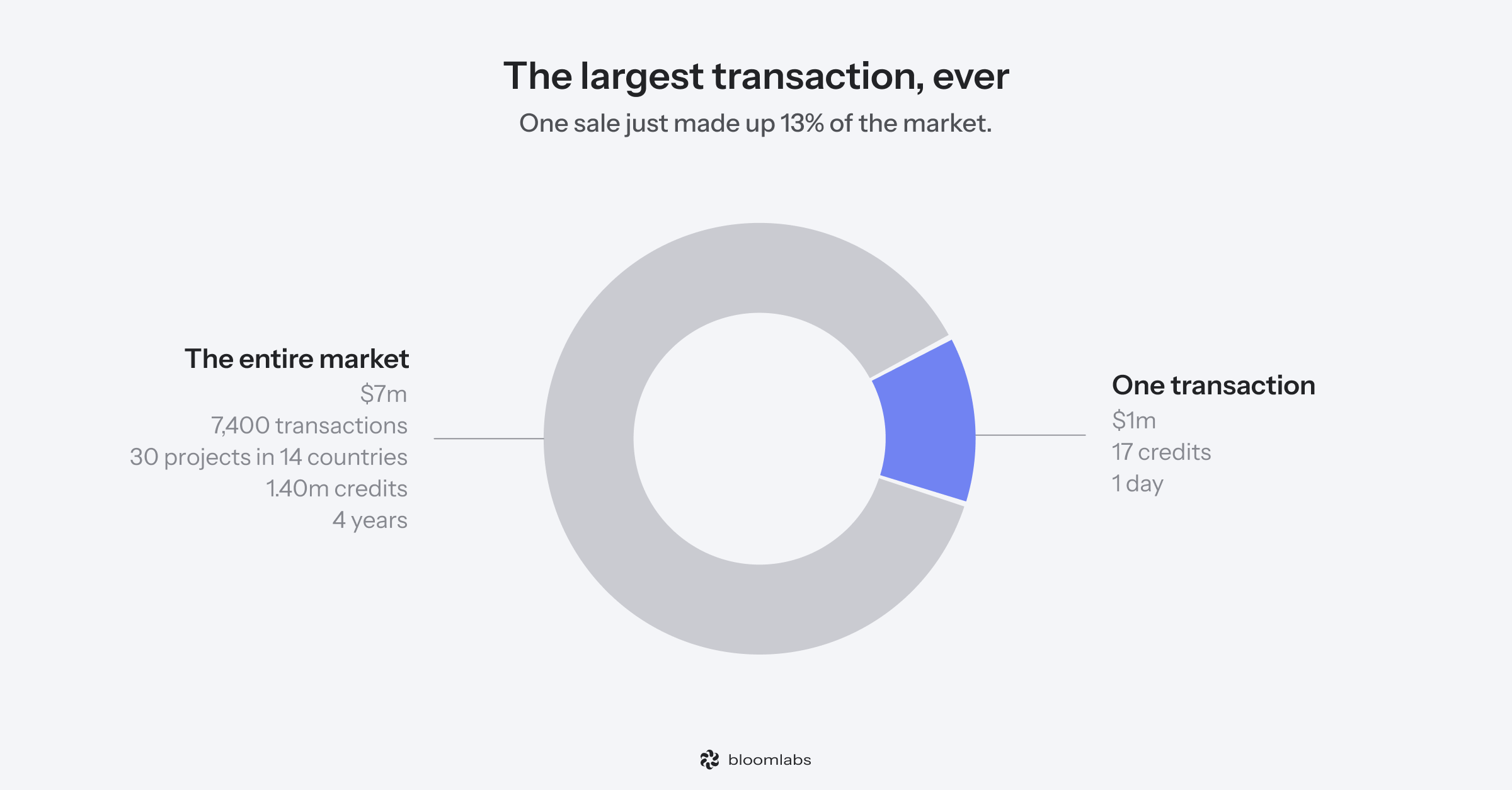
On October 23, CDC Biodiversité sold 17 units of Tourbières Tuile Pradeaux, its fourth France Crédits Biodiversité site, for $1.03m, a few days after the state validated the project. It is the largest biodiversity credit transaction we have ever recorded, worth 12.7% of everything this market has sold since 2022 and more than the whole market from February to September. We know the price, the volume and the seller. We do not know who bought, and neither does anyone else outside CDC Biodiversité.
On the policy side, COP17 closed in Yerevan with credits confirmed as a means of meeting Target 19 and twenty governments joining a forum on high-integrity credits, Indonesia said it wants its market to be mandatory, Australia’s Nature Repair Market reached four projects, Brazil took its credits to Yerevan on two tracks, and ten countries moved up our Countries ladder in a single month.
Learn more and explore the data on Bloom.
The biggest deal in the market’s history
CDC Biodiversité informed us of the biggest single transaction in the history of the voluntary biodiversity market - a monumental achievement. When we asked CDC Biodiversité for buyer’s information, the questions went to the executive committee, and it decided that nothing could be said until the terms of communication have been settled with the buyer, which will take at least another month.
By value, 63% of all corporate purchases ever made are anonymous. Most developers publish a price and a volume, and stop there. After four years and more than $8m of sales, the market still cannot agree on a common transparency approach.
Without buyer data, other potential buyers cannot see that their peers are moving on credits, investors cannot properly size the demand, developers cannot target their outreach, and the people designing national schemes work with isolated cases. Each anonymous transaction removes critical data that everyone could benefit from.
A state-backed scheme carries a particular responsibility here. France Crédits Biodiversité exists to show that a public framework can create a credible market for nature. Even if the buyer wanted to stay anonymous - for reasons we can understand - there is still a lot of value in providing buyer analytical data (its sector, size, country and reason for buying). The commercial sensitivity for that is much lower, and it is exactly what the market is missing.
In our experience, the best way to move this market forward is through building trust. And transparency is one of the best ways to build it. That is why we believe that every developer, registry, and scheme operator who closes a corporate sale should publish, at minimum, the buyer’s sector, size band, and country, plus the stated purpose of the purchase. The market will not be taken seriously if its largest transactions are opaque.
Building on transparency
In November 2024, La Poste and La Banque Postale bought $159k of credits from the same CDC Biodiversité, and that purchase followed a clear path: a first carbon retirement in 2012, a nature program with CDC in 2015, a biodiversity policy in 2021, a stake in a biodiversity fund in 2022, carbon retirements that turned mostly nature-based in 2023, then the credits.
A path that visible for one buyer can be traced for every company. So that is what we did. Last week we released Corporates, the seventh Bloom dataset, built to answer one question: how ready is this company to buy biodiversity credits?
Each profile answers eight questions, from what the company has committed to and what it has already retired to where its nature money goes and how to reach it, and closes with a Buyer Readiness score built from six parts: purchases, nature spend, commitments, disclosure, momentum and sector.
The market in October
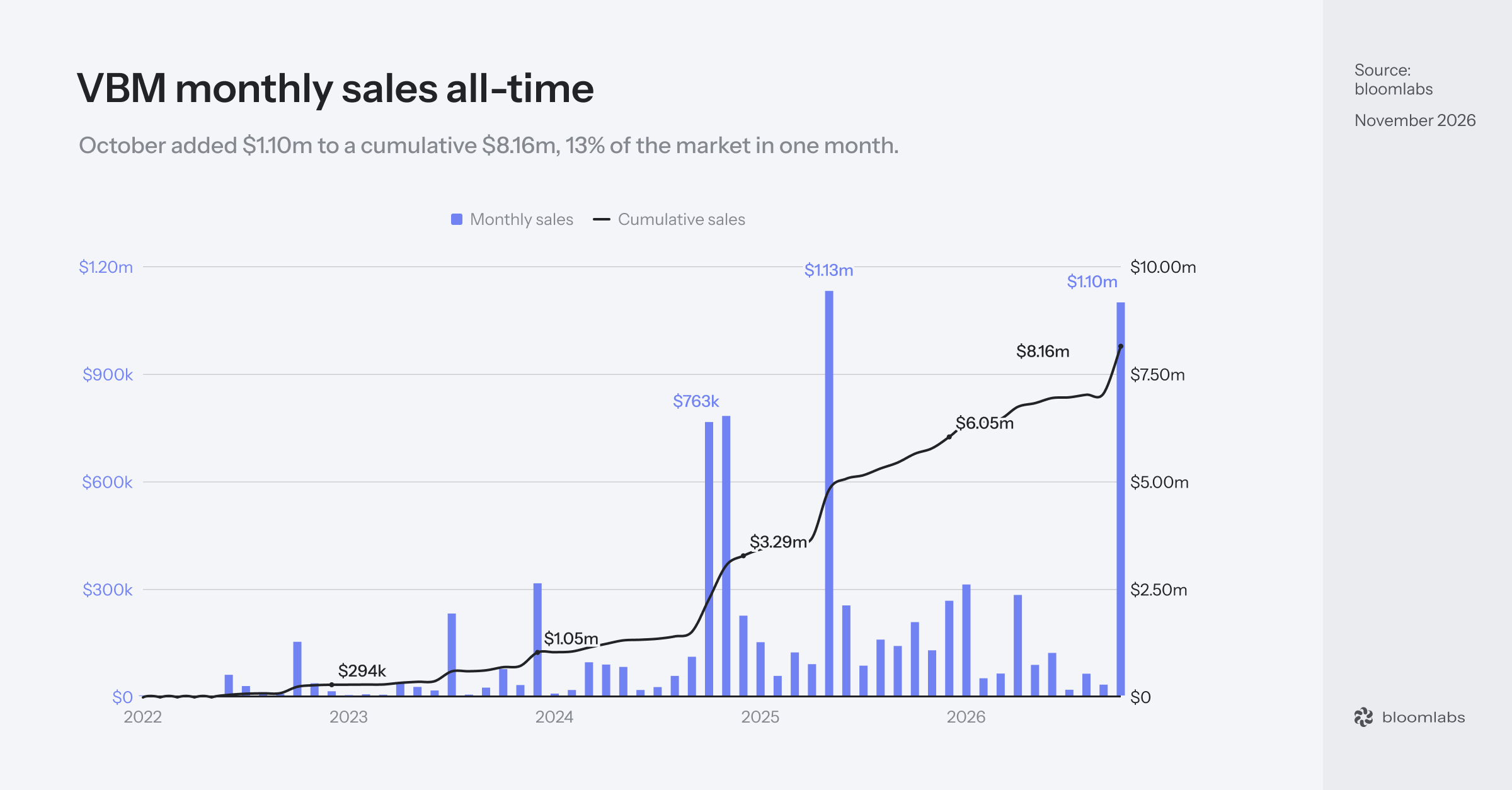
The voluntary biodiversity market has now sold $8.16m worth of credits since the first recorded sale in early 2022. October added $1.10m, which makes it the second-largest month we have ever recorded, behind May 2025 ($1.13m, when three New Zealand public bodies bought Sanctuary Mountain Maungatautari credits in one day) and ahead of November 2024 ($780k).
Ten months in, 2026 stands at $2.51m, against $2.76m for the whole of 2025, so the year will set a new record if November and December together match an ordinary month.
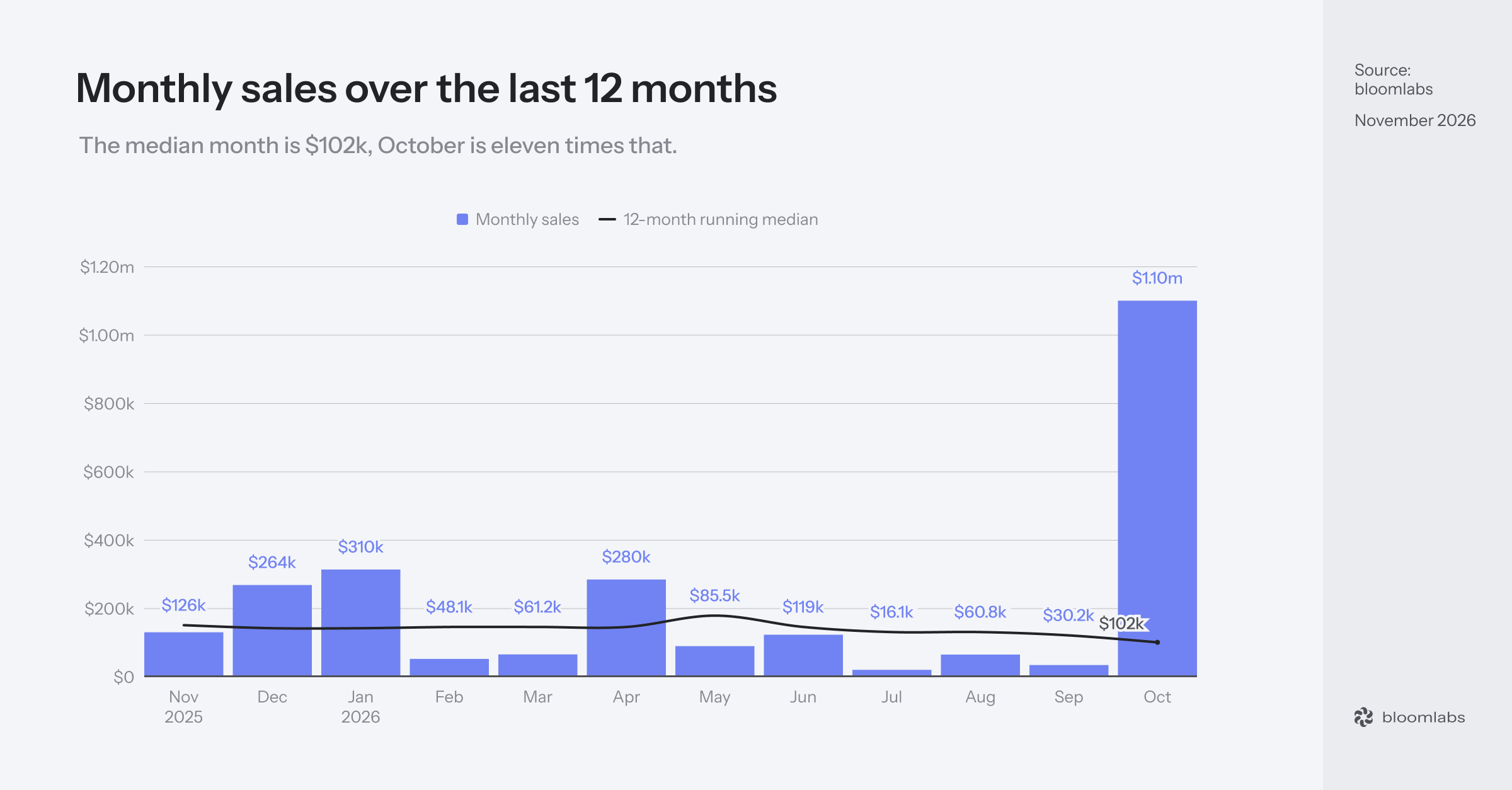
October 2026 recorded $1.10m in sales across 57 transactions, up from September’s $30k. The earlier months of the year came in at $310k in January, $48k in February, $61k in March, $280k in April, $85k in May, $119k in June, $16k in July, $61k in August and $30k in September. The median month since 2024 is $93k.
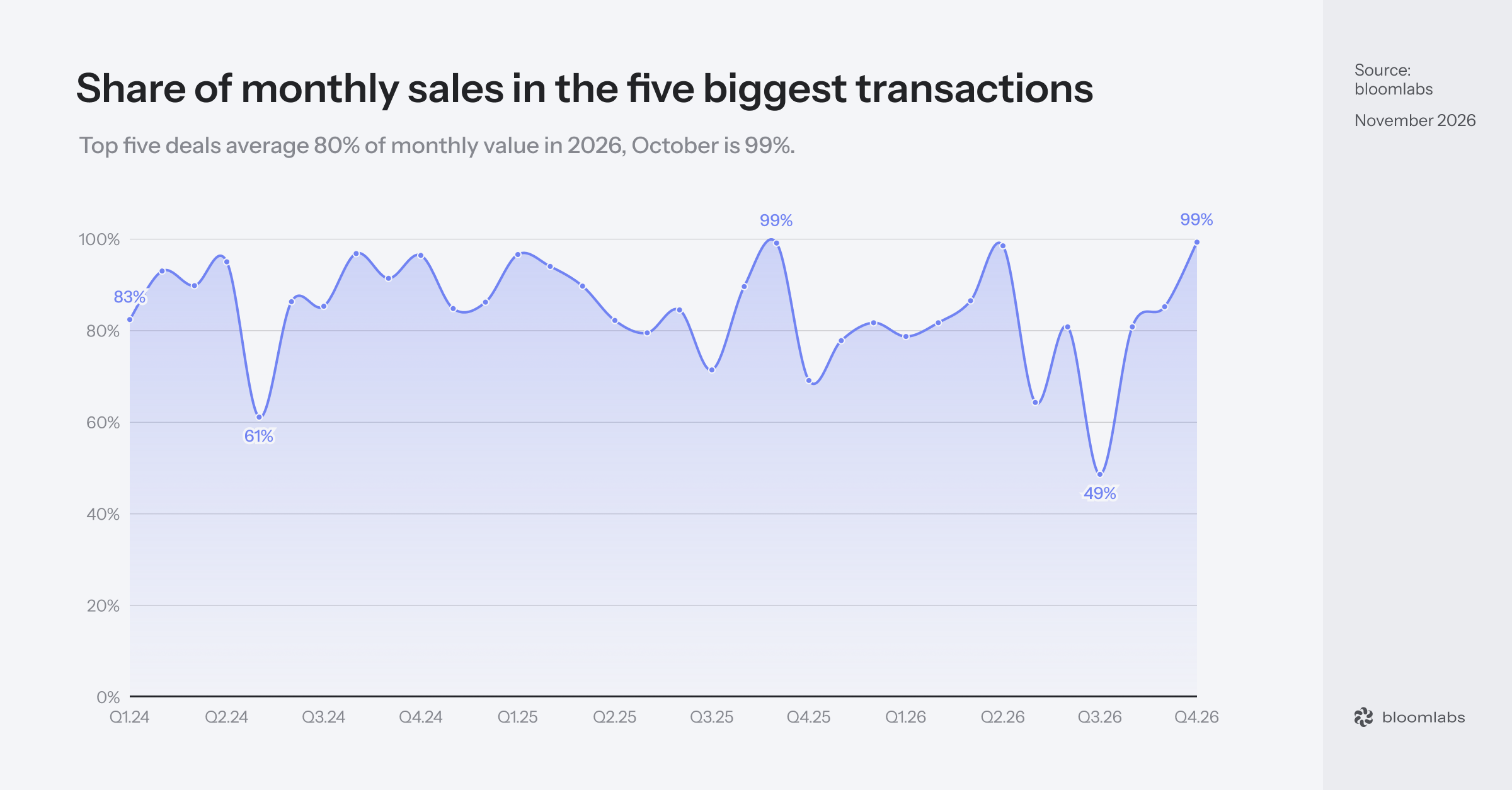
The five largest transactions made up 99.2% of October’s value, the highest concentration we have measured in any month, and one deal made up 94.1% on its own. Behind the French sale, the next four are an anonymous 5,270-unit purchase on Coorong Lakes at $27,562 and the three German October aggregates from green account, Sumpfwald at $11,523, Ippenburg at $10,032 and Moorprojekt at $6,396.
October has been a strong month in most years we track, at $150k in 2022, $74k in 2023, $763k in 2024 and $205k in 2025. The 2024 figure came from Air New Zealand‘s $600k purchase of Te Kautuku credits from Toha Network, which held the record for a single transaction until this month. Two of the four largest Octobers, and the two largest transactions in the market’s history, came from a single buyer each.
Projects
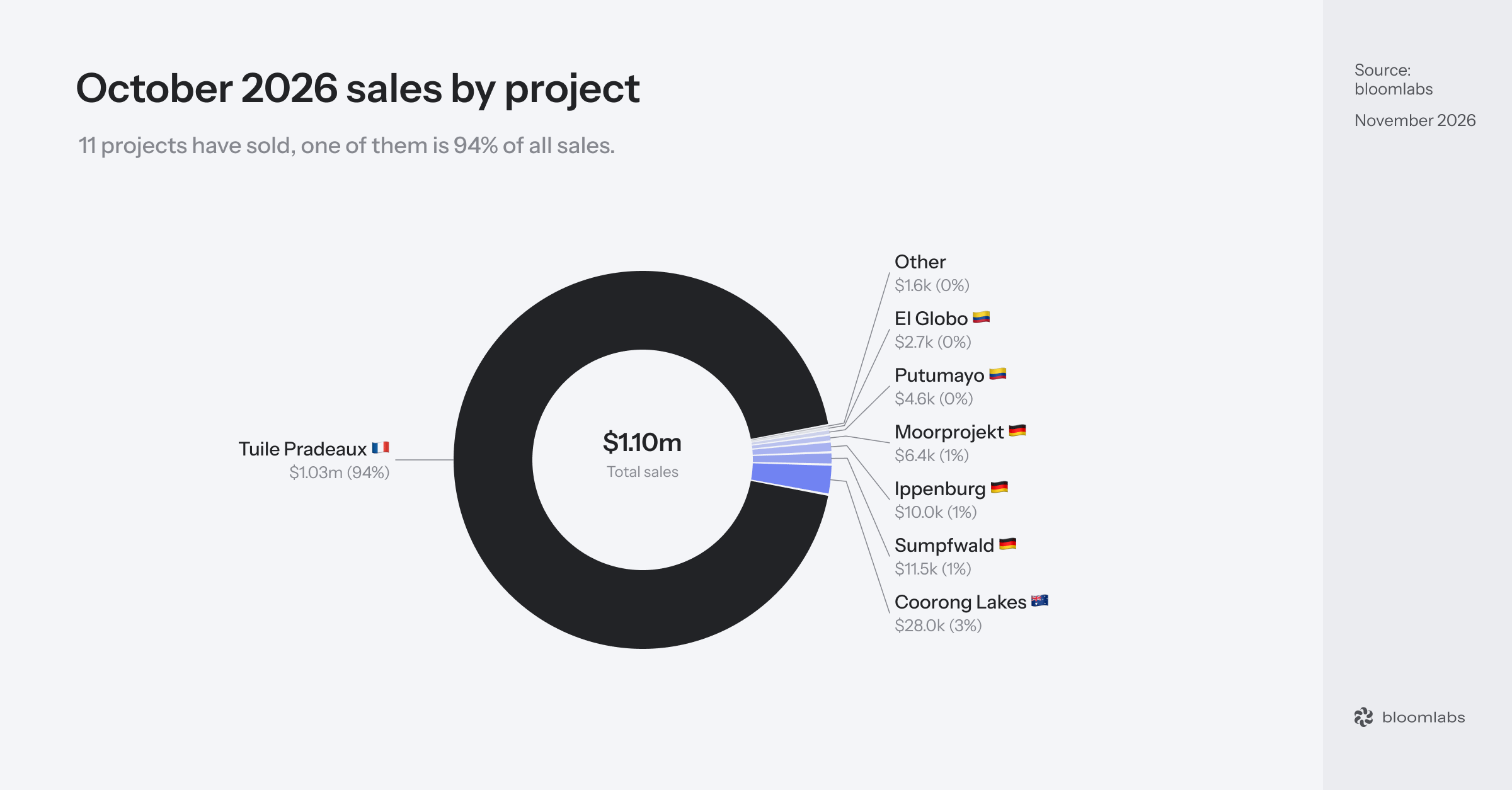
11 projects sold in October across 5 countries, one more than September. Four projects that sold in September did not report an October sale (Aguadulce, Marereni, Boothby Wildland and Sanctuary Mountain Maungatautari), and five others came in: the three German sites, Halnaker Hill in England, and Tourbières Tuile Pradeaux, which had never sold before.
Tourbières Tuile Pradeaux is two peatlands at Saint-Anthème in the Puy-de-Dôme, 56.5 hectares managed by CDC Biodiversité and validated by the French state on October 19 under the national scheme, with rewetting work planned from 2027. 17 units sold at the site’s opening at $60,837 each. France is now the third-largest country in our data by sales value at $1.80m, within $31k of New Zealand and $196k of Australia.
Coorong Lakes, the South Australian wetland sold by Wilderlands, recorded $28,038 across 11 transactions, 2.6% of the month, almost all of it in one anonymous business purchase of 5,270 units at $27,562 on October 16. The other three Wilderlands sites, Alleena, Crowes Lookout and Budgerum, added $702 across 28 small retail sales.
The three German projects sold through green account reported $27,951 for the month: Sumpfwald sold 2,095 Eco-Points at $5.50 each ($11,523), Ippenburg 1,216 at $8.25 ($10,032), and Moorprojekt 1,599 at $4.00 ($6,396). It is green account’s first reported month since May, and it brings the German voluntary channel to $508k for 2026.
Putumayo, Savimbo‘s Colombian project, recorded $4,560 across 9 transactions, its best month of the year, carried by two business purchases of 120 credits ($3,420) and 66 credits ($1,000). Seven consumer purchases added $140.
El Globo, Terrasos‘s habitat bank in Antioquia, recorded $2,706 across 4 business purchases at $36.57 a credit. Two of them were marketing actions paid by Terrasos itself, 38 credits allocated to LOGYCA, the Bogotá logistics association ($1,390), and 10 to the consultancy Jaime Arteaga y Asociados ($366). FUNDACION CORFICOLOMBIANA, the Grupo Aval foundation, bought 25 credits ($914), its second El Globo purchase after 37 credits in October 2025, and Alpes Travel took one credit under an offtake agreement. Terrasos stands at $22,493 across 68 transactions for 2026.
Halnaker Hill, the South Downs National Park Authority site sold through Earthly, recorded its second sale ever, 7 credits for $886 to Rickshaw Travel on October 27. Earthly’s English projects are at $10,278 for 2026, with August’s $5,082 still the high point.
Buyers
B2B buyers accounted for 99.9% of October’s value across 13 transactions, while consumer buyers made up $973 across 44 transactions, all of them retail sales on the four Wilderlands sites and Putumayo. This is quite typical, as we have not yet seen any successful B2C systems yet.
Rickshaw Travel, a Brighton tour operator, bought 7 Halnaker Hill credits for $886. It is the company’s third purchase through Earthly, after 17 Iford credits in April 2025 ($4,505) and 4 more in July 2026 ($1,060), and its first on a second project. The four El Globo buyers put their names on their purchases too, so five named buyers account for $3,592, 0.3% of the month. Every other buyer is anonymous, including the one behind the largest transaction in the market’s history. In September, named buyers were 86% of value because Kiwibank put its name on its purchase. One month later the share is close to zero because one buyer did not.
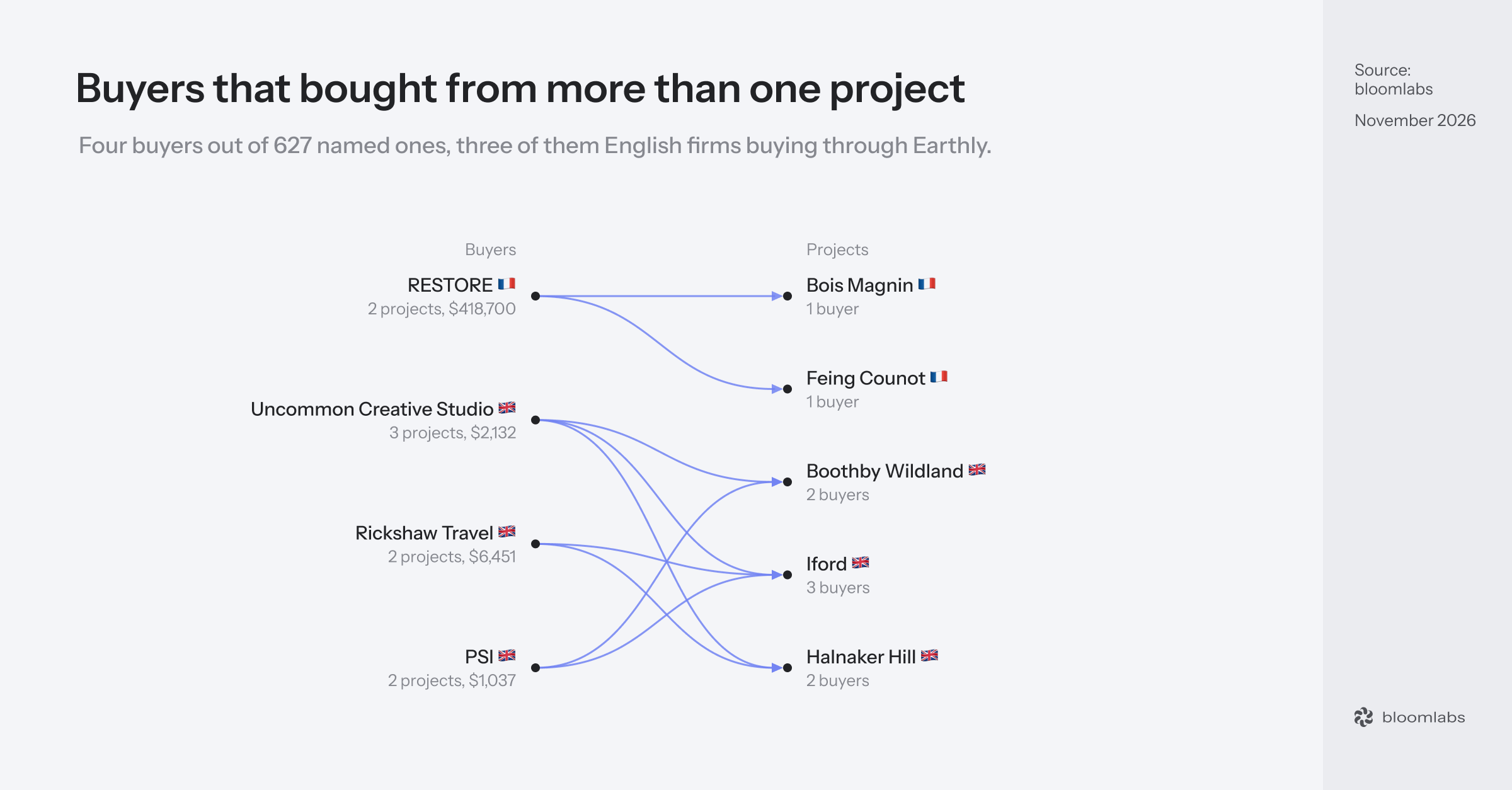
Rickshaw Travel’s move from Iford to Halnaker Hill puts it in a very small club: of the 627 named buyers in our data, four have bought from more than one project.
Uncommon Creative Studio, a London agency, is the only one at three (Boothby Wildland, Iford and Halnaker Hill, $2,132 in total). PSI, another English firm, bought Iford and Boothby credits a year apart. RESTORE, a French investment vehicle, bought Bois Magnin and Feing Counot units on the same day in November 2024 for $418,700, which is 98% of the value in this group.
RESTORE is a sister company of Le Printemps des Terres, the developer of the two French projects, so it’s not surprising that it bought from those. But the reason why this group is largely made of UK-based entities is still a mystery. It could be explained by England’s Biodiversity Net Gain national system influence on local buyers and their familiarity with credits.
Buying again is far more common than buying elsewhere. 44 of the 627 named buyers have bought more than once, and they carry $957k, 32% of all named value. The habit is strongest in Colombia, where Cortineros Líder has bought El Globo credits 24 times over 22 months and Autocolombiana, Casa Legado and Colombia Travel Operator follow the same pattern, and in New Zealand, where APL Window Solutions has made four Sanctuary Mountain purchases worth $170k.
If you are exploring whether and how biodiversity credits fit into your organization’s strategy, we would love to talk, so reach out at hello@bloomlabs.earth.
News
Featured - CBD COP17
The UN event, considered the most important event for biodiversity happening every 2 years, ran in Yerevan from October 19 to 30 and found the world behind on 22 of the 23 targets for 2030. Biodiversity credits and offsets were confirmed as an accepted means of meeting Target 19.
On October 27 the European Commission, France and Peru launched the Friends of Credits for Nature and Biodiversity, a government forum on high-integrity nature credits. Finland, the UK, Indonesia, Japan, Belgium, Chile, Canada, Portugal, Czechia, Lithuania, Thailand, Australia, the Netherlands, Spain, New Zealand and Luxembourg joined or spoke, with Armenia, Brazil and Estonia on the Commission’s list. Next step is a non-binding joint statement.
The IAPB opened three exposure drafts on October 25, Additionality, Credit Lifecycle, and Inclusion and Equity, open to January 8, 2027, and released an insurance working paper with AXA Climate. The Biodiversity Credit Alliance launched the pilot of its assessment framework, built with Accounting for Nature and CAF, which scores a scheme against the High-Level Principles, and published two papers on buyer motivations and greenwashing risk. Accounting for Nature opened a consultation on an Attribution Protocol with Oxford, to February 26, 2027. More than 70 organizations signed a Call to Action on High-Integrity Nature Markets asking governments for rules, verification and safeguards.
National news
Indonesia wants its market to be mandatory
On October 8 the environment ministry said it has formed a task force and is drafting a ministerial regulation as the framework for biodiversity credits. At COP17 it presented credits as results-based finance against a gap of $7.1 to 9.8 billion a year, and an official told Carbon Pulse that Indonesia aims for a mandatory market requiring companies to finance restoration, with regulatory steps early next year. Forest Watch Indonesia, Walhi and MADANI answered that a scheme that ignores extractive industries is futile.
A mandatory market in a country of 280 million people with nickel, palm oil and pulp obligations could be one of the largest compliance biodiversity credits systems.
Australia’s Nature Repair Market reached four projects
The Clean Energy Regulator registered the third and fourth Nature Repair Market projects in October: Nortongong, 968 hectares near Coonamble registered on October 2 and stacked with ACCU abatement, and Silva Capital‘s Cooplacurripa 2, 1,230 hectares in north-east New South Wales registered on October 9, next to Cooplacurripa 1 and Karinya Downs, the first two.
10 projects are likely by year end, with ACCU buyers the likeliest purchasers, and certificates are expected to become offset-eligible on December 1.
Brazil took its credits to Yerevan on two tracks
Brazil’s industry confederation CNI, Gaia Silva Gaede and Instituto LIFE launched a policy brief at COP17 on October 22 with integrity rules for a Brazilian market, defining credits as nature-positive gains and ruling offsets out (although we don’t know if they meant it in the voluntary and/or regulatory context). Rio de Janeiro became the first brazilian state with a biodiversity strategy, launched in Yerevan on October 19 with 22 targets and a BIOFIN finance plan to come.
An industry body asking for a credit market that rules offsets out is rare. The environmental reserve quota is the link to watch: Brazil’s forest service asked at Terrasos’s offsets forum in September for guarantees, insurance and buffers before the quotas could connect to credit markets. Brazil has 27 projects on Bloom, the most outside Australia.
The ladder moves
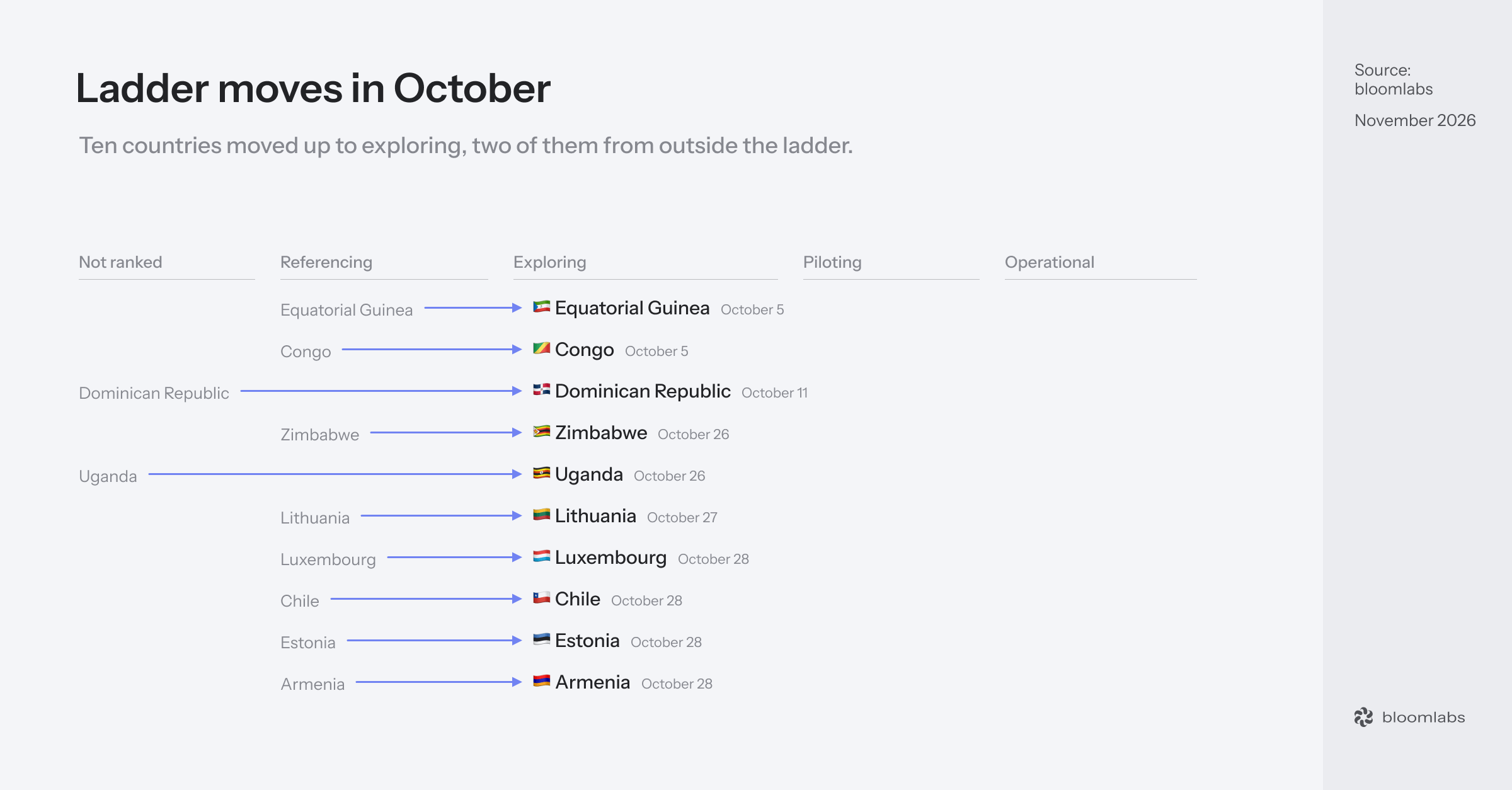
Ten countries changed rung on our Countries ladder in October, all of them up to exploring.
Equatorial Guinea on October 5, with a 7th National Report that names biodiversity credits three times as its own route to resource mobilization.
Congo the same day, where the BIODEV2030 program funded by the French development agency and run with WWF has analyzed biodiversity certificates and picked a pilot territory in the TRIDOM landscape.
The Dominican Republic on October 11, with a $1.96 million Inter-American Development Bank cooperation designed to create a voluntary credit market on the base of its 2018 payments-for-environmental-services law.
Zimbabwe and Uganda on October 26, both through their BIOFIN finance plans: Zimbabwe lists offsets, credits and biobanking as a finance solution to develop, and Uganda’s plan commits to a national mitigation banking system carrying voluntary and regulated credits.
Lithuania on October 27, after its vice minister said at the Friends launch that credit schemes could complement Natura 2000, backed by the $15.3 million LIFE BIO-CRED Baltic project.
Luxembourg, Chile, Estonia and Armenia on October 28, by joining the Friends group.
Market news
A $770 million port will meet its lender’s biodiversity condition with Tebu units
Puerto Antioquia, a $770 million port in the Gulf of Urabá, will meet the IFC Performance Standard 6 (PS6) condition in its loans from BID Invest, Davivienda, Bancóldex and FDN with Tebu units from Terrasos, about 1% of the deal, a 30-year net gain on more than 600 hectares of critical habitat, Mariana Sarmiento announced on COP17’s Finance Day. Terrasos calls it the first infrastructure project to meet a lender’s biodiversity requirement with verifiable units.
PS6 binds every development bank and most lenders to emerging-market infrastructure, and until now it was met with the borrower’s own offset works. A unit bought from a habitat bank turns a loan covenant into credit demand, at around 30 times Terrasos’s best year in Colombia in our data, and a covenant cannot be dropped when a budget tightens.
The TNFD updated its guidance and adopted the State of Nature metrics
The TNFD’s purchase of 110 Tebu units from Terrasos, which we featured in October, stays the reference purchase for disclosure-driven demand. On October 15 the TNFD published updated guidance as adoption passed $26 trillion in assets, aligned with SBTN’s targets 2.0 and the Nature Positive Initiative’s State of Nature metrics: four indicators (ecosystem extent and condition, species extinction risk and populations) from 500 experts and a test with 29 companies in 23 countries, now built into TNFD and SBTN.
This increasing harmonization in the state of nature metrics (and especially ecosystem condition) is a very welcome sign for the biodiversity credit market and the reporting companies. The EU Commission is exploring ecosystem condition as the key unit of account for nature credits in their roadmap. If that materializes, a direct link would be established between the metrics corporates report on and the metrics used to issue nature credits. That might set a precedent where corporates that follow TNFD, CSRD and other frameworks can also justify purchasing biodiversity credits and reporting them rigorously. In other words, nature impact measurement is slowly harmonizing.
The IAPB published a way to price a credit against direct investment
The IAPB, The Landbanking Group and the WEF released Return on Nature Credits, an open methodology and tool that links a change in land management to a company’s cash flows and enterprise value, and compares direct investment with buying nature credits across data centers, agriculture, forestry, nuclear and hydropower. NTT DATA, Natura, Ritter Sport, EDF and Manulife tested it, and Deutsche Bank, Storebrand and Danske Bank welcomed it in Yerevan. Further testing and proof is necessary but this is one step forward to connecting nature credits to their related monetary value for corporate buyers.
Cercarbono launched its Nature Integrity Methodology at COP31
On November 12, at the IETA Business Pavilion in Antalya, Cercarbono launched the final version of the Nature Integrity Methodology for Biodiversity Conservation and Restoration, written by Biodiversity Intelligence and the Environmental Markets Fairness Foundation (EMFF), after a public consultation in September and October. Cercarbono says the methodology is built for corporate nature claims and for government-led schemes.
This is the second methodology under Cercarbono’s Biodiversity Certification Programme. The programme is the standard: it sets the rules and defines the credit (one hectare for one month, weighted by an integrity score from 0 to 1). Each methodology defines how that integrity is measured. The first, Savimbo’s Indicator Species Biodiversity Methodology, covers conservation only, scores integrity from sightings of indicator species, and is the one behind the Putumayo credits.
The new methodology issues the same credit and measures integrity differently: an Ecosystem Condition Score that combines species composition and habitat structure against a reference condition - a more common approach used by other known methodologies like Verra’s SD VISta Nature Framework, Wallacea Trust or Plan Vivo’s PV Nature. It also widens the programme. Restoration is now covered, with credits for the gain in condition since the start of the project, issued as a separate class from conservation credits. Freshwater and marine ecosystems are eligible alongside land.
Recommended reads
Foundations for high-integrity credit use, BCA discussion papers 1 and 2
The Biodiversity Credit Alliance‘s demand-side papers: a taxonomy of why companies engage (compliance, risk and resilience, value creation, reputation) and a map of greenwashing risk in credit claims.
Our motivation data on Bloom puts marketing and co-benefits at about a third each. It is always interesting to compare what project developers are seeing on the ground with what policymakers publish and recommend.
Insurance and Nature Markets: De-risking for Scale, IAPB and AXA Climate
How insurers and insurance mechanisms can de-risk nature credit markets, presented at COP17 and listed on the IAPB publications page. Read it knowing the insurers see themselves de-risking projects, and no further.
Announcements
Vanga Seagrass PDD, public consultation until November 26
The Vanga Seagrass Project PDD is in public consultation until November 26. The project protects 225 hectares of seagrass in Vanga Bay, Kenya, coordinated by the Association for Coastal Ecosystem Services and bundled with the Vanga Blue Forest carbon project, and expects about 4,050 units a year, first issuance in 2028, more than 60% of revenue to the community.
Amelia Allerton, ACES’s biodiversity lead, shared the PDD for reviews from anyone working on marine projects or certification: biodiversity@planvivo.org, consultation page on planvivo.org.
EU survey on demand for nature credits, open until January 4, 2027
The European Commission’s DG ENV opened a survey on demand for nature credits on November 16, run by BioInt as part of the EU Nature Credits Roadmap. It is aimed at current and potential buyers, including companies that have never bought a credit, and tries to quantify how the market could develop over the next ten years and which policy measures would encourage demand. The survey takes about 12 minutes, responses are analyzed in aggregate only, and it closes on January 4, 2027.
Upcoming events
Nature-based solutions, restoration and finance, November 18, COP31 side event, livestreamed
The European Commission’s side event at UNFCCC COP31 follows the launch of the Friends of Credits for Nature and Biodiversity at COP17. Representatives of the partner countries and of the international initiatives will compare practical experience and cooperation options at the intersection of biodiversity, climate and restoration. The event will be livestreamed.
Expert Group on Nature Credits, fifth meeting, December 7 and 8, Brussels and online
The Commission’s expert group meets for the fifth time, a full hybrid day on December 7 at the Commission’s Borschette building in Brussels on methodologies and metrics, governance and integrity, market readiness and finance, and policy coherence, followed by an online morning on December 8 on international cooperation. Attendance is for members and observers; the agenda and documents are circulated by the DG ENV nature credits team, and the minutes of the October meeting are due to be approved there.
Webinars, Accounting for Nature Attribution Protocol, December 3 and 8, online
Two briefing sessions on the draft Attribution Protocol written with the University of Oxford, December 3 at 14:00 GMT for Europe and the Americas and December 8 at 14:00 AEST for Asia-Pacific. The consultation itself runs to February 26, 2027.
Westminster Forum, Natural Capital in England, January 14, online
A morning policy conference on nature markets and integrity, voluntary and compliance markets, BSI Flex 700, net gain, the Nature Restoration Fund and private finance for nature recovery.
World Economic Forum Annual Meeting, January 18 to 22, Davos, Switzerland
The usual January venue for nature finance announcements. The WEF co-authored the High-Level Principles with the BCA and the IAPB, whose exposure drafts close for comment ten days before the meeting.