


In November 2024, La Poste and its bank La Banque Postale bought $159k of biodiversity credits.
La Poste‘s first carbon credit retirement dates from 2012. In 2015, it launched “Climat + Territoires” with CDC Biodiversité, the same developer it would buy from nine years later. In 2019 it retired its first nature-based carbon credit.
In 2021 it wrote a biodiversity policy and La Banque Postale signed the Finance for Biodiversity Pledge. In 2022 the bank put €120m into a biodiversity fund. In 2023 the group’s carbon retirements flipped from mostly technology-based to mostly nature-based, 1.7 Mt of forests and land in one year.
Then, in 2024, the biodiversity credits. A TNFD report followed in 2025 and SBTN participation in 2026.
We identified a clear path leading to this purchase, and we thought we could build a tool to predict when other companies would go down the same road.
Today we are releasing Corporates, the 7th addition to Bloom‘s datasets, built to answer one question: Is this company ready to buy biodiversity credits?
What we have built
3 months ago, we released our study “How to sell a biodiversity credit?“, conducted on the most successful developers today. They shared insights, advice, and methods to improve the sales process in this market. What still lacked was the exact companies to reach out to. We had our Organizations dataset, compiling all the voluntary biodiversity credit buyers, but we knew we could go way deeper.
So we built a tool to help credit sellers research and target the prospective buyers better. This is the main job. And while it is not the only one (investors and consultants, among others, might save significant amounts of time with it), it guided the development of this new dataset.
What has Nestlé committed to, what has Microsoft bought, is Volkswagen doing more or less than last year? Those critical data points are lost across sustainability reports, frameworks, press releases and carbon registries. Now, they all sit together in one corporate profile.
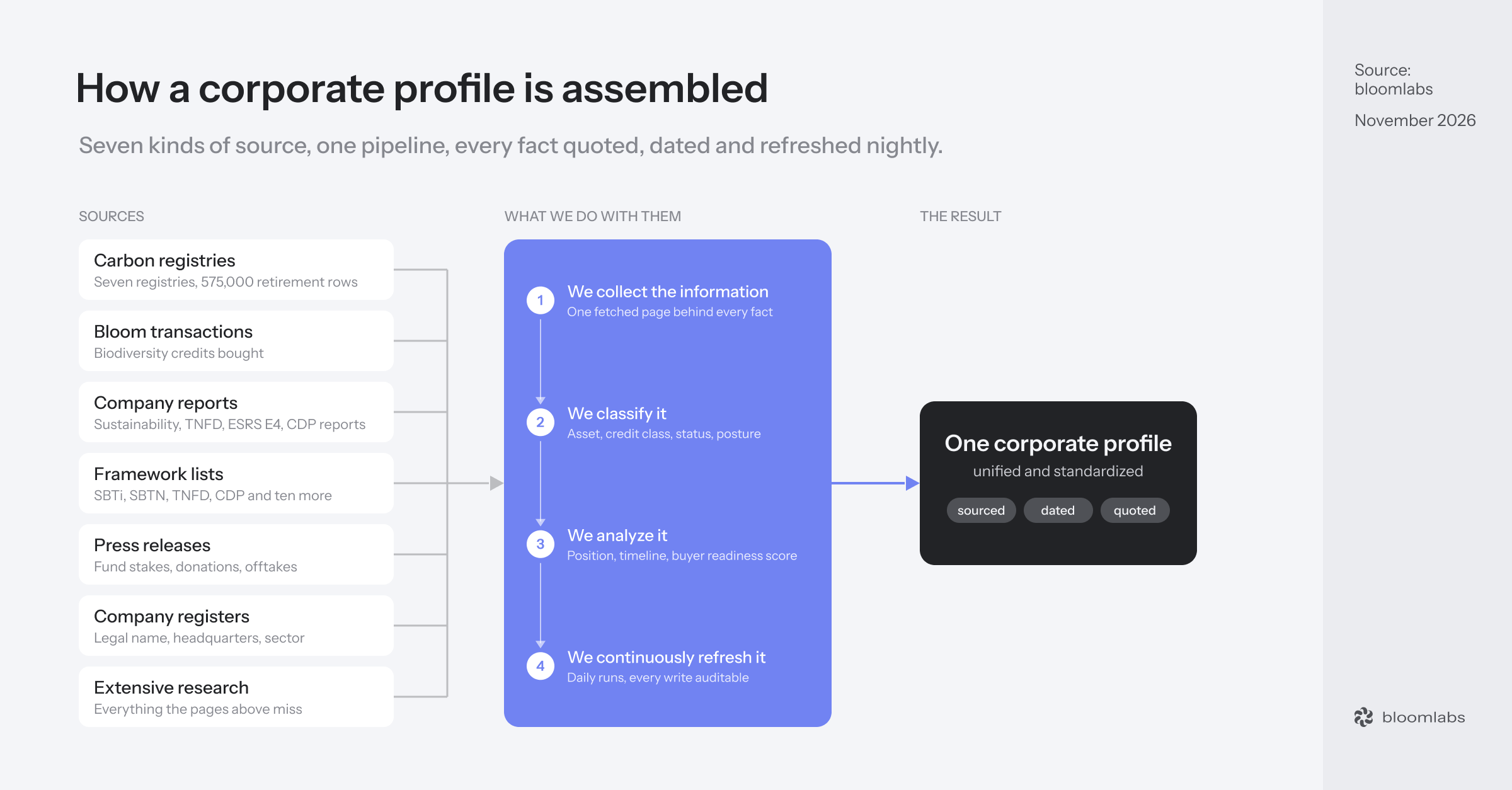
A company profile answers eight questions:
Who is the company?
What has it committed to?
How does it publicly communicate about nature markets?
What has it already retired?
Where do its funds for nature go?
What has it done, and when?
How can we contact it?
How close is it to buying a biodiversity credit?
We scoped this beta version of the dataset to the 100 largest buyers of voluntary carbon credits and the 53 companies with over 50 employees that have bought biodiversity credits. Microsoft and La Poste are the only corporates in both lists.
The key sections and early insights
Frameworks
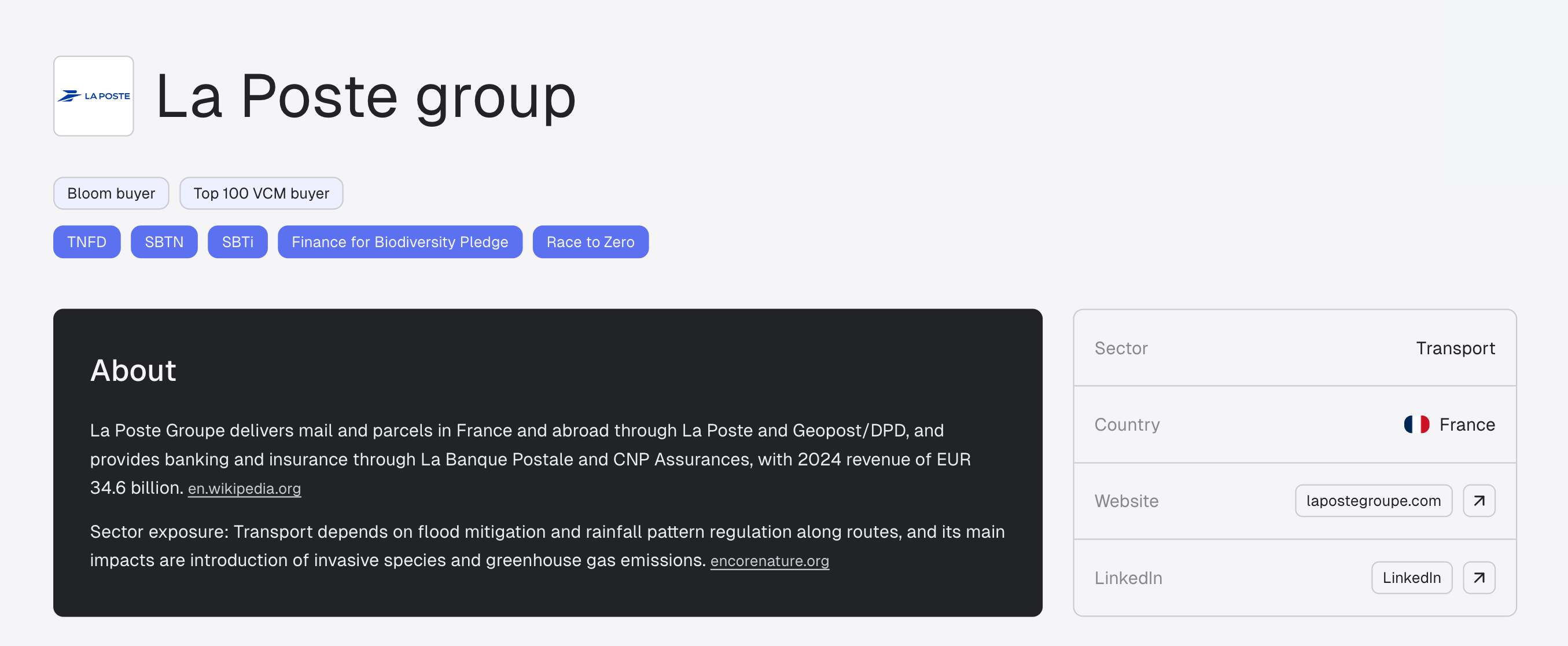
We selected 14 major frameworks that a corporate can engage in. 65 of the 151 companies hold at least one membership. SBTi leads with 49, Race to Zero 22, TNFD 19, SBTN 14, Business for Nature 11, LEAF 10, etc... Eight companies have withdrawn from SBTi. The nature-specific frameworks, TNFD and SBTN, are the most important for our tool. La Poste reached them last, in 2025 and 2026, after it had already bought biodiversity credits.
Buyer posture
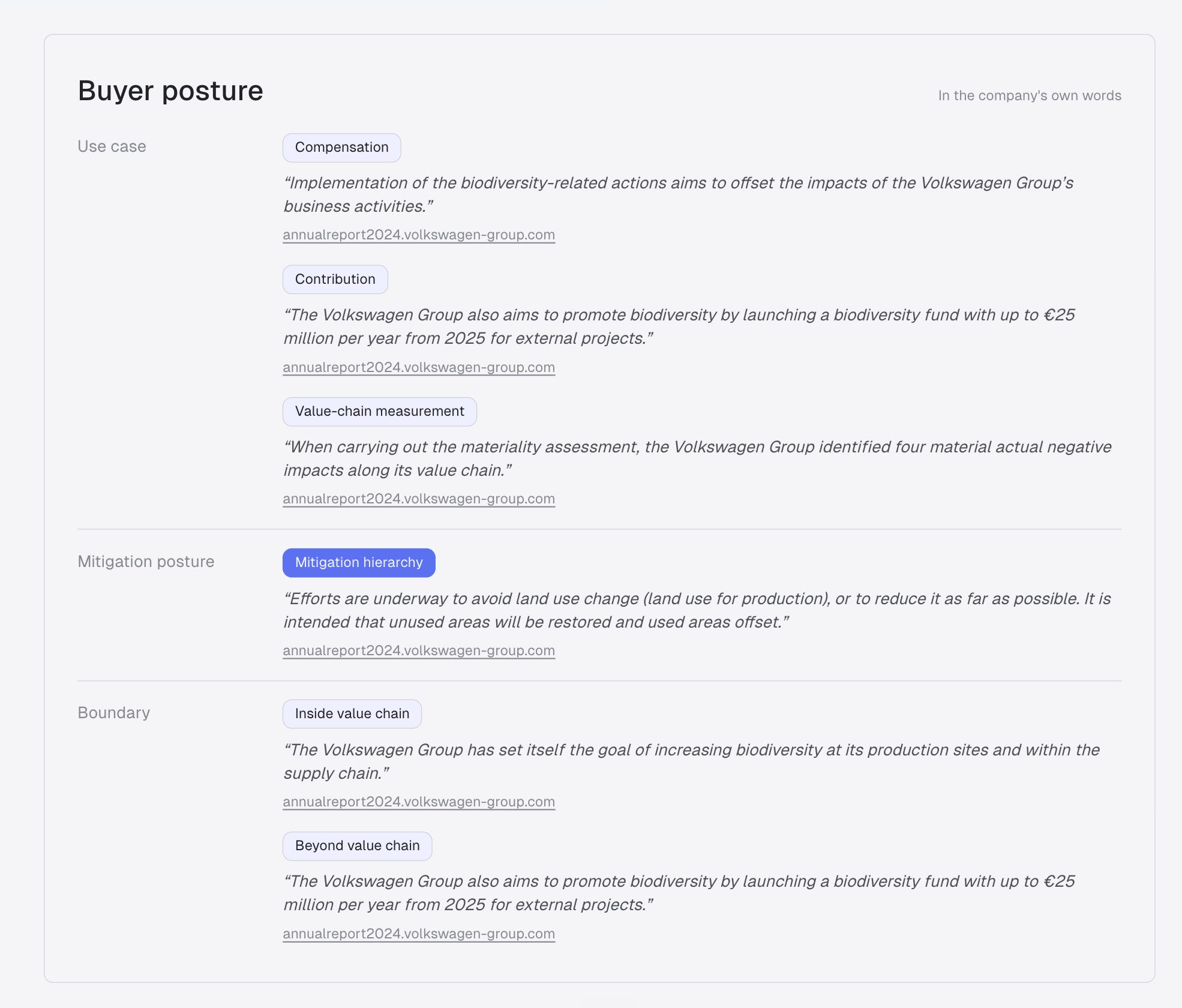
Three assessments giving a complete view of the company’s approach:
Use case: what the company says it uses nature projects for.
Mitigation posture: whether it adopts the mitigation hierarchy.
Boundary: whether its nature targets stay inside its value chain, go beyond it, or both.
17 companies commit in their own words to a mitigation hierarchy for nature, 14 of them from the carbon top 100. A handful go further and mention a no net loss or net gain target, none of them clearly company-wide. Disney’s covers one site, Shell’s only projects in critical habitats. No company claims to be nature positive today in the ones we cover.
Carbon credit retirements
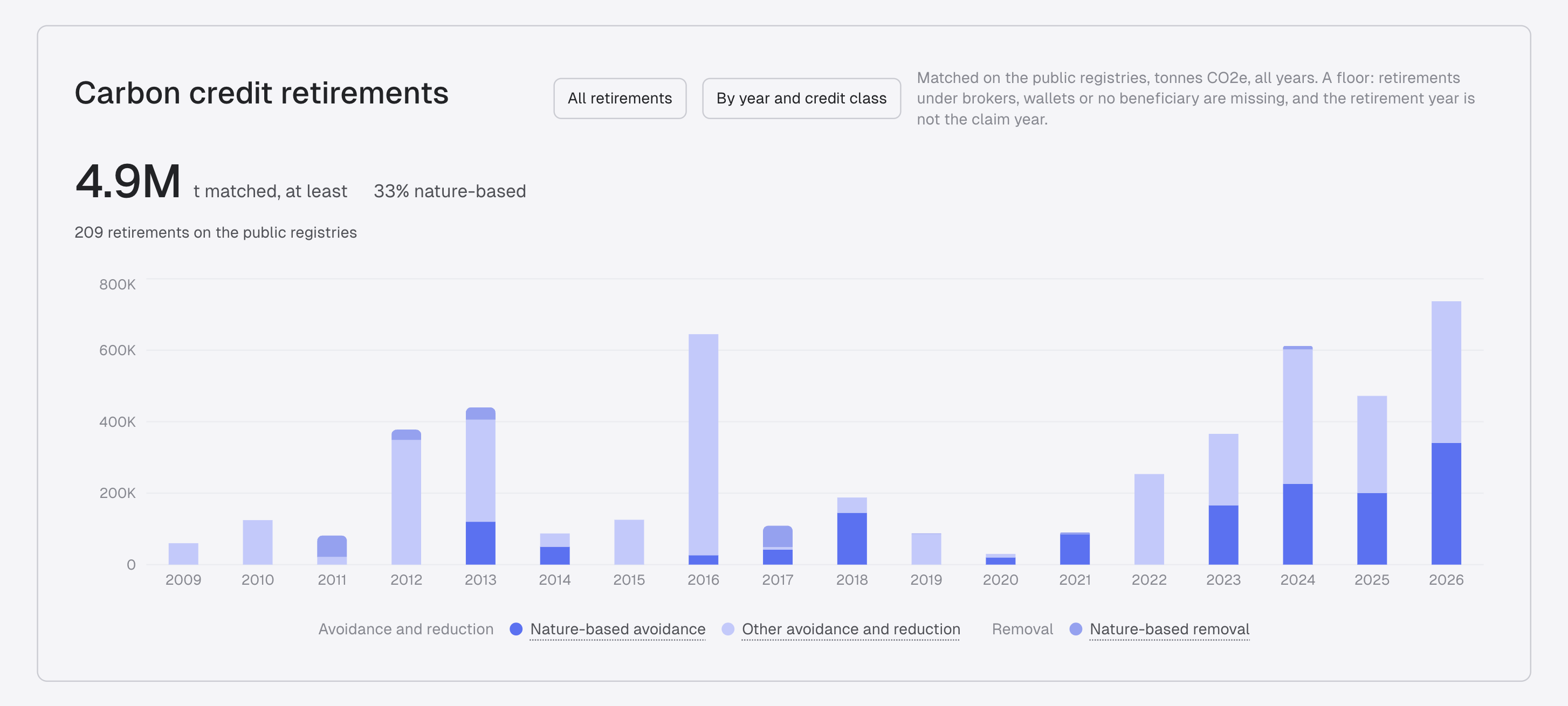
Tonnes retired per year from the biggest public carbon registries, split by credit class (nature-based avoidance, nature-based removal, durable removal, other) and by project sector, with every retirement row.
The top 100 retired 354 Mt, 202 Mt of it (57%) nature-based. Four companies, Shell (49.6 Mt), Eni (31.2 Mt), Delta Air Lines (26 Mt) and Volkswagen (20.7 Mt), make up for 36% of everything. The nature-based share has held between 47% and 78% every year since 2018 and sits at 55% so far in 2026. These companies already pay for ecosystems. They pay in tonnes because it became the main currency, but the bridge to biodiversity credit is short.
Biodiversity credit retirements
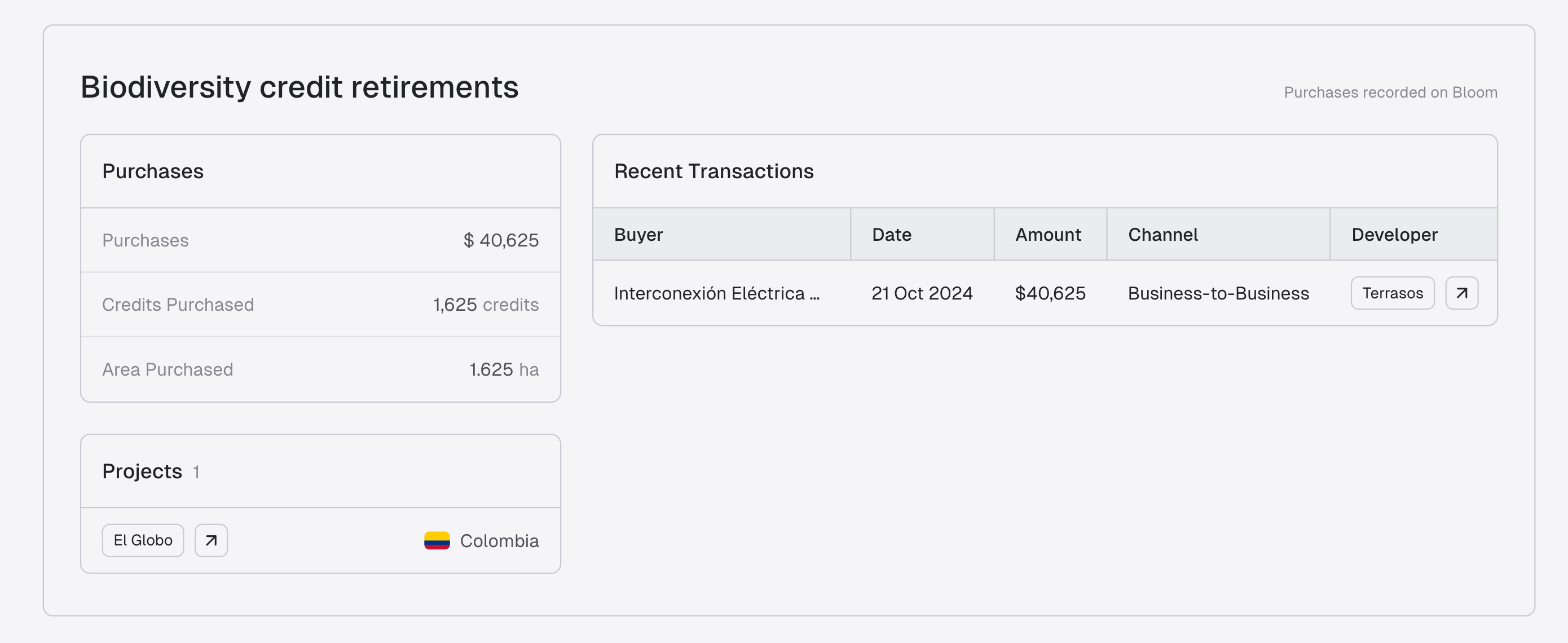
The biodiversity credits the company has bought, from Bloom’s transactions dataset. The card shows the projects, the credits and the value.
53 of the 151 companies have bought a biodiversity credit, and the purchases we can source across the whole dataset add up to about $1.3m. Only two of the top 100 carbon buyers, Microsoft and La Poste, are among them. Most of today’s biodiversity buyers are small Colombian, French and New Zealand firms, and most of the sold value is still anonymous. As we tighten our ties with project developers across the market, we hope to provide more named buyers soon.
Disclosed activity and reports
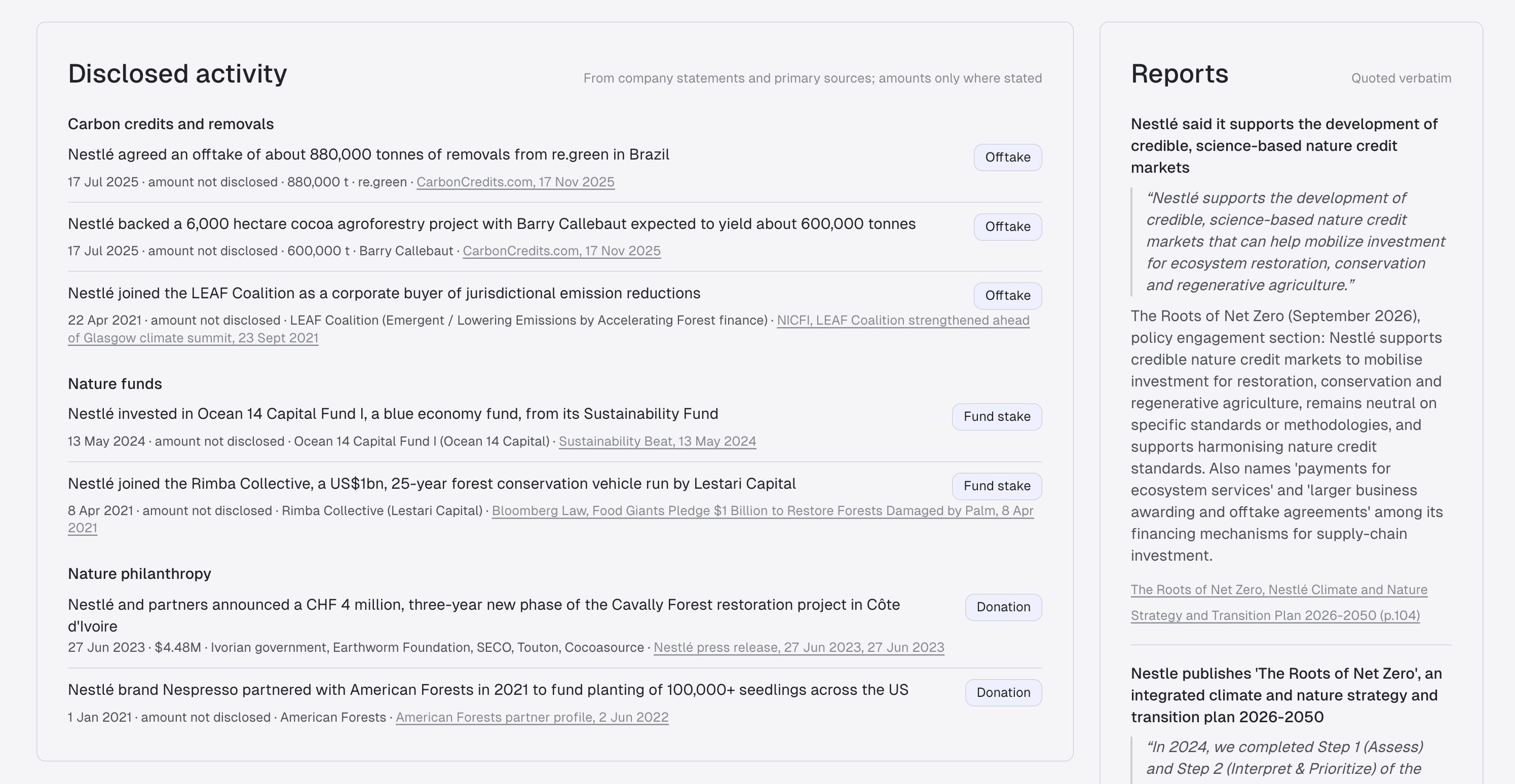
Disclosed activity gives every purchase, retirement, offtake, fund stake and donation we found in a primary source, grouped by asset (carbon credits, nature funds, climate funds, nature philanthropy), each with its date, the counterparty, the source, and the amount only where the company stated it.
We sourced 27 nature fund stakes worth $1.35bn across 16 companies and 165 nature donations worth $558m across 62 companies. Nature fund stakes ran at about one a year before 2021 and three to seven a year since. Dated donations went from 13 in 2020 to 41 in 2025. The money for nature exists and it is growing. So far it flows through more recognized mechanisms but nature markets and increasingly more sophisticated nature funds will play a bigger role in the future.
Reports are all about what the company publishes on nature. A TNFD-aligned report or section, an ESRS E4 biodiversity statement, a standalone nature report or strategy, a published biodiversity footprint, a GRI 101 or 304 biodiversity index, or a CDP response.
66 of the 151 companies publish at least one of the six, 59 of them from the carbon top 100. TNFD-aligned reporting leads with 20 companies, 16 publish their CDP response, 12 a biodiversity footprint, 12 a GRI biodiversity index, 11 a standalone nature report. ESRS E4 statements are at 9, from 36 companies headquartered in the EU, with the first CSRD reporting year still in progress and 3 companies having assessed biodiversity as not material.
Timeline
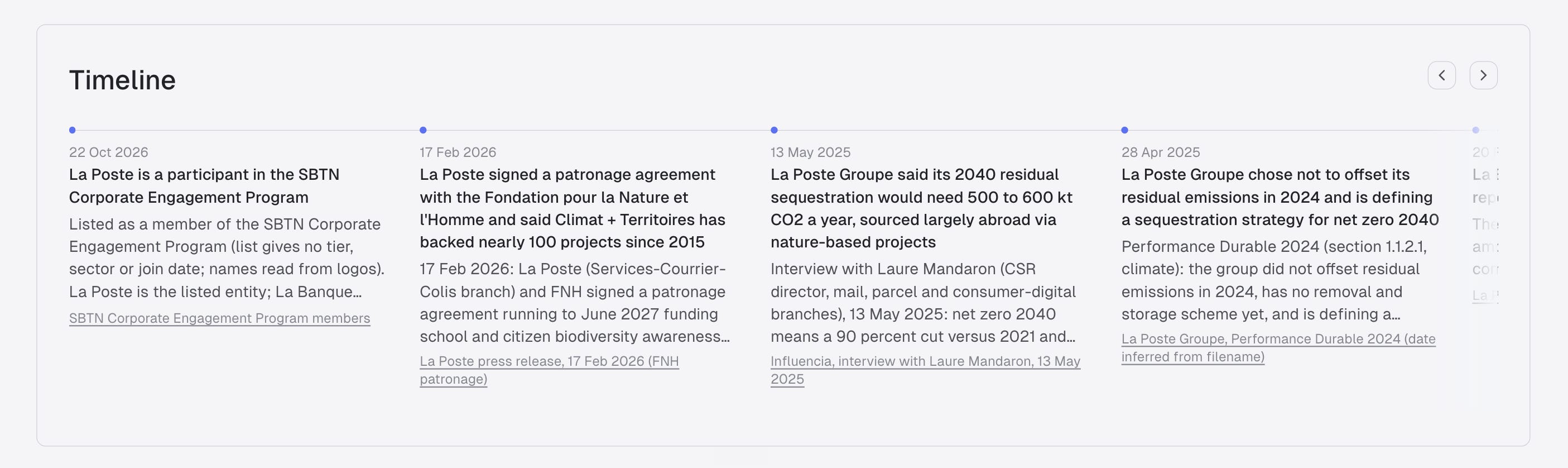
Every dated fact on the profile. Purchases, fund stakes, donations, framework joins and withdrawals, reports, nature policies, the first and the latest registry retirement. The timeline is used by the momentum part of the readiness score. The 151 companies logged 32 dated nature moves in 2019, 137 in 2021, 341 in 2025.
The Buyer Readiness score
The key to this new dataset is putting together all the above information into one standardized score. The score by itself should not eliminate a given company from an outreach process, but it is here to help identify the most probable successes.
It answers one question for a supplier: If we approached this company tomorrow with a biodiversity credit project, how likely is it to listen?
As of today, we don’t analyze impact, ambition, or size. A company can be large with a heavy nature marketing and score 20/100. It can be a Colombian logistics firm nobody has heard of and score 80/100, because it has bought biodiversity credits three times for $100k. The score measures a probability based on past behavior and current commitments.
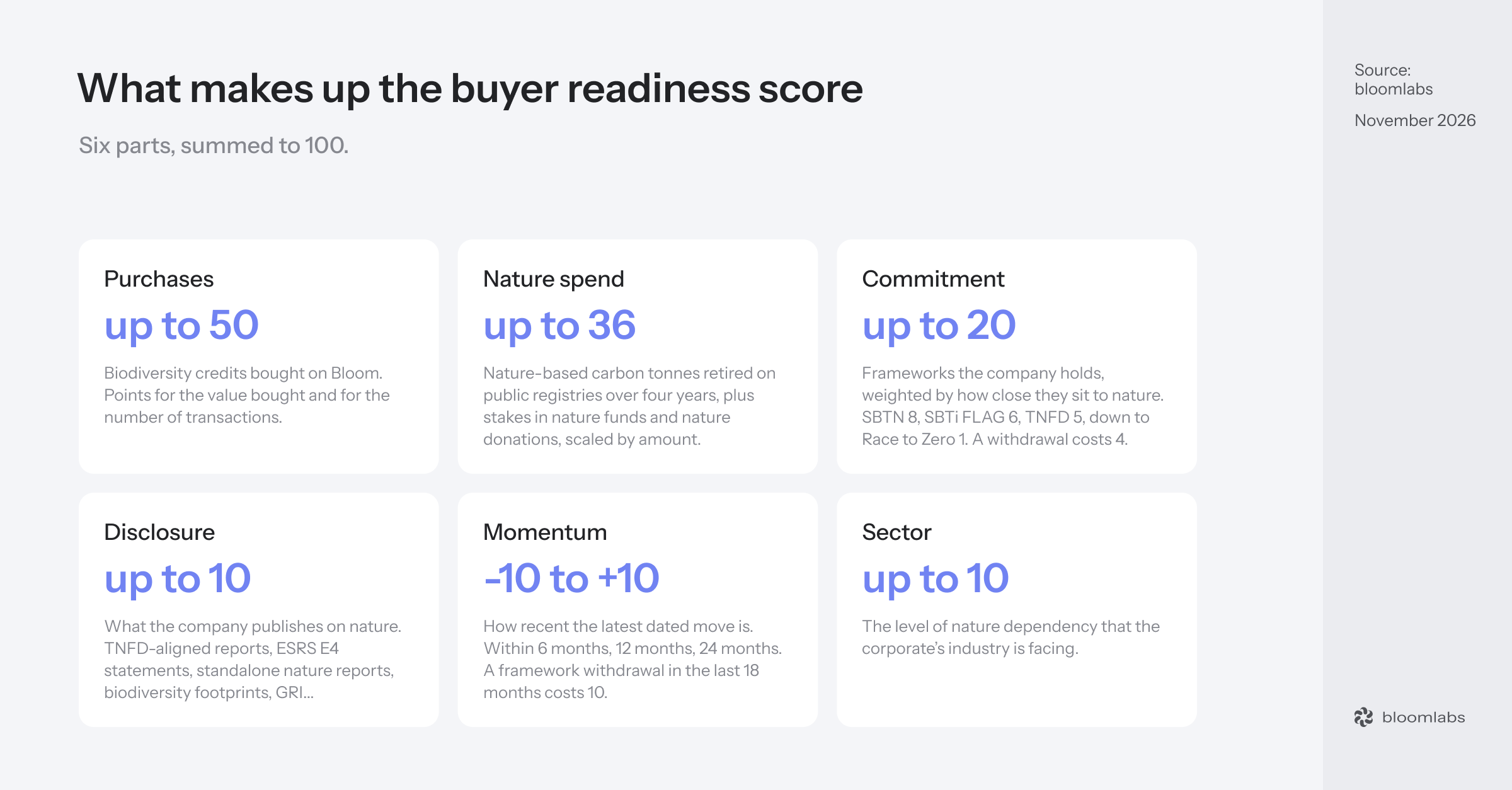
Six parts add up to the score.
Purchases: Has the company already bought biodiversity credits? Counted from Bloom only, on both the value bought and the number of transactions.
Nature spend: Does the company already pay for nature through other channels? Nature-based carbon credits, stakes in nature funds, and nature donations.
Commitment: What has the company signed up to? The frameworks it holds, weighted by how close each one is to positive nature outcomes (SBTN at the top).
Disclosure: Does the company report on nature? Six kinds of reporting count (TNFD-aligned report, ESRS E4, GRI index, etc…).
Momentum: Is the company moving? Points for a recent dated move, fewer as it ages, and a penalty for a recent withdrawal.
Sector: How much does the company’s industry depend on nature?
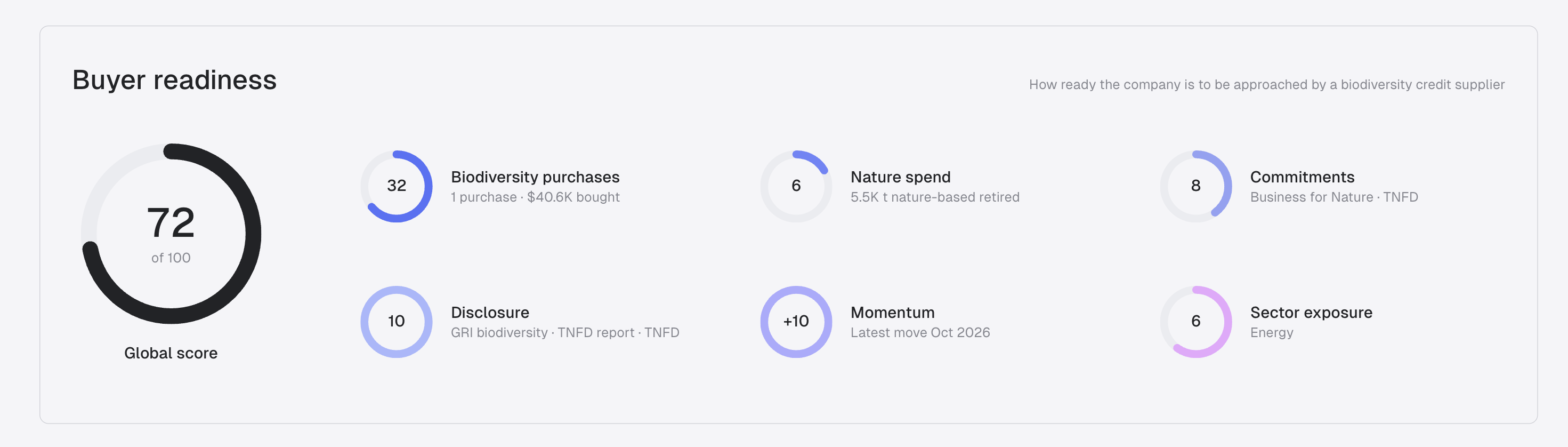
The formulas that we use to compute each part of this score are bound to evolve as we add more data and more corporates to this dataset. But they will keep the same goal: to understand how far a company is from buying biodiversity credits.
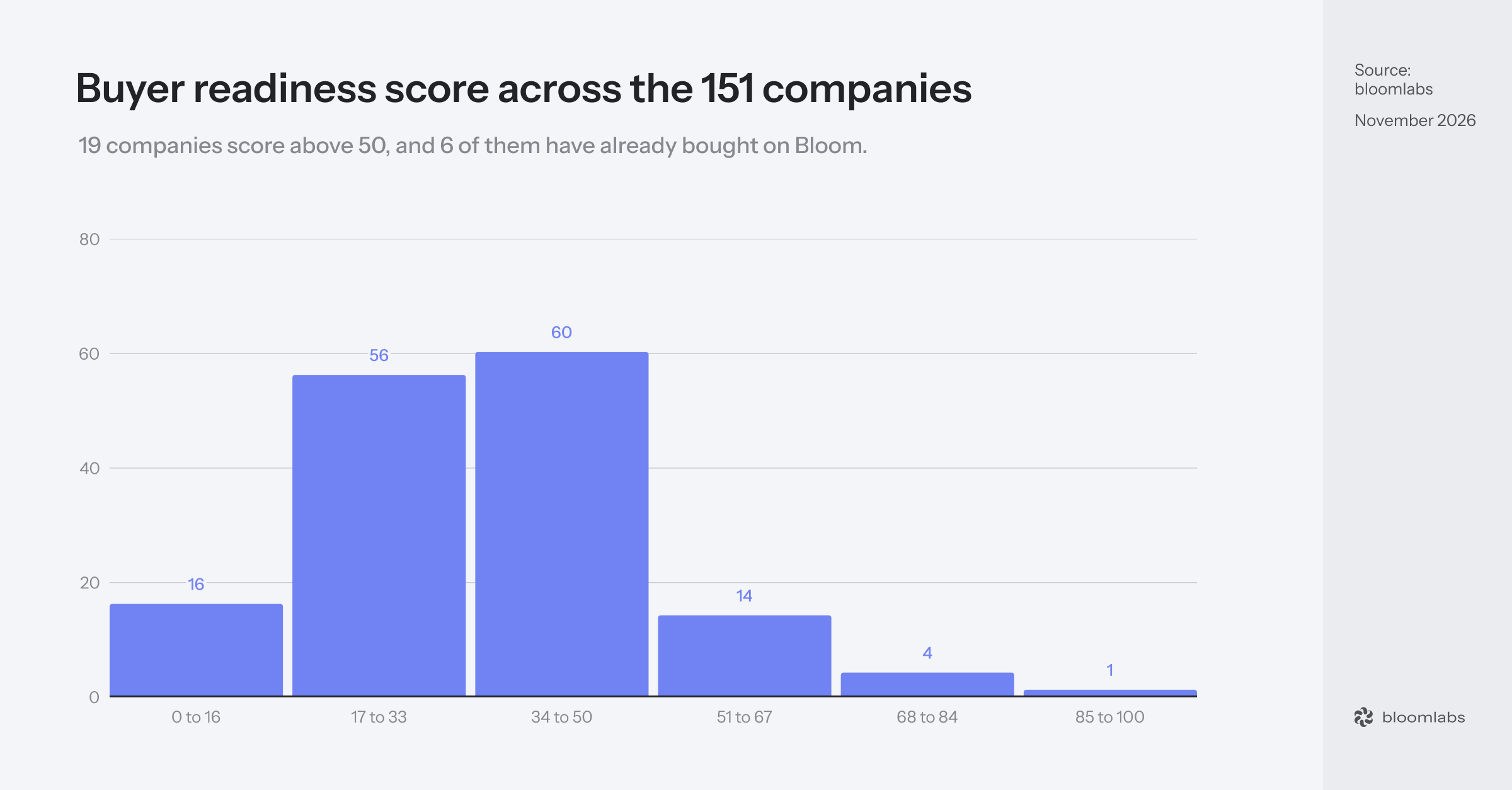
Today, they already give us a fair representation of the market. The vast majority of them score below 50, which is aligned with the state of the demand side today.
Why corporates, why now
We have spent more than 3 years mapping supply. 192 projects in 43 countries, the 104 schemes behind them, and all their developers. The Countries dataset released in September was our first attempt to go beyond the pure market and transactional data and to give more context on the broader political landscape. It quickly became one of the most successful features we have launched to date. With the Corporates dataset, we aim to fill the commercial outreach hole and complete the funnel of actions made possible with Bloom:
Studying the political landscape in a given country and understanding if it has any national credit system. Getting familiar with the projects and organizations already there.
Understanding who can help in developing a biodiversity credit project in a given place, for a given activity type, for a given ecosystem. Choosing the right scheme for this project.
Collecting insights from all the past transactions that have happened in this market to price the credits well, and understand the purchase motivations.
And, now, identify potential buyers to sell those credits.
The dataset is available now in beta version. Errors might surface. Tell us at hello@bloomlabs.earth, and if you want to suggest the next batch of companies or sections, write to us too.