


Hi, Martin from bloomlabs here.
Welcome to our monthly read of the Voluntary Biodiversity Market (VBM), built on data from our intelligence platform Bloom and the market updates that matter.
July was a small month at $15k, but the least concentrated of the year. The five largest transactions made up 53% of the total, the lowest of any month in 2026, and named buyers covered 36% of the value against 6.5% in June. More named entities bought.
Autocolombiana, the Colombian importer behind KTM and Husqvarna motorcycle brands, split a single retirement across both brands - something we have never recorded before. It points to a deliberate, organized purchase based on corporate budgets, used in marketing communications.
On the policy side, the first review of the Global Biodiversity Framework opened in Nairobi, Malawi published a plan that names biodiversity credits, Finland wrote a 10-year roadmap for its nature credit market, and Indonesia is now running three credit tracks at once.
Explore the data on Bloom.
Market context
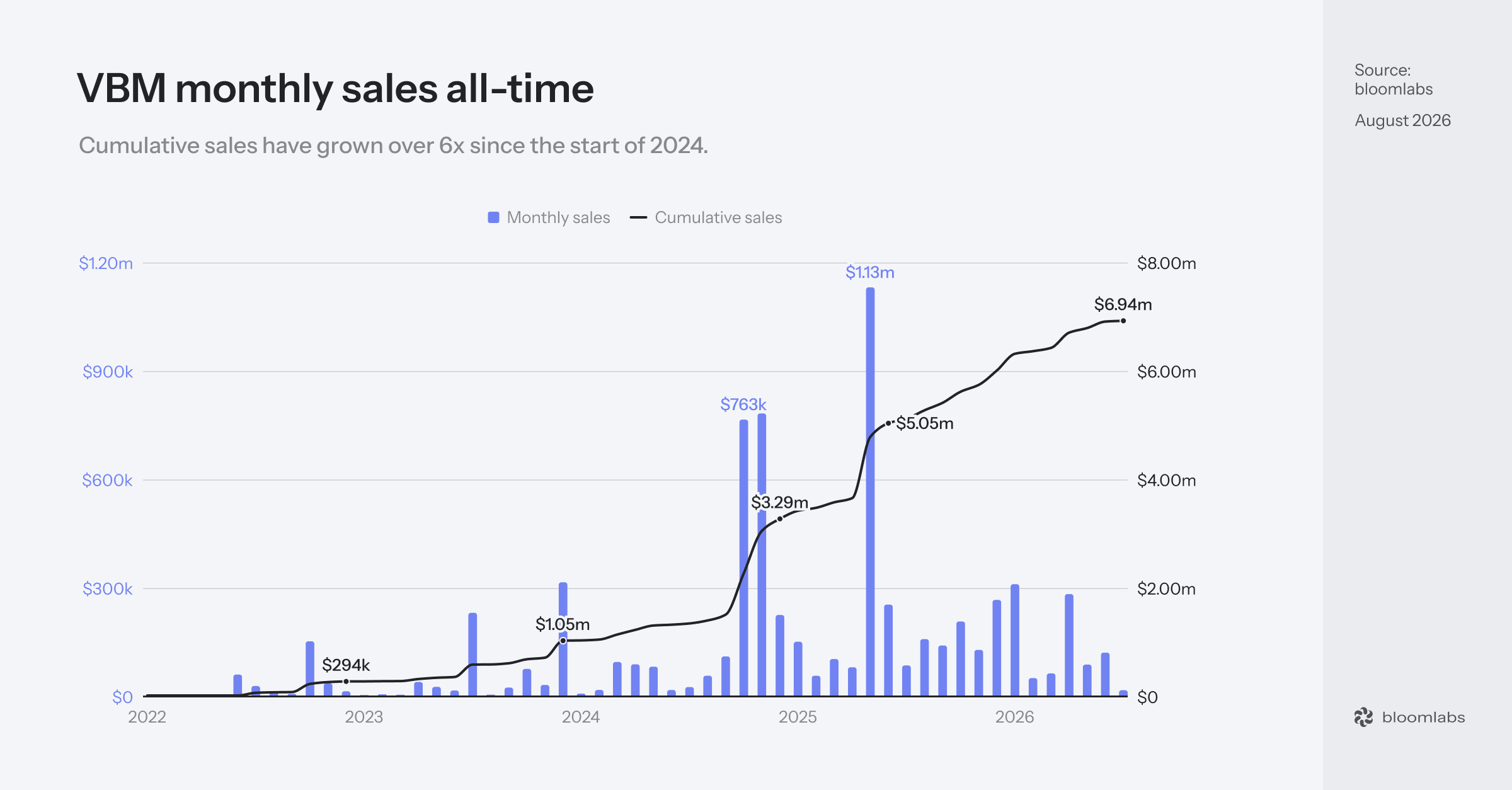
VBM has now sold $6.94m worth of credits since the first recorded sale in early 2022. We still believe a meaningful share of that activity happens over-the-counter and is never announced publicly, which would put the real total somewhere between $8m and $10m.
Volatility is still significant, since 2026 alone runs from $15k in July to $308k in January, and quarterly totals have moved from under $100k to nearly $1.8m across the life of the market. This is why month-on-month or quarter-on-quarter comparisons still do not tell us much, and it is also why we would not read one quiet month as the start of a trend.
July 2026
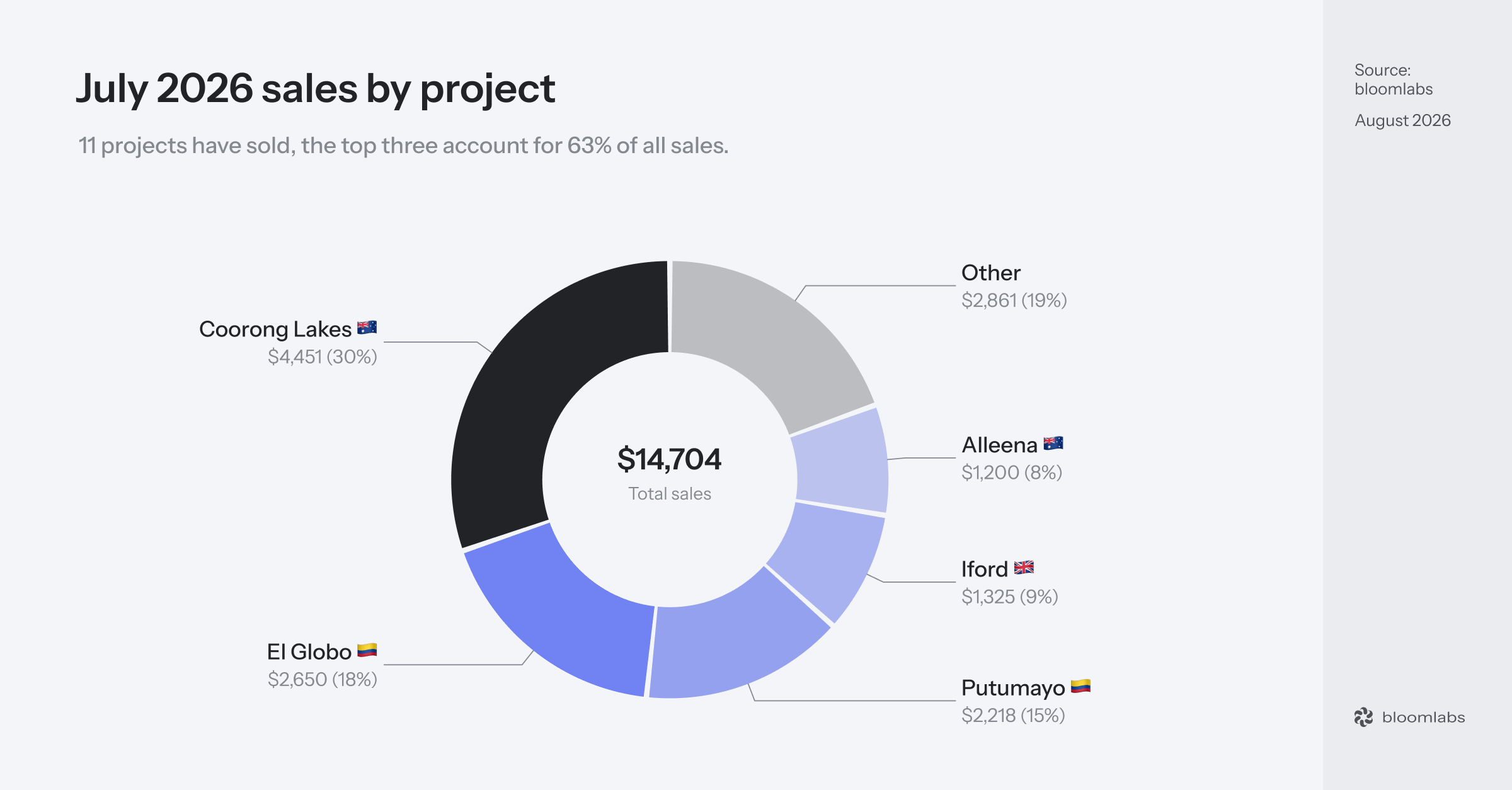
July 2026 recorded $15k in sales across 84 transactions, down from June’s $119k. For comparison, the earlier months of the year came in at $308k in January, $48k in February, $61k in March, $280k in April, $85k in May, and $119k in June. With a median monthly value of $101k since 2024, July sits far below the average month.
The five largest transactions made up 53% of July’s value, the lowest concentration of any month this year and well under June’s 81%, while the average transaction fell to $175 against $1,445 in June. There were 84 transactions in July against 82 in June, and 11 projects sold in both months, so the buying activity did not slow down. What July never produced was one large deal, and the biggest transaction of the entire month was $4,294.
In a market this thin, one anonymous business choosing to buy 821 credits instead of 8,000 is the whole difference between a quiet month and an average one, and we would resist reading July as a market decline, especially in the summer holiday period. July has come in under the median month three years running: $23k in 2024, $83k in 2025, $15k in 2026.
Projects
11 projects sold in July across 5 countries, and none of them carried the month on its own. Wilderlands‘ four Australian projects took 43% of the total between them, led by Coorong Lakes at $4,451 across 12 transactions, of which a single anonymous business purchase of 821 credits accounts for $4,294. The three others added $1,200 for Alleena, $469 for Budgerum and $263 for Crowes Lookout, which is the long tail of small consumer purchases Wilderlands sells every month.
Colombia was the other pole with 33% of the month, split across two developers who work in very different ways. El Globo brought $2,650 across 12 transactions of Terrasos‘ $25 credits, and Putumayo added $2,218 across 10 Savimbo transactions, including two business purchases of 141 credits each at $6.05 and $5.85 per credit.
The three English sites sold through Earthly contributed $2,604, or 18% of the month, which is their best result since November 2025. Iford led at $1,325, with Timsbury at $795 and Boothby Wildland at $484.
Marereni added $843 across 7 transactions of its $3 Kenyan mangrove credits, well down from $9,105 in June, and Osa Peninsula, the Costa Rican coral project we introduced last month, recorded a single $6 purchase.
Buyers
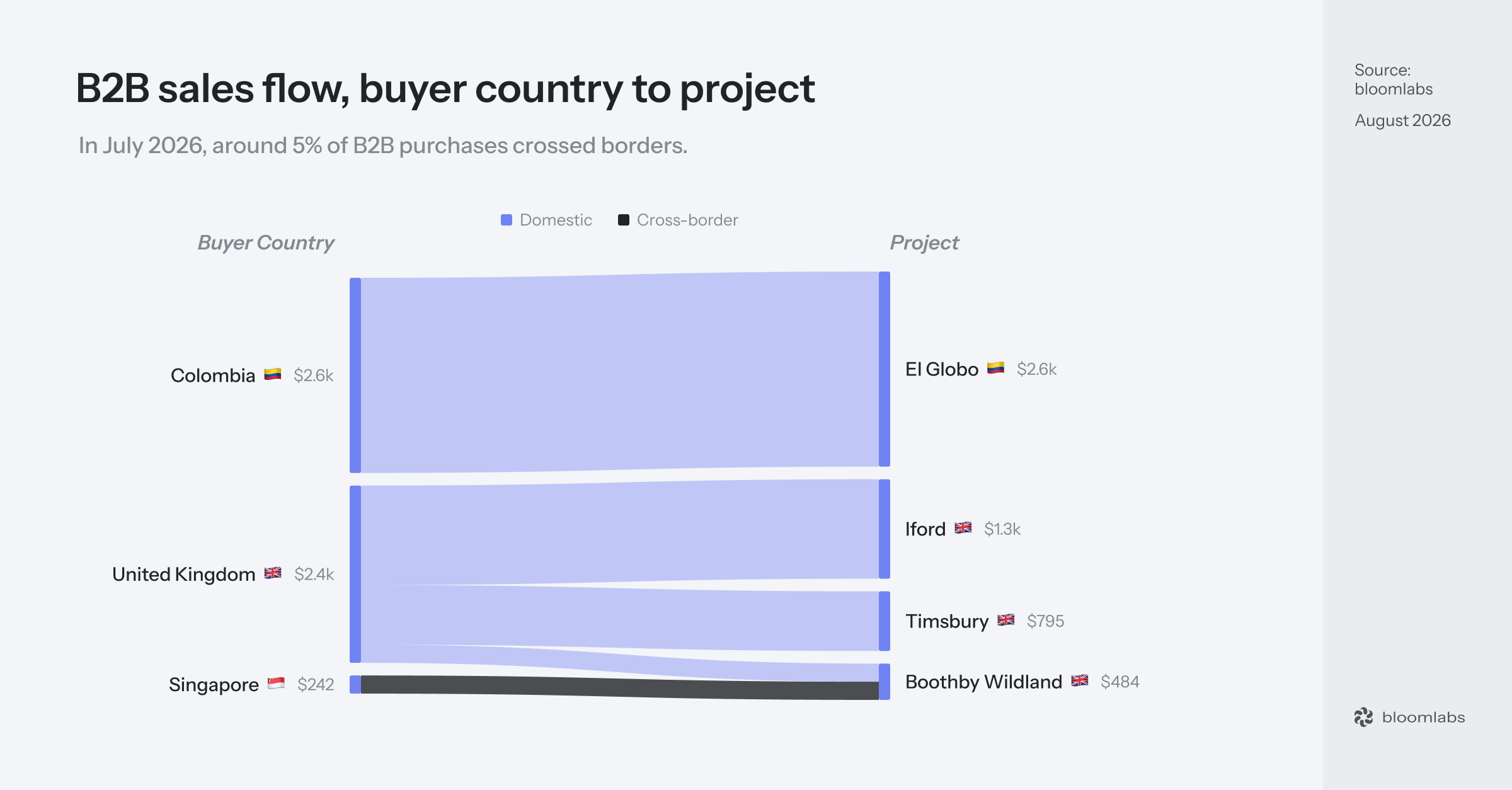
Business buyers accounted for 91% of July’s value across 23 transactions, while consumer buyers made up $1,278 across 61 transactions.
Named buyers covered 36% of July’s value across 17 transactions, up sharply from 6.5% in June and short of May’s 46%. The largest was Autocolombiana, the Colombian importer that distributes KTM, Husqvarna and 15 other mobility brands, which retired 100 El Globo credits for $2,500 across eight certificates in one session on July 27. The certificates alternate between its KTM and Husqvarna brands under a single company registration, and we have not recorded any other buyer splitting one retirement across two of its own brands.
We find that detail more useful than the amount, because it suggests a multi-brand group may account for credits per brand rather than per company, which would multiply the number of internal budgets a developer can approach. They also use them explicitly in their marketing communications, something we have rarely seen until now.
The United Kingdom supplied four of the seven named buyers. Rickshaw Travel, the Brighton travel company, bought $1,060 of Iford credits and is now a returning buyer after first purchasing in April 2025, and We Are Tilt, also from Brighton, came back for a second $265 Iford purchase after its first in November 2025. Ecorys UK, the Birmingham arm of the Dutch research consultancy, made its first purchase at $795 on Timsbury, and the Oxfordshire advertising agency The Ad Plain bought $242 of Boothby Wildland credits.
COMO Hotels & Resorts, the Singapore luxury hotel group, which bought one $242 Boothby Wildland credit is the only cross-border business buyer in July whose country we can place, against six domestic ones. The amount is small enough to be a rounding error, but this is encouraging for the formation of an international market.
If you are exploring whether and how biodiversity credits fit into your organization’s strategy, we would love to talk, so reach out at hello@bloomlabs.earth.
News
Featured
The first global review of the GBF opened in Nairobi with finance at the bottom of the scorecard
On July 27, SBSTTA-28 opened the Nairobi round of CBD negotiations, running to August 1 and followed by SBI-7 from August 4 to 12, the first global review of collective progress under the Kunming-Montreal Global Biodiversity Framework since its adoption in 2022. The draft State of Biodiversity Action report, built on 129 national reports, finds the world off track on most of the 23 targets for 2030, and it gives target 19 on biodiversity finance the lowest score, together with target 18 on harmful subsidies and target 23 on gender, while only the climate resilience target earned the top score.
The European Commission’s Joint Research Centre published its own version of this exercise on July 7, based on the 7th National Reports that parties had to submit this year ahead of COP17. Of the 17 member states assessed plus the EU itself, the majority are not on track for 17 of the 23 targets, and target 19 sits exactly at the 50% threshold, with four reports claiming the target is achieved, five on track, and nine progressing insufficiently. Target 19 commits parties to mobilizing $200 billion per year for biodiversity by 2030, so the target this market depends on is also the one parties disagree about most.
On August 4, the IAPB co-organized a side event at SBI-7 with Brazil’s environment and foreign affairs ministries, Indonesia’s Ministry of Environment and Forestry, LIFE Institute, BRDE, and DG Environment. Regiane Borsato presented LIFE Institute’s voluntary offsetting model, which requires companies to buy credits from the same biome they operate in, and BRDE presented a protected area project it supports through purchases of LIFE biodiversity credits, one of the few public examples of a development bank on the buy side.
The 7th National Reports were due ahead of Yerevan, and governments used them to name their financing tools, which is why about 50 countries now mention biodiversity credits in their national strategies. A growing buyer demand and the reporting deadline are the two sources of this trend.
National news
Finland published a 10-year roadmap for voluntary nature credits
Finland published a roadmap for its voluntary nature credit market, led by the Ministry of Environment, with actions running to 2035. The plan runs in two phases, building the operating model, guidelines, and verification and monitoring systems between 2026 and 2030, then institutionalizing and scaling what works between 2031 and 2035, with an interim assessment in between. Planned actions include a national monitoring system with independent verification, guidance for buyers on nature-related claims, mapping potential buyers, and instruments such as tax incentives or binding ecological offsetting to expand the market.
Finland is building national infrastructure before the Commission finalizes its EU-wide frameworks at the end of next year, and the roadmap names that EU work as a priority to follow. The country stating that market-based solutions supplement legislated obligations and publicly funded measures - rather than replacing them - is also aligned with the EU. Buyer mapping and tax incentives sitting in the same plan also tell the ministry knows the constraint here is demand and not supply.
Indonesia is running three tracks at once
Indonesia’s government confirmed it is exploring biodiversity credits with the Wildlife Conservation Society in North Sulawesi, one of the country’s most biodiverse provinces, during an EU delegation visit. KSDAE Secretary Nandang Prihadi also said the two are working on a National Parks Bond modeled on the World Bank’s Rhino Bond, the five-year, $150 million bond issued in 2022 with payments linked to rhino numbers in South African parks.
A week later, at the Indonesia Biodiversity Business Forum in Jakarta, the environment ministry said it is preparing a biodiversity credit instrument and finalizing Access and Benefit Sharing rules, reviewing voluntary, market-based, and mandatory models, alongside broader economic instruments, in parallel. It puts the country’s biodiversity funding need at IDR 163 trillion per year, about $10 billion, with only 13% of it currently covered. A task force has been drafting accounting policies and standards since February, the IAPB works with the government as an official knowledge partner, and UNDP BIOFIN launched a pilot in Indigenous-managed landscapes in Southwest Papua in June.
Of the models under review, the mandatory one is the one to watch, because Indonesia already has the damage to compensate. Nickel mining has cleared over 5,000 hectares of forest in Halmahera alone, with around half a million more at risk, and Raja Ampat saw four of five mining licenses revoked last year after public protest. What is missing is any obligation to pay for it.
Malawi named biodiversity credits in its national nature plan and floated mandatory offsetting for mining
Malawi published its 2025 to 2035 National Biodiversity Strategy and Action Plan on the CBD platform on July 9, and it names biodiversity credits as one option for mobilizing private finance for conservation and restoration, alongside payments for ecosystem services and public-private partnerships. Public finance covered 83% of biodiversity funding under the previous plan, with private finance contributing $21.5 million across the whole period. Malawi now wants biodiversity finance to reach at least $93 million per year by 2035, roughly six times what it has been spending annually. The same plan sets out mandatory biodiversity offsetting, restoration bonds, and strategic environmental assessments for the mining sector, on the grounds that the mining expansion in the Malawi 2063 vision will worsen ecological destruction and water pollution.
The plan’s own costing is $1.02 billion over ten years, and even hitting $93 million a year by 2035 would fund only about half of that, so credits are being asked to help close a gap the country has already conceded it cannot fully finance. Mandatory offsetting for mining would also create compliance demand the day it is enforced, and that is the compliance-pulls-voluntary thesis again.
Market news
WCS assessed HIFOR against the High-Level Principles and published the score
The High Integrity Forest Investment Initiative compared its Methodology v2.1 against the 2025 High-Level Principles developed by the World Economic Forum, the BCA, and the IAPB. Excluding six requirements assessed as not applicable to stewardship-based credits, HIFOR fully aligns with 71 of 83 requirements, 86%, partially aligns with seven, and does not align with five. The methodology was revamped in March to align with the WEF, BCA, and IAPB framework, and the Wildlife Conservation Society, which backs HIFOR, produced the assessment internally and shared the report with us directly.
Self-assessment against the High-Level Principles is slowly becoming a welcome credibility exercise in this market. However, WCS assessed WCS, and nobody outside the organization gave an independent review. That does not make it wrong, and we have no particular reason to think it is, but it is not verification either. The BCA is building the formal version of the same exercise, with an assessment framework now at 101 sub-principles, so we expect scored alignment claims to become standard scheme practice within a year or two.
Stewardship based credits represent the long-term protection of intact biodiversity through conservation management, in areas where medium or long-term threats would otherwise lead to degradation.
The EU may put €230 million into biodiversity research
The EU is preparing to analyze a Horizon Europe amendment that could channel €230 million into biodiversity research and innovation over 2026 and 2027. The 2026 strand would fund eight projects worth €42.45 million on PFAS impacts, clean and digital industry effects on biodiversity, and transformative change, plus €60 million for ocean observation and the detection of solar radiation modification, while 2027 would fund 13 projects worth €108 million covering invertebrate decline, living labs for restoration, wildlife trafficking, and cost-effective biodiversity monitoring, plus €20 million for a biodiversity and health project.
Of everything on that list, cost-effective biodiversity monitoring is the line that touches VBM directly, because MRV cost can be a significant burden for projects, especially the smaller ones.
IIGCC will consult on a nature finance translation tool
The Institutional Investors Group on Climate Change published a paper on a translation layer that would give investors one consistent way to describe, compare, and flag the risks of any nature investment, whatever its label or marketing, ahead of a consultation in the last quarter of 2026. From conversations with investors, IIGCC identifies three frictions: the same asset being described in several ways, an overfocus on impact investing that miss risk reduction, and nature-specific risks sitting outside standard frameworks. Institutional investors admitting they cannot describe nature investments consistently means nobody is quite sure what is being bought and sold. Hence the need for clarification.
Eight businesses joined the UK’s first rewilding buyers club
Nattergal and Nature Broking launched a rewilding buyers club at Boothby Wildland, with eight businesses funding restoration collectively. Structuring conservation projects via pooled commitments from multiple buyers is one way to tackle one of the biggest weaknesses in voluntary environmental markets - lack of stable multi-decade cashflows at scale.
The African Union pledged blue economy financing mechanisms by 2027, biodiversity credits included
All 55 African Union member states adopted the Luanda Declaration at the Third African Blue Economy Week in Angola, committing to establish national blue funds, blue bonds, blue insurance, debt-for-nature instruments, and blended finance vehicles by 2027, with biodiversity credits explicitly referenced as a potential mechanism for channeling blue economy finance. This declaration could be the biggest boost for biodiversity on the African continent.
Announcements
Eurosite Annual Meeting, Seville, November 2 to 4
Eurosite, the European land conservation network, is hosting their annual meeting in Seville on November 2 to 4, three days organized across four thematic lines, and Conservation Finance is one of them, which is where nature and biodiversity credits sit on the agenda. Alongside keynotes and workshops, participants can join the Dolphin Tanks, pitch sessions where conservation initiatives get expert feedback, before the meeting closes with a field visit to Coto de Doñana. Registration is open on the event page, and the detailed agenda is worth a look if you want to see the finance sessions before committing.
Meo Carbon Solutions published a biodiversity credits dossier for the agri-food sector
Meo Carbon Solutions prepared a dossier and shared its summary with us:
“The ‘Ecosystem Restoration and Biodiversity Credits’ dossier, prepared by Meo Carbon Solutions as part of the EU LIFE project ‘Fit for Biodiversity’, officially titled ‘Biodiversity Governance and Performance in the Food Sector’, highlights that biodiversity credits can help mobilise additional private finance for measurable biodiversity outcomes, provided they are supported by strong integrity safeguards, proportionate MRV and clear claims rules. In the agri-food sector, their strongest potential lies in supply-chain insetting and landscape-level approaches that support farmers while delivering additional and verifiable biodiversity outcomes.”
Meo is also offering ten free biodiversity insetting feasibility assessments to agri-food companies, NGOs, and project developers. The assessments explore how biodiversity conservation and restoration activities could be developed within food supply chains, whether they could deliver measurable biodiversity outcomes, and whether suitable financing or certification pathways exist, including high-integrity biodiversity credits where relevant. If insetting is something you are looking at, Meo can be reached directly.
Upcoming events
Natural Capital Investment Americas - September 15 - New York, US
Environmental Finance’s dedicated natural capital investment conference, timed to sit alongside Climate Week NYC and bringing together investors, asset owners, and regulators.
Climate Week NYC - September 20-27 - New York, US
One of the largest climate events of the year, held alongside the UN General Assembly, with a climate and nature focus area and a thousand-plus affiliated events across the city. As with London in June, the value for our market is less the main stage than the density of nature finance side events and announcements that cluster around it. The World Biodiversity Summit also runs on the sidelines on September 24, though the organizers flag that date as still subject to change.
CBD COP17 - October 19-30 - Yerevan, Armenia
The single most important policy event for biodiversity credits this year, and the first global review of progress against the Global Biodiversity Framework. Governments will negotiate on resource allocation and finance, which is the track where biodiversity credits sit, so this is the clearest read we will get on the official support for the market. More details to come throughout the year.
Le Forum Biodiversité & Économie - November 3-4 - Paris, France
The sixth edition of the French Biodiversity Agency’s biennial forum for business, held at the Cité des sciences et de l’industrie and aimed at companies of every size and sector that want to act on biodiversity.